

Atmospheric Corrosion
97
While it is possible for OH − radicals to oxidize several of the corrosion-stimulating materials such as SO 2 , H 2 S, and NO 2 , a large portion of the hydroxyl
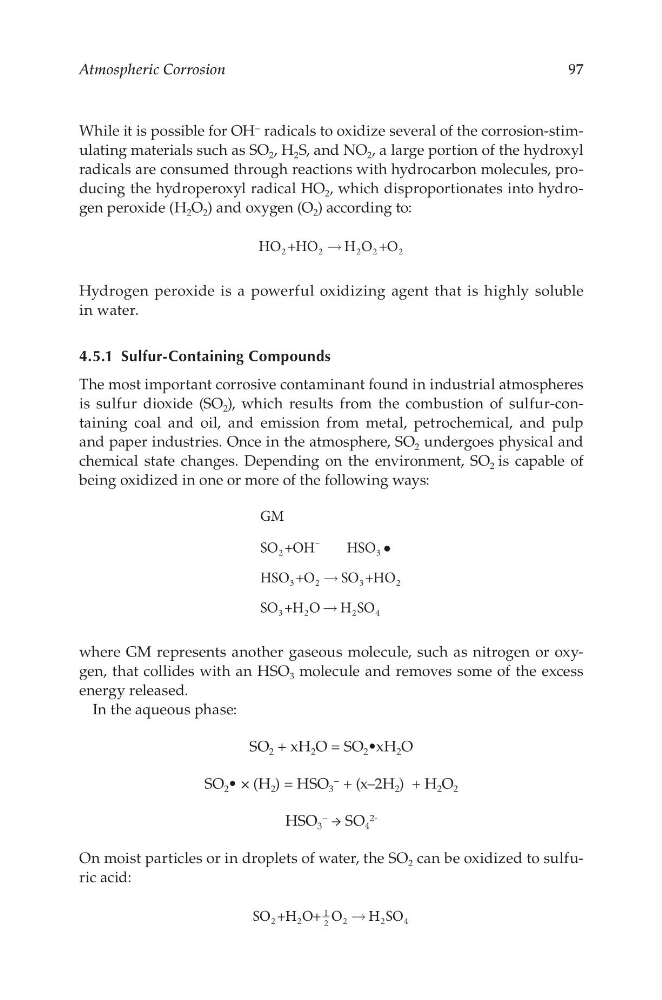
radicals are consumed through reactions with hydrocarbon molecules, producing the hydroperoxyl radical HO 2 , which disproportionates into hydrogen peroxide (H 2 O 2 ) and oxygen (O 2 ) according to:
HO +HO
H O +O
2
2
2 2
2
→
Hydrogen peroxide is a powerful oxidizing agent that is highly soluble
in water.
4.5.1 Sulfur-Containing Compounds
The most important corrosive contaminant found in industrial atmospheres
is sulfur dioxide (SO 2 ), which results from the combustion of sulfur-containing coal and oil, and emission from metal, petrochemical, and pulp
and paper industries. Once in the atmosphere, SO 2 undergoes physical and
chemical state changes. Depending on the environment, SO 2 is capable of
being oxidized in one or more of the following ways:
GM
SO +OH
HSO
HSO +O
SO +HO
SO +H O H SO
2
–
3
2
3
2
3
2
2
4
3 •
→
→
where GM represents another gaseous molecule, such as nitrogen or oxygen, that collides with an HSO 3 molecule and removes some of the excess
energy released.
In the aqueous phase:
SO 2 + xH 2 O = SO 2 •xH 2 O
SO 2 • × (H 2 ) = HSO 3
− + (x–2H 2 ) + H 2 O 2
HSO 3
− → SO 4
2On moist particles or in droplets of water, the SO 2 can be oxidized to sulfuric acid:
SO +H O+ O
H SO
2
2
1
2
2
2
4
→
97
While it is possible for OH − radicals to oxidize several of the corrosion-stimulating materials such as SO 2 , H 2 S, and NO 2 , a large portion of the hydroxyl
radicals are consumed through reactions with hydrocarbon molecules, producing the hydroperoxyl radical HO 2 , which disproportionates into hydrogen peroxide (H 2 O 2 ) and oxygen (O 2 ) according to:
HO +HO
H O +O
2
2
2 2
2
→
Hydrogen peroxide is a powerful oxidizing agent that is highly soluble
in water.
4.5.1 Sulfur-Containing Compounds
The most important corrosive contaminant found in industrial atmospheres
is sulfur dioxide (SO 2 ), which results from the combustion of sulfur-containing coal and oil, and emission from metal, petrochemical, and pulp
and paper industries. Once in the atmosphere, SO 2 undergoes physical and
chemical state changes. Depending on the environment, SO 2 is capable of
being oxidized in one or more of the following ways:
GM
SO +OH
HSO
HSO +O
SO +HO
SO +H O H SO
2
–
3
2
3
2
3
2
2
4
3 •
→
→
where GM represents another gaseous molecule, such as nitrogen or oxygen, that collides with an HSO 3 molecule and removes some of the excess
energy released.
In the aqueous phase:
SO 2 + xH 2 O = SO 2 •xH 2 O
SO 2 • × (H 2 ) = HSO 3
− + (x–2H 2 ) + H 2 O 2
HSO 3
− → SO 4
2On moist particles or in droplets of water, the SO 2 can be oxidized to sulfuric acid:
SO +H O+ O
H SO
2
2
1
2
2
2
4
→