

Powers, roots and laws of indices 51
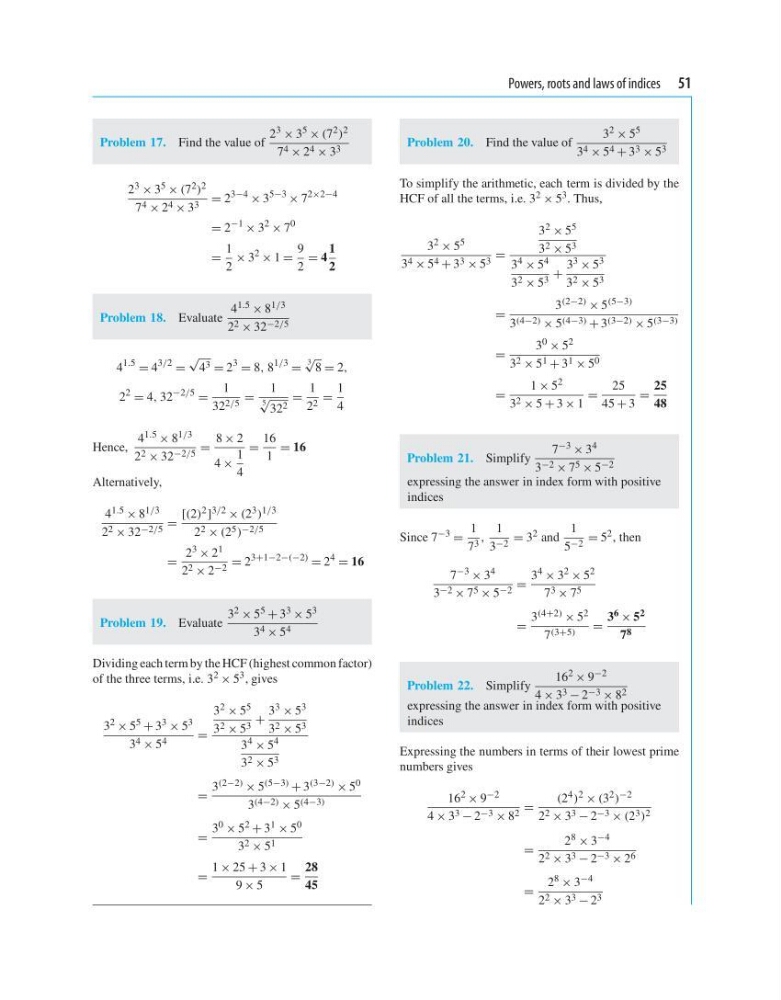
Problem 17. Find the value of
2 3 × 3 5 × (7 2 ) 2
7 4 × 2 4 × 3 3
2 3 × 3 5 × (7 2 ) 2
7 4 × 2 4 × 3 3 = 2
3−4
× 3
5−3
× 7
2×2−4
= 2
−1
× 3
2
× 7
0
=
1
2
× 3
2
× 1 =
9
2
= 4
1
2
Problem 18. Evaluate
4 1.5 × 8 1/3
2 2 × 32 −2/5
4
1.5
= 4
3/2
=
√
4 3 = 2
3
= 8, 8
1/3
=
3
√
8 = 2,
2
2
= 4, 32
−2/5
=
1
32 2/5 =
1
5
√
32 2
=
1
2 2 =
1
4
Hence,
4 1.5 × 8 1/3
2 2 × 32 −2/5 =
8 × 2
4 ×
1
4
=
16
1
= 16
Alternatively,
4 1.5 × 8 1/3
2 2 × 32 −2/5 =
[(2) 2 ] 3/2 × (2 3 ) 1/3
2 2 × (2 5 ) −2/5
=
2 3 × 2 1
2 2 × 2 −2 = 2
3+1−2−(−2)
= 2
4
= 16
Problem 19. Evaluate
3 2 × 5 5 + 3 3 × 5 3
3 4 × 5 4
Dividing each term by the HCF (highest common factor)
of the three terms, i.e. 3 2 × 5 3 , gives
3 2 × 5 5 + 3 3 × 5 3
3 4 × 5 4
=
3 2 × 5 5
3 2 × 5 3 +
3 3 × 5 3
3 2 × 5 3
3
4
× 5
4
3 2 × 5 3
=
3 (2−2) × 5 (5−3) + 3 (3−2) × 5 0
3 (4−2) × 5 (4−3)
=
3 0 × 5 2 + 3 1 × 5 0
3 2 × 5 1
=
1 × 25 + 3 × 1
9 × 5
=
28
45
Problem 20. Find the value of
3 2 × 5 5
3 4 × 5 4 + 3 3 × 5 3
To simplify the arithmetic, each term is divided by the
HCF of all the terms, i.e. 3 2 × 5 3 . Thus,
3 2 × 5 5
3 4 × 5 4 + 3 3 × 5 3 =
3 2 × 5 5
3 2 × 5 3
3 4 × 5 4
3 2 × 5 3 +
3 3 × 5 3
3 2 × 5 3
=
3 (2−2) × 5 (5−3)
3 (4−2) × 5 (4−3) + 3 (3−2) × 5 (3−3)
=
3 0 × 5 2
3 2 × 5 1 + 3 1 × 5 0
=
1 × 5 2
3 2 × 5 + 3 × 1
=
25
45 + 3
=
25
48
Problem 21. Simplify
7 −3 × 3 4
3 −2 × 7 5 × 5 −2
expressing the answer in index form with positive
indices
Since 7 −3 =
1
7 3 ,
1
3 −2 = 3 2 and
1
5 −2 = 5 2 , then
7
−3
× 3
4
3 −2 × 7 5 × 5 −2 =
3
4
× 3
2
× 5
2
7 3 × 7 5
=
3 (4+2) × 5 2
7 (3+5) =
3 6 × 5 2
7 8
Problem 22. Simplify
16 2 × 9 −2
4 × 3 3 − 2 −3 × 8 2
expressing the answer in index form with positive
indices
Expressing the numbers in terms of their lowest prime
numbers gives
16 2 × 9 −2
4 × 3 3 − 2 −3 × 8 2 =
(2 4 ) 2 × (3 2 ) −2
2 2 × 3 3 − 2 −3 × (2 3 ) 2
=
2 8 × 3 −4
2 2 × 3 3 − 2 −3 × 2 6
=
2 8 × 3 −4
2 2 × 3 3 − 2 3
Problem 17. Find the value of
2 3 × 3 5 × (7 2 ) 2
7 4 × 2 4 × 3 3
2 3 × 3 5 × (7 2 ) 2
7 4 × 2 4 × 3 3 = 2
3−4
× 3
5−3
× 7
2×2−4
= 2
−1
× 3
2
× 7
0
=
1
2
× 3
2
× 1 =
9
2
= 4
1
2
Problem 18. Evaluate
4 1.5 × 8 1/3
2 2 × 32 −2/5
4
1.5
= 4
3/2
=
√
4 3 = 2
3
= 8, 8
1/3
=
3
√
8 = 2,
2
2
= 4, 32
−2/5
=
1
32 2/5 =
1
5
√
32 2
=
1
2 2 =
1
4
Hence,
4 1.5 × 8 1/3
2 2 × 32 −2/5 =
8 × 2
4 ×
1
4
=
16
1
= 16
Alternatively,
4 1.5 × 8 1/3
2 2 × 32 −2/5 =
[(2) 2 ] 3/2 × (2 3 ) 1/3
2 2 × (2 5 ) −2/5
=
2 3 × 2 1
2 2 × 2 −2 = 2
3+1−2−(−2)
= 2
4
= 16
Problem 19. Evaluate
3 2 × 5 5 + 3 3 × 5 3
3 4 × 5 4
Dividing each term by the HCF (highest common factor)
of the three terms, i.e. 3 2 × 5 3 , gives
3 2 × 5 5 + 3 3 × 5 3
3 4 × 5 4
=
3 2 × 5 5
3 2 × 5 3 +
3 3 × 5 3
3 2 × 5 3
3
4
× 5
4
3 2 × 5 3
=
3 (2−2) × 5 (5−3) + 3 (3−2) × 5 0
3 (4−2) × 5 (4−3)
=
3 0 × 5 2 + 3 1 × 5 0
3 2 × 5 1
=
1 × 25 + 3 × 1
9 × 5
=
28
45
Problem 20. Find the value of
3 2 × 5 5
3 4 × 5 4 + 3 3 × 5 3
To simplify the arithmetic, each term is divided by the
HCF of all the terms, i.e. 3 2 × 5 3 . Thus,
3 2 × 5 5
3 4 × 5 4 + 3 3 × 5 3 =
3 2 × 5 5
3 2 × 5 3
3 4 × 5 4
3 2 × 5 3 +
3 3 × 5 3
3 2 × 5 3
=
3 (2−2) × 5 (5−3)
3 (4−2) × 5 (4−3) + 3 (3−2) × 5 (3−3)
=
3 0 × 5 2
3 2 × 5 1 + 3 1 × 5 0
=
1 × 5 2
3 2 × 5 + 3 × 1
=
25
45 + 3
=
25
48
Problem 21. Simplify
7 −3 × 3 4
3 −2 × 7 5 × 5 −2
expressing the answer in index form with positive
indices
Since 7 −3 =
1
7 3 ,
1
3 −2 = 3 2 and
1
5 −2 = 5 2 , then
7
−3
× 3
4
3 −2 × 7 5 × 5 −2 =
3
4
× 3
2
× 5
2
7 3 × 7 5
=
3 (4+2) × 5 2
7 (3+5) =
3 6 × 5 2
7 8
Problem 22. Simplify
16 2 × 9 −2
4 × 3 3 − 2 −3 × 8 2
expressing the answer in index form with positive
indices
Expressing the numbers in terms of their lowest prime
numbers gives
16 2 × 9 −2
4 × 3 3 − 2 −3 × 8 2 =
(2 4 ) 2 × (3 2 ) −2
2 2 × 3 3 − 2 −3 × (2 3 ) 2
=
2 8 × 3 −4
2 2 × 3 3 − 2 −3 × 2 6
=
2 8 × 3 −4
2 2 × 3 3 − 2 3