

50 Basic Engineering Mathematics
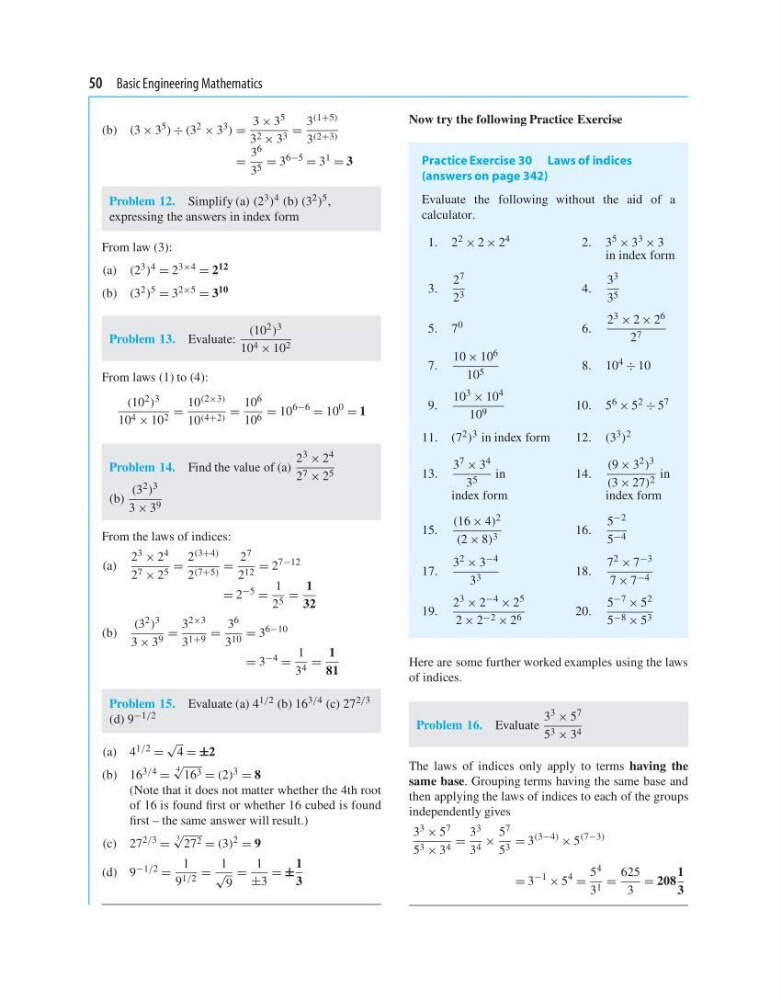
(b) (3 × 3 5 ) ÷ (3 2 × 3 3 ) =
3 × 3 5
3 2 × 3 3 =
3 (1+5)
3 (2+3)
=
3 6
3 5 = 3 6−5 = 3 1 = 3
Problem 12. Simplify (a) (2 3 ) 4 (b) (3 2 ) 5 ,
expressing the answers in index form
From law (3):
(a) (2 3 ) 4 = 2 3×4 = 2 12
(b) (3 2 ) 5 = 3 2×5 = 3 10
Problem 13. Evaluate:
(10 2 ) 3
10 4 × 10 2
From laws (1) to (4):
(10 2 ) 3
10 4 × 10 2 =
10 (2×3)
10 (4+2) =
10 6
10 6 = 10
6−6
= 10
0
= 1
Problem 14. Find the value of (a)
2 3 × 2 4
2 7 × 2 5
(b)
(3 2 ) 3
3 × 3 9
From the laws of indices:
(a)
2 3 × 2 4
2 7 × 2 5 =
2 (3+4)
2 (7+5) =
2 7
2 12 = 2 7−12
= 2 −5 =
1
2 5 =
1
32
(b)
(3 2 ) 3
3 × 3 9 =
3 2×3
3 1+9 =
3 6
3 10 = 3 6−10
= 3 −4 =
1
3 4 =
1
81
Problem 15. Evaluate (a) 4 1/2 (b) 16 3/4 (c) 27 2/3
(d) 9 −1/2
(a) 4 1/2 =
√
4 = ±2
(b) 16 3/4 =
4
√
16 3 = (2) 3 = 8
(Note that it does not matter whether the 4th root
of 16 is found first or whether 16 cubed is found
first – the same answer will result.)
(c) 27 2/3 =
3
√
27 2 = (3) 2 = 9
(d) 9 −1/2 =
1
9 1/2 =
1
√
9
=
1
±3
= ±
1
3
Now try the following Practice Exercise
Practice Exercise 30 Laws of indices
(answers on page 342)
Evaluate the following without the aid of a
calculator.
1. 2 2 × 2 × 2 4
2. 3 5 × 3 3 × 3
in index form
3.
2 7
2 3
4.
3 3
3 5
5. 7 0
6.
2 3 × 2 × 2 6
2 7
7.
10 × 10 6
10 5
8. 10 4 ÷ 10
9.
10 3 × 10 4
10 9
10. 5 6 × 5 2 ÷ 5 7
11. (7 2 ) 3 in index form
12. (3 3 ) 2
13.
3 7 × 3 4
3 5 in
14.
(9 × 3 2 ) 3
(3 × 27) 2 in
index form
index form
15.
(16 × 4) 2
(2 × 8) 3
16.
5 −2
5 −4
17.
3 2 × 3 −4
3 3
18.
7 2 × 7 −3
7 × 7 −4
19.
2 3 × 2 −4 × 2 5
2 × 2 −2 × 2 6
20.
5 −7 × 5 2
5 −8 × 5 3
Here are some further worked examples using the laws
of indices.
Problem 16. Evaluate
3 3 × 5 7
5 3 × 3 4
The laws of indices only apply to terms having the
same base. Grouping terms having the same base and
then applying the laws of indices to each of the groups
independently gives
3 3 × 5 7
5 3 × 3 4 =
3 3
3 4 ×
5 7
5 3 = 3
(3−4)
× 5
(7−3)
= 3
−1
× 5
4
=
5 4
3 1 =
625
3
= 208
1
3
(b) (3 × 3 5 ) ÷ (3 2 × 3 3 ) =
3 × 3 5
3 2 × 3 3 =
3 (1+5)
3 (2+3)
=
3 6
3 5 = 3 6−5 = 3 1 = 3
Problem 12. Simplify (a) (2 3 ) 4 (b) (3 2 ) 5 ,
expressing the answers in index form
From law (3):
(a) (2 3 ) 4 = 2 3×4 = 2 12
(b) (3 2 ) 5 = 3 2×5 = 3 10
Problem 13. Evaluate:
(10 2 ) 3
10 4 × 10 2
From laws (1) to (4):
(10 2 ) 3
10 4 × 10 2 =
10 (2×3)
10 (4+2) =
10 6
10 6 = 10
6−6
= 10
0
= 1
Problem 14. Find the value of (a)
2 3 × 2 4
2 7 × 2 5
(b)
(3 2 ) 3
3 × 3 9
From the laws of indices:
(a)
2 3 × 2 4
2 7 × 2 5 =
2 (3+4)
2 (7+5) =
2 7
2 12 = 2 7−12
= 2 −5 =
1
2 5 =
1
32
(b)
(3 2 ) 3
3 × 3 9 =
3 2×3
3 1+9 =
3 6
3 10 = 3 6−10
= 3 −4 =
1
3 4 =
1
81
Problem 15. Evaluate (a) 4 1/2 (b) 16 3/4 (c) 27 2/3
(d) 9 −1/2
(a) 4 1/2 =
√
4 = ±2
(b) 16 3/4 =
4
√
16 3 = (2) 3 = 8
(Note that it does not matter whether the 4th root
of 16 is found first or whether 16 cubed is found
first – the same answer will result.)
(c) 27 2/3 =
3
√
27 2 = (3) 2 = 9
(d) 9 −1/2 =
1
9 1/2 =
1
√
9
=
1
±3
= ±
1
3
Now try the following Practice Exercise
Practice Exercise 30 Laws of indices
(answers on page 342)
Evaluate the following without the aid of a
calculator.
1. 2 2 × 2 × 2 4
2. 3 5 × 3 3 × 3
in index form
3.
2 7
2 3
4.
3 3
3 5
5. 7 0
6.
2 3 × 2 × 2 6
2 7
7.
10 × 10 6
10 5
8. 10 4 ÷ 10
9.
10 3 × 10 4
10 9
10. 5 6 × 5 2 ÷ 5 7
11. (7 2 ) 3 in index form
12. (3 3 ) 2
13.
3 7 × 3 4
3 5 in
14.
(9 × 3 2 ) 3
(3 × 27) 2 in
index form
index form
15.
(16 × 4) 2
(2 × 8) 3
16.
5 −2
5 −4
17.
3 2 × 3 −4
3 3
18.
7 2 × 7 −3
7 × 7 −4
19.
2 3 × 2 −4 × 2 5
2 × 2 −2 × 2 6
20.
5 −7 × 5 2
5 −8 × 5 3
Here are some further worked examples using the laws
of indices.
Problem 16. Evaluate
3 3 × 5 7
5 3 × 3 4
The laws of indices only apply to terms having the
same base. Grouping terms having the same base and
then applying the laws of indices to each of the groups
independently gives
3 3 × 5 7
5 3 × 3 4 =
3 3
3 4 ×
5 7
5 3 = 3
(3−4)
× 5
(7−3)
= 3
−1
× 5
4
=
5 4
3 1 =
625
3
= 208
1
3