

Introduction to integration 333
x 0 1.0 1.5 2.0 2.5 3.0 3.5 4.0
y 4 7 10.75 16 22.75 31 40.75 52
0
1
2
3
4
x
4
50
40
30
20
10
y
y 5 3x 2 1 4
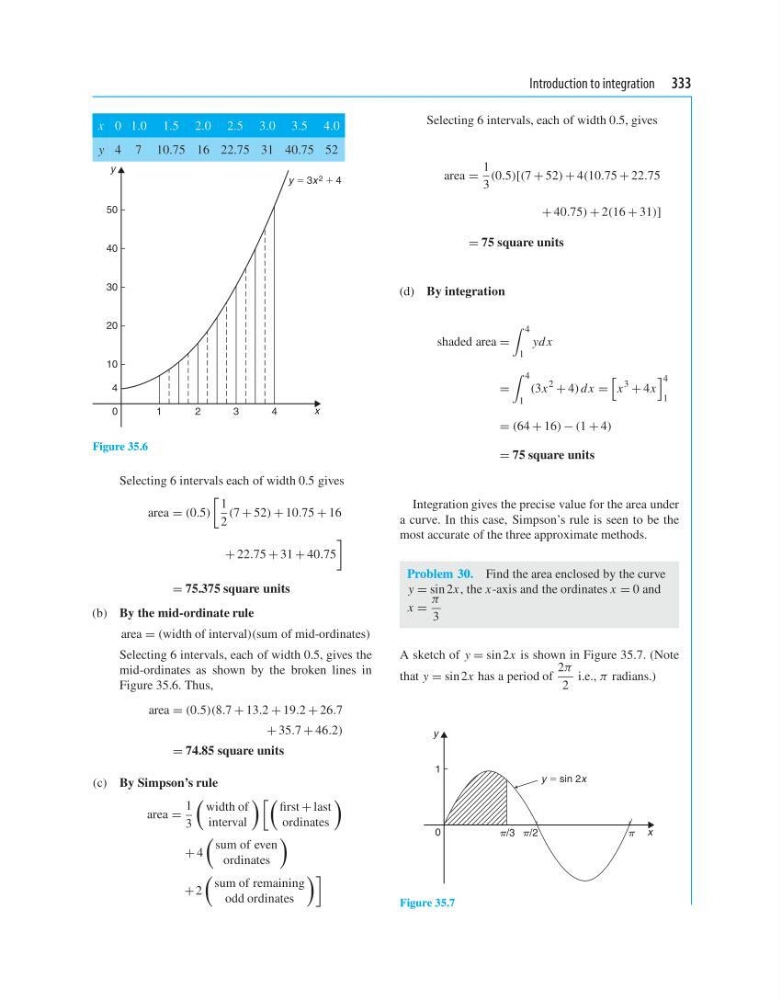
Figure 35.6
Selecting 6 intervals each of width 0.5 gives
area = (0.5)
1
2
(7 + 52) + 10.75 + 16
+ 22.75 + 31 + 40.75
= 75.375 square units
(b) By the mid-ordinate rule
area = (width of interval)(sum of mid-ordinates)
Selecting 6 intervals, each of width 0.5, gives the
mid-ordinates as shown by the broken lines in
Figure 35.6. Thus,
area = (0.5)(8.7 + 13.2 + 19.2 + 26.7
+ 35.7 + 46.2)
= 74.85 square units
(c) By Simpson’s rule
area =
1
3
width of
interval
first + last
ordinates
+ 4
sum of even
ordinates
+ 2
sum of remaining
odd ordinates
Selecting 6 intervals, each of width 0.5, gives
area =
1
3
(0.5)[(7 + 52) + 4(10.75 + 22.75
+ 40.75) + 2(16 + 31)]
= 75 square units
(d) By integration
shaded area =
4
1
ydx
=
4
1
(3x
2
+ 4) dx =
x
3
+ 4x
4
1
= (64 + 16) − (1 + 4)
= 75 square units
Integration gives the precise value for the area under
a curve. In this case, Simpson’s rule is seen to be the
most accurate of the three approximate methods.
Problem 30. Find the area enclosed by the curve
y = sin 2x, the x-axis and the ordinates x = 0 and
x =
π
3
A sketch of y = sin 2x is shown in Figure 35.7. (Note
that y = sin 2x has a period of
2π
2
i.e., π radians.)
1
0
/2
/3
y 5 sin 2x
x
y
Figure 35.7
x 0 1.0 1.5 2.0 2.5 3.0 3.5 4.0
y 4 7 10.75 16 22.75 31 40.75 52
0
1
2
3
4
x
4
50
40
30
20
10
y
y 5 3x 2 1 4
Figure 35.6
Selecting 6 intervals each of width 0.5 gives
area = (0.5)
1
2
(7 + 52) + 10.75 + 16
+ 22.75 + 31 + 40.75
= 75.375 square units
(b) By the mid-ordinate rule
area = (width of interval)(sum of mid-ordinates)
Selecting 6 intervals, each of width 0.5, gives the
mid-ordinates as shown by the broken lines in
Figure 35.6. Thus,
area = (0.5)(8.7 + 13.2 + 19.2 + 26.7
+ 35.7 + 46.2)
= 74.85 square units
(c) By Simpson’s rule
area =
1
3
width of
interval
first + last
ordinates
+ 4
sum of even
ordinates
+ 2
sum of remaining
odd ordinates
Selecting 6 intervals, each of width 0.5, gives
area =
1
3
(0.5)[(7 + 52) + 4(10.75 + 22.75
+ 40.75) + 2(16 + 31)]
= 75 square units
(d) By integration
shaded area =
4
1
ydx
=
4
1
(3x
2
+ 4) dx =
x
3
+ 4x
4
1
= (64 + 16) − (1 + 4)
= 75 square units
Integration gives the precise value for the area under
a curve. In this case, Simpson’s rule is seen to be the
most accurate of the three approximate methods.
Problem 30. Find the area enclosed by the curve
y = sin 2x, the x-axis and the ordinates x = 0 and
x =
π
3
A sketch of y = sin 2x is shown in Figure 35.7. (Note
that y = sin 2x has a period of
2π
2
i.e., π radians.)
1
0
/2
/3
y 5 sin 2x
x
y
Figure 35.7