

332 Basic Engineering Mathematics
40
30
20
10
5
1
2
3
4
0
v (m/s)
t(s)
v ϭ 2t 2 ϩ 5
Figure 35.4
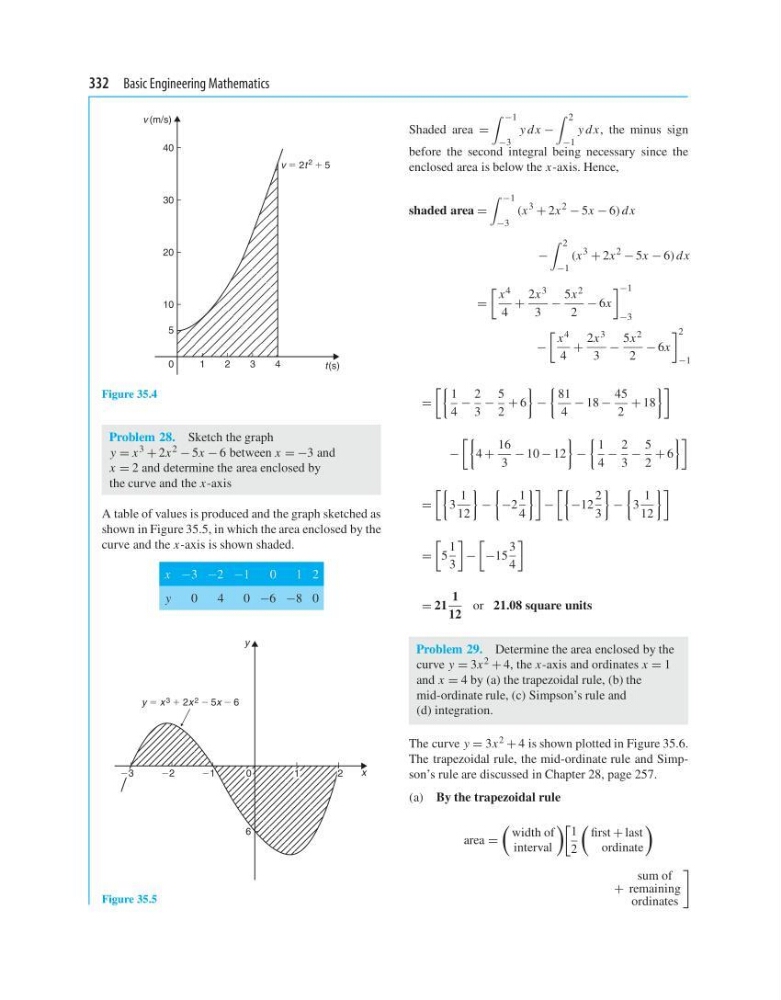
Problem 28. Sketch the graph
y = x 3 + 2x 2 − 5x − 6 between x = −3 and
x = 2 and determine the area enclosed by
the curve and the x-axis
A table of values is produced and the graph sketched as
shown in Figure 35.5, in which the area enclosed by the
curve and the x-axis is shown shaded.
x −3 −2 −1
0
1 2
y
0
4
0 −6 −8 0
y
x
6
0
1
21
22
23
y 5 x 3 1 2x 2 2 5x 2 6
2
Figure 35.5
Shaded area =
−1
−3
y dx −
2
−1
y dx, the minus sign
before the second integral being necessary since the
enclosed area is below the x-axis. Hence,
shaded area =
−1
−3
(x
3
+ 2x
2
− 5x − 6) dx
−
2
−1
(x
3
+ 2x
2
− 5x − 6) dx
=
x 4
4
+
2x 3
3
−
5x 2
2
− 6x
−1
−3
−
x 4
4
+
2x 3
3
−
5x 2
2
− 6x
2
−1
=
1
4
−
2
3
−
5
2
+ 6
−
81
4
− 18 −
45
2
+ 18
−
4 +
16
3
− 10 − 12
−
1
4
−
2
3
−
5
2
+ 6
=
3
1
12
−
−2
1
4
−
−12
2
3
−
3
1
12
=
5
1
3
−
−15
3
4
= 21
1
12
or 21.08 square units
Problem 29. Determine the area enclosed by the
curve y = 3x 2 + 4, the x-axis and ordinates x = 1
and x = 4 by (a) the trapezoidal rule, (b) the
mid-ordinate rule, (c) Simpson’s rule and
(d) integration.
The curve y = 3x 2 + 4 is shown plotted in Figure 35.6.
The trapezoidal rule, the mid-ordinate rule and Simpson’s rule are discussed in Chapter 28, page 257.
(a) By the trapezoidal rule
area =
width of
interval
1
2
first + last
ordinate
+
sum of
remaining
ordinates
40
30
20
10
5
1
2
3
4
0
v (m/s)
t(s)
v ϭ 2t 2 ϩ 5
Figure 35.4
Problem 28. Sketch the graph
y = x 3 + 2x 2 − 5x − 6 between x = −3 and
x = 2 and determine the area enclosed by
the curve and the x-axis
A table of values is produced and the graph sketched as
shown in Figure 35.5, in which the area enclosed by the
curve and the x-axis is shown shaded.
x −3 −2 −1
0
1 2
y
0
4
0 −6 −8 0
y
x
6
0
1
21
22
23
y 5 x 3 1 2x 2 2 5x 2 6
2
Figure 35.5
Shaded area =
−1
−3
y dx −
2
−1
y dx, the minus sign
before the second integral being necessary since the
enclosed area is below the x-axis. Hence,
shaded area =
−1
−3
(x
3
+ 2x
2
− 5x − 6) dx
−
2
−1
(x
3
+ 2x
2
− 5x − 6) dx
=
x 4
4
+
2x 3
3
−
5x 2
2
− 6x
−1
−3
−
x 4
4
+
2x 3
3
−
5x 2
2
− 6x
2
−1
=
1
4
−
2
3
−
5
2
+ 6
−
81
4
− 18 −
45
2
+ 18
−
4 +
16
3
− 10 − 12
−
1
4
−
2
3
−
5
2
+ 6
=
3
1
12
−
−2
1
4
−
−12
2
3
−
3
1
12
=
5
1
3
−
−15
3
4
= 21
1
12
or 21.08 square units
Problem 29. Determine the area enclosed by the
curve y = 3x 2 + 4, the x-axis and ordinates x = 1
and x = 4 by (a) the trapezoidal rule, (b) the
mid-ordinate rule, (c) Simpson’s rule and
(d) integration.
The curve y = 3x 2 + 4 is shown plotted in Figure 35.6.
The trapezoidal rule, the mid-ordinate rule and Simpson’s rule are discussed in Chapter 28, page 257.
(a) By the trapezoidal rule
area =
width of
interval
1
2
first + last
ordinate
+
sum of
remaining
ordinates