

224 Basic Engineering Mathematics
Problem 7. A rectangular tray is 820 mm long
and 400 mm wide. Find its area in (a) mm 2 (b) cm 2
(c) m 2
(a) Area of tray = length × width = 820 × 400
= 328000 mm
2
(b) Since 1 cm = 10 mm, 1 cm
2
= 1 cm × 1 cm
= 10 mm × 10 mm = 100 mm
2
, or
1 mm
2
=
1
100
cm
2
= 0.01 cm
2
Hence, 328000 mm
2
= 328000 × 0.01 cm
2
= 3280 cm
2
.
(c) Since 1 m = 100 cm, 1 m
2
= 1 m × 1 m
= 100 cm × 100 cm = 10000 cm
2
, or
1 cm
2
=
1
10000
m
2
= 0.0001m
2
Hence, 3280 cm
2
= 3280 × 0.0001 m
2
= 0.3280 m
2
.
Problem 8. The outside measurements of a
picture frame are 100 cm by 50 cm. If the frame is
4 cm wide, find the area of the wood used to make
the frame
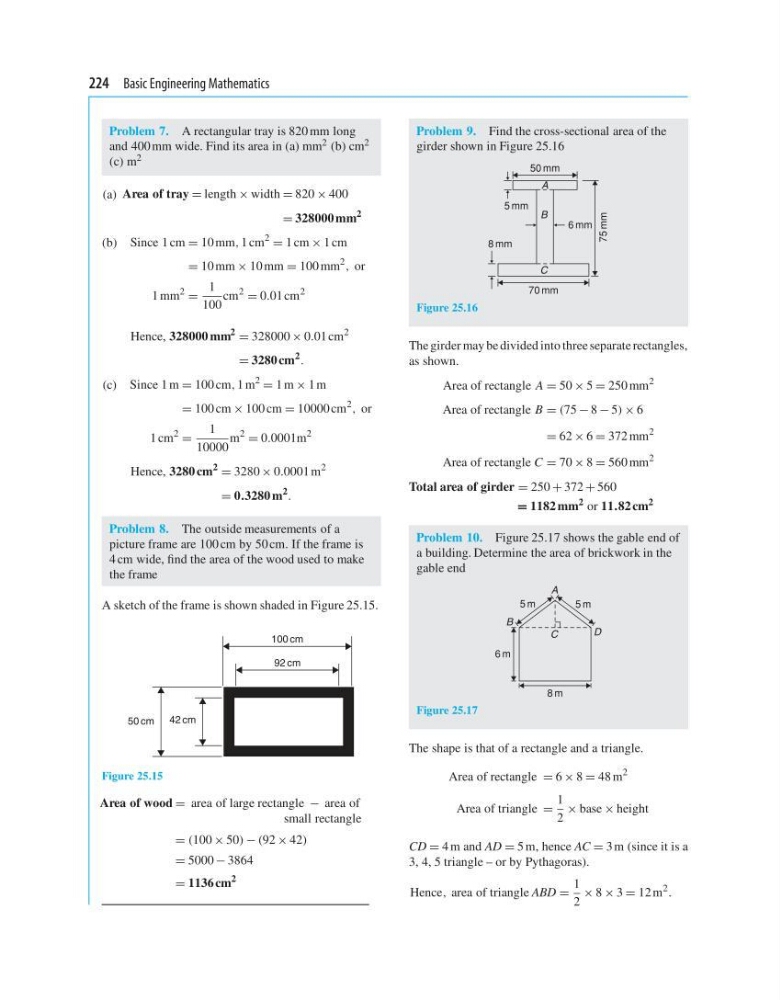
A sketch of the frame is shown shaded in Figure 25.15.
100 cm
50 cm 42 cm
92 cm
Figure 25.15
Area of wood = area of large rectangle − area of
small rectangle
= (100 × 50) − (92 × 42)
= 5000 − 3864
= 1136 cm
2
Problem 9. Find the cross-sectional area of the
girder shown in Figure 25.16
5 mm
50 mm
B
C
A
8 mm
70 mm
75 mm
6 mm
Figure 25.16
The girder may be divided into three separate rectangles,
as shown.
Area of rectangle A = 50 × 5 = 250 mm
2
Area of rectangle B = (75 − 8 − 5) × 6
= 62 × 6 = 372 mm
2
Area of rectangle C = 70 × 8 = 560 mm
2
Total area of girder = 250 + 372 + 560
= 1182 mm
2 or 11.82 cm
2
Problem 10. Figure 25.17 shows the gable end of
a building. Determine the area of brickwork in the
gable end
6 m
5 m
5 m
A
D
C
B
8 m
Figure 25.17
The shape is that of a rectangle and a triangle.
Area of rectangle = 6 × 8 = 48 m
2
Area of triangle =
1
2
× base × height
CD = 4 m and AD = 5 m, hence AC = 3 m (since it is a
3, 4, 5 triangle – or by Pythagoras).
Hence, area of triangle ABD =
1
2
× 8 × 3 = 12 m
2
.
Problem 7. A rectangular tray is 820 mm long
and 400 mm wide. Find its area in (a) mm 2 (b) cm 2
(c) m 2
(a) Area of tray = length × width = 820 × 400
= 328000 mm
2
(b) Since 1 cm = 10 mm, 1 cm
2
= 1 cm × 1 cm
= 10 mm × 10 mm = 100 mm
2
, or
1 mm
2
=
1
100
cm
2
= 0.01 cm
2
Hence, 328000 mm
2
= 328000 × 0.01 cm
2
= 3280 cm
2
.
(c) Since 1 m = 100 cm, 1 m
2
= 1 m × 1 m
= 100 cm × 100 cm = 10000 cm
2
, or
1 cm
2
=
1
10000
m
2
= 0.0001m
2
Hence, 3280 cm
2
= 3280 × 0.0001 m
2
= 0.3280 m
2
.
Problem 8. The outside measurements of a
picture frame are 100 cm by 50 cm. If the frame is
4 cm wide, find the area of the wood used to make
the frame
A sketch of the frame is shown shaded in Figure 25.15.
100 cm
50 cm 42 cm
92 cm
Figure 25.15
Area of wood = area of large rectangle − area of
small rectangle
= (100 × 50) − (92 × 42)
= 5000 − 3864
= 1136 cm
2
Problem 9. Find the cross-sectional area of the
girder shown in Figure 25.16
5 mm
50 mm
B
C
A
8 mm
70 mm
75 mm
6 mm
Figure 25.16
The girder may be divided into three separate rectangles,
as shown.
Area of rectangle A = 50 × 5 = 250 mm
2
Area of rectangle B = (75 − 8 − 5) × 6
= 62 × 6 = 372 mm
2
Area of rectangle C = 70 × 8 = 560 mm
2
Total area of girder = 250 + 372 + 560
= 1182 mm
2 or 11.82 cm
2
Problem 10. Figure 25.17 shows the gable end of
a building. Determine the area of brickwork in the
gable end
6 m
5 m
5 m
A
D
C
B
8 m
Figure 25.17
The shape is that of a rectangle and a triangle.
Area of rectangle = 6 × 8 = 48 m
2
Area of triangle =
1
2
× base × height
CD = 4 m and AD = 5 m, hence AC = 3 m (since it is a
3, 4, 5 triangle – or by Pythagoras).
Hence, area of triangle ABD =
1
2
× 8 × 3 = 12 m
2
.