

Areas of common shapes 223
Area of rectangle = l × b = 7.0 × 4.5
= 31.5 cm
2
Perimeter of rectangle = 7.0 cm + 4.5 cm
+ 7.0 cm + 4.5 cm
= 23.0 cm
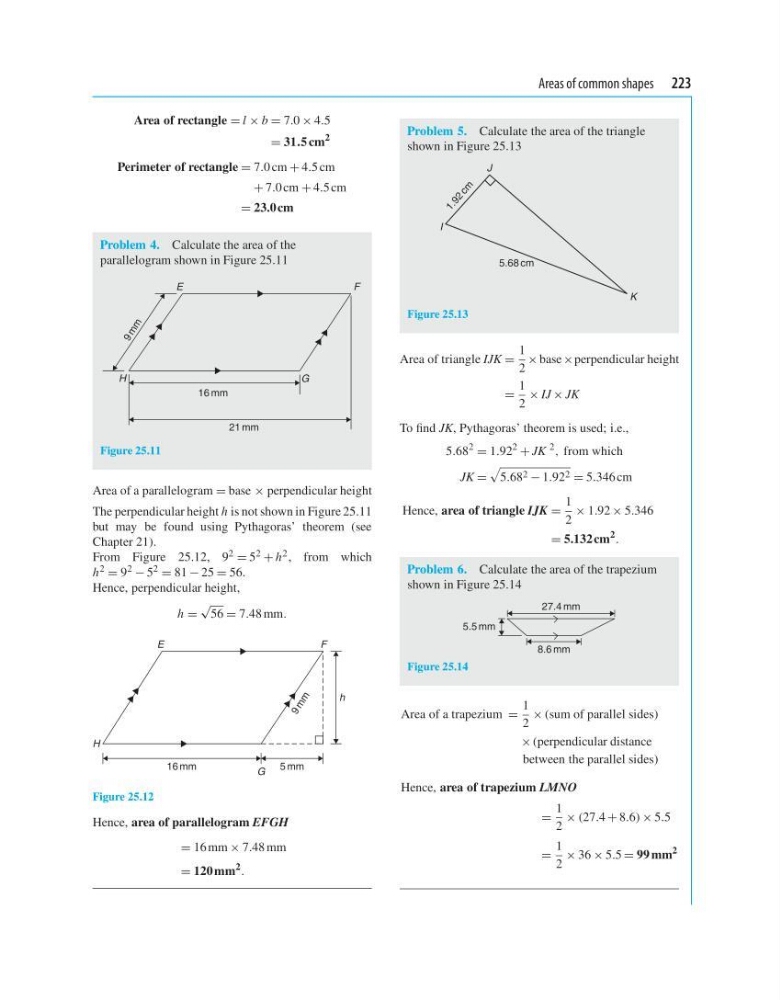
Problem 4. Calculate the area of the
parallelogram shown in Figure 25.11
21 mm
16 mm
G
H
E
F
9 m m
Figure 25.11
Area of a parallelogram = base × perpendicular height
The perpendicular height h is not shown in Figure 25.11
but may be found using Pythagoras’ theorem (see
Chapter 21).
From Figure 25.12, 9 2 = 5 2 + h 2 , from which
h 2 = 9 2 − 5 2 = 81 − 25 = 56.
Hence, perpendicular height,
h =
√
56 = 7.48 mm.
9 m m
E
G
h
F
H
16 mm
5 mm
Figure 25.12
Hence, area of parallelogram EFGH
= 16 mm × 7.48 mm
= 120 mm
2
.
Problem 5. Calculate the area of the triangle
shown in Figure 25.13
I
K
J
5.68 cm
1 . 9 2 c m
Figure 25.13
Area of triangle IJK =
1
2
× base ×perpendicular height
=
1
2
× IJ × JK
To find JK, Pythagoras’ theorem is used; i.e.,
5.68
2
= 1.92
2
+ JK
2
, from which
JK =
5.68 2 − 1.92 2 = 5.346 cm
Hence, area of triangle IJK =
1
2
× 1.92 × 5.346
= 5.132 cm
2
.
Problem 6. Calculate the area of the trapezium
shown in Figure 25.14
27.4 mm
8.6 mm
5.5 mm
Figure 25.14
Area of a trapezium =
1
2
× (sum of parallel sides)
× (perpendicular distance
between the parallel sides)
Hence, area of trapezium LMNO
=
1
2
× (27.4 + 8.6) × 5.5
=
1
2
× 36 × 5.5 = 99 mm
2
Area of rectangle = l × b = 7.0 × 4.5
= 31.5 cm
2
Perimeter of rectangle = 7.0 cm + 4.5 cm
+ 7.0 cm + 4.5 cm
= 23.0 cm
Problem 4. Calculate the area of the
parallelogram shown in Figure 25.11
21 mm
16 mm
G
H
E
F
9 m m
Figure 25.11
Area of a parallelogram = base × perpendicular height
The perpendicular height h is not shown in Figure 25.11
but may be found using Pythagoras’ theorem (see
Chapter 21).
From Figure 25.12, 9 2 = 5 2 + h 2 , from which
h 2 = 9 2 − 5 2 = 81 − 25 = 56.
Hence, perpendicular height,
h =
√
56 = 7.48 mm.
9 m m
E
G
h
F
H
16 mm
5 mm
Figure 25.12
Hence, area of parallelogram EFGH
= 16 mm × 7.48 mm
= 120 mm
2
.
Problem 5. Calculate the area of the triangle
shown in Figure 25.13
I
K
J
5.68 cm
1 . 9 2 c m
Figure 25.13
Area of triangle IJK =
1
2
× base ×perpendicular height
=
1
2
× IJ × JK
To find JK, Pythagoras’ theorem is used; i.e.,
5.68
2
= 1.92
2
+ JK
2
, from which
JK =
5.68 2 − 1.92 2 = 5.346 cm
Hence, area of triangle IJK =
1
2
× 1.92 × 5.346
= 5.132 cm
2
.
Problem 6. Calculate the area of the trapezium
shown in Figure 25.14
27.4 mm
8.6 mm
5.5 mm
Figure 25.14
Area of a trapezium =
1
2
× (sum of parallel sides)
× (perpendicular distance
between the parallel sides)
Hence, area of trapezium LMNO
=
1
2
× (27.4 + 8.6) × 5.5
=
1
2
× 36 × 5.5 = 99 mm
2