

Introduction to trigonometry 191
3. A ladder rests against the top of the perpendicular wall of a building and makes an angle of
73 ◦ with the ground. If the foot of the ladder is
2 m from the wall, calculate the height of the
building.
4. Determine the length x in Figure 21.26.
x
568
10 mm
Figure 21.26
21.6 Angles of elevation and
depression
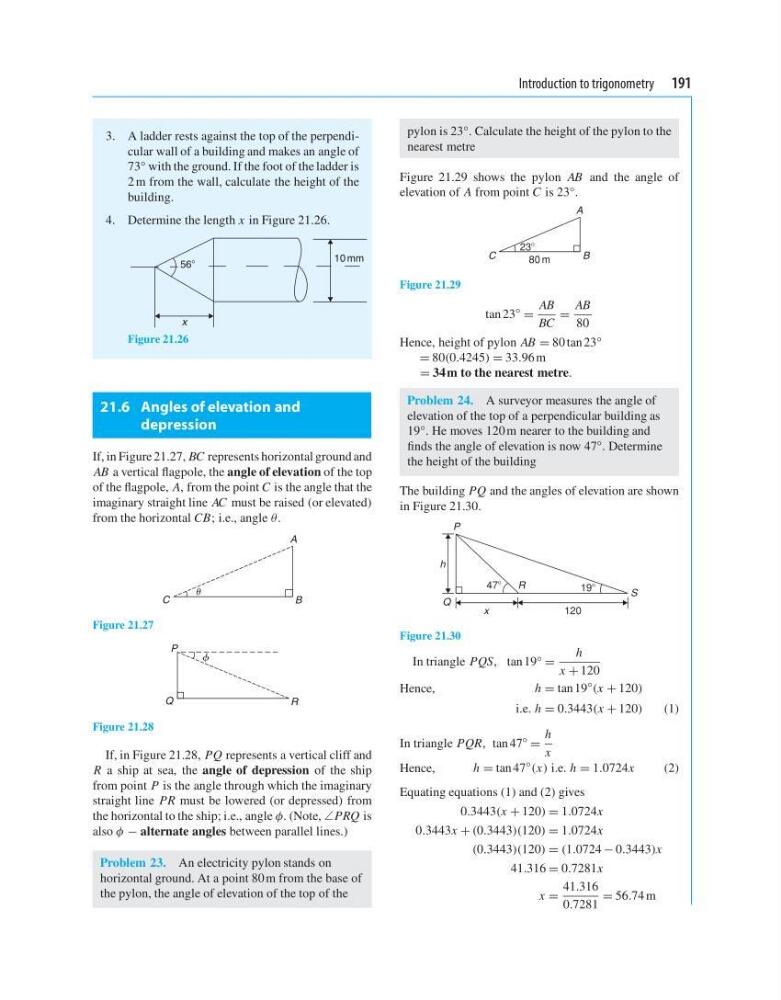
If, in Figure 21.27, BC represents horizontal ground and
AB a vertical flagpole, the angle of elevation of the top
of the flagpole, A, from the point C is the angle that the
imaginary straight line AC must be raised (or elevated)
from the horizontal CB; i.e., angle θ.
A
B
C
Figure 21.27
P
Q
R
Figure 21.28
If, in Figure 21.28, PQ represents a vertical cliff and
R a ship at sea, the angle of depression of the ship
from point P is the angle through which the imaginary
straight line PR must be lowered (or depressed) from
the horizontal to the ship; i.e., angle φ. (Note, ∠PRQ is
also φ − alternate angles between parallel lines.)
Problem 23. An electricity pylon stands on
horizontal ground. At a point 80 m from the base of
the pylon, the angle of elevation of the top of the
pylon is 23 ◦ . Calculate the height of the pylon to the
nearest metre
Figure 21.29 shows the pylon AB and the angle of
elevation of A from point C is 23 ◦ .
80 m
238
A
B
C
Figure 21.29
tan 23
◦
=
AB
BC
=
AB
80
Hence, height of pylon AB = 80 tan 23 ◦
= 80(0.4245) = 33.96 m
= 34 m to the nearest metre.
Problem 24. A surveyor measures the angle of
elevation of the top of a perpendicular building as
19 ◦ . He moves 120 m nearer to the building and
finds the angle of elevation is now 47 ◦ . Determine
the height of the building
The building PQ and the angles of elevation are shown
in Figure 21.30.
P
Q
h
x
R
S
120
478
198
Figure 21.30
In triangle PQS, tan19 ◦ =
h
x + 120
Hence,
h = tan 19
◦
(x + 120)
i.e. h = 0.3443(x + 120)
(1)
In triangle PQR, tan47
◦
=
h
x
Hence,
h = tan 47
◦
(x) i.e. h = 1.0724x
(2)
Equating equations (1) and (2) gives
0.3443(x + 120) = 1.0724x
0.3443x + (0.3443)(120) = 1.0724x
(0.3443)(120) = (1.0724 − 0.3443)x
41.316 = 0.7281x
x =
41.316
0.7281
= 56.74 m
3. A ladder rests against the top of the perpendicular wall of a building and makes an angle of
73 ◦ with the ground. If the foot of the ladder is
2 m from the wall, calculate the height of the
building.
4. Determine the length x in Figure 21.26.
x
568
10 mm
Figure 21.26
21.6 Angles of elevation and
depression
If, in Figure 21.27, BC represents horizontal ground and
AB a vertical flagpole, the angle of elevation of the top
of the flagpole, A, from the point C is the angle that the
imaginary straight line AC must be raised (or elevated)
from the horizontal CB; i.e., angle θ.
A
B
C
Figure 21.27
P
Q
R
Figure 21.28
If, in Figure 21.28, PQ represents a vertical cliff and
R a ship at sea, the angle of depression of the ship
from point P is the angle through which the imaginary
straight line PR must be lowered (or depressed) from
the horizontal to the ship; i.e., angle φ. (Note, ∠PRQ is
also φ − alternate angles between parallel lines.)
Problem 23. An electricity pylon stands on
horizontal ground. At a point 80 m from the base of
the pylon, the angle of elevation of the top of the
pylon is 23 ◦ . Calculate the height of the pylon to the
nearest metre
Figure 21.29 shows the pylon AB and the angle of
elevation of A from point C is 23 ◦ .
80 m
238
A
B
C
Figure 21.29
tan 23
◦
=
AB
BC
=
AB
80
Hence, height of pylon AB = 80 tan 23 ◦
= 80(0.4245) = 33.96 m
= 34 m to the nearest metre.
Problem 24. A surveyor measures the angle of
elevation of the top of a perpendicular building as
19 ◦ . He moves 120 m nearer to the building and
finds the angle of elevation is now 47 ◦ . Determine
the height of the building
The building PQ and the angles of elevation are shown
in Figure 21.30.
P
Q
h
x
R
S
120
478
198
Figure 21.30
In triangle PQS, tan19 ◦ =
h
x + 120
Hence,
h = tan 19
◦
(x + 120)
i.e. h = 0.3443(x + 120)
(1)
In triangle PQR, tan47
◦
=
h
x
Hence,
h = tan 47
◦
(x) i.e. h = 1.0724x
(2)
Equating equations (1) and (2) gives
0.3443(x + 120) = 1.0724x
0.3443x + (0.3443)(120) = 1.0724x
(0.3443)(120) = (1.0724 − 0.3443)x
41.316 = 0.7281x
x =
41.316
0.7281
= 56.74 m