

158 Basic Engineering Mathematics
Let y = 4x
2
+ 4x − 15. A table of values is drawn up as
shown below.
x
−3 −2 −1
0
1 2
y = 4x 2 + 4x − 15
9 −7 −15 −15 −7 9
y 5 4x
2 1 4x 215
12
y
8
4
24
28
212
216
20.5
1.5
0
1
2
x
A
B
22.5
23 22 21
Figure 19.8
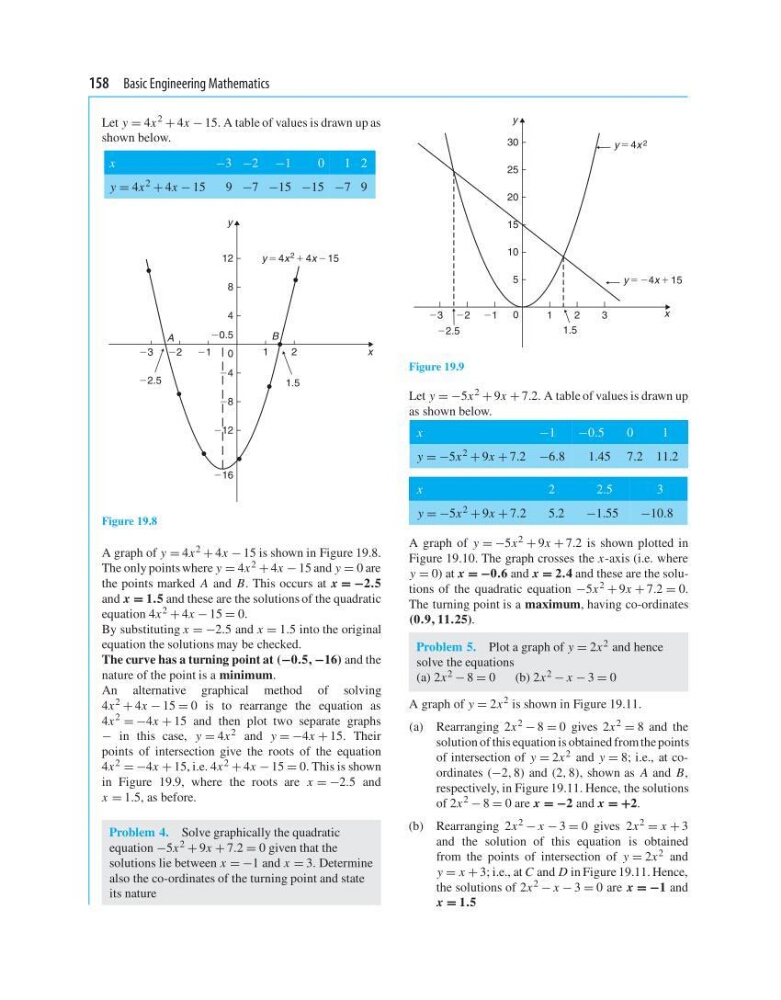
A graph of y = 4x 2 + 4x − 15 is shown in Figure 19.8.
The only points where y = 4x 2 + 4x − 15 and y = 0 are
the points marked A and B. This occurs at x = −2.5
and x = 1.5 and these are the solutions of the quadratic
equation 4x 2 + 4x − 15 = 0.
By substituting x = −2.5 and x = 1.5 into the original
equation the solutions may be checked.
The curve has a turning point at (−0.5, −16) and the
nature of the point is a minimum.
An alternative graphical method of solving
4x 2 + 4x − 15 = 0 is to rearrange the equation as
4x
2
= −4x + 15 and then plot two separate graphs
− in this case, y = 4x 2 and y = −4x + 15. Their
points of intersection give the roots of the equation
4x 2 = −4x + 15, i.e. 4x 2 + 4x − 15 = 0. This is shown
in Figure 19.9, where the roots are x = −2.5 and
x = 1.5, as before.
Problem 4. Solve graphically the quadratic
equation −5x 2 + 9x + 7.2 = 0 given that the
solutions lie between x = −1 and x = 3. Determine
also the co-ordinates of the turning point and state
its nature
y 5 24x 1 15
30
25
20
15
10
5
y
1
0
2
3
x
21
22
22.5
1.5
23
y 5 4x 2
Figure 19.9
Let y = −5x 2 + 9x + 7.2. A table of values is drawn up
as shown below.
x
−1
−0.5
0
1
y = −5x 2 + 9x + 7.2 −6.8
1.45 7.2 11.2
x
2
2.5
3
y = −5x 2 + 9x + 7.2
5.2
−1.55
−10.8
A graph of y = −5x 2 + 9x + 7.2 is shown plotted in
Figure 19.10. The graph crosses the x-axis (i.e. where
y = 0) at x = −0.6 and x = 2.4 and these are the solutions of the quadratic equation −5x 2 + 9x + 7.2 = 0.
The turning point is a maximum, having co-ordinates
(0.9, 11.25).
Problem 5. Plot a graph of y = 2x 2 and hence
solve the equations
(a) 2x 2 − 8 = 0
(b)2x 2 − x − 3 = 0
A graph of y = 2x
2 is shown in Figure 19.11.
(a) Rearranging 2x 2 − 8 = 0 gives 2x 2 = 8 and the
solution of this equation is obtained from the points
of intersection of y = 2x 2 and y = 8; i.e., at coordinates (−2, 8) and (2, 8), shown as A and B,
respectively, in Figure 19.11. Hence, the solutions
of 2x
2
− 8 = 0 are x = −2 and x = +2.
(b) Rearranging 2x 2 − x − 3 = 0 gives 2x 2 = x + 3
and the solution of this equation is obtained
from the points of intersection of y = 2x 2 and
y = x + 3; i.e., at C and D in Figure 19.11. Hence,
the solutions of 2x 2 − x − 3 = 0 are x = −1 and
x = 1.5
Let y = 4x
2
+ 4x − 15. A table of values is drawn up as
shown below.
x
−3 −2 −1
0
1 2
y = 4x 2 + 4x − 15
9 −7 −15 −15 −7 9
y 5 4x
2 1 4x 215
12
y
8
4
24
28
212
216
20.5
1.5
0
1
2
x
A
B
22.5
23 22 21
Figure 19.8
A graph of y = 4x 2 + 4x − 15 is shown in Figure 19.8.
The only points where y = 4x 2 + 4x − 15 and y = 0 are
the points marked A and B. This occurs at x = −2.5
and x = 1.5 and these are the solutions of the quadratic
equation 4x 2 + 4x − 15 = 0.
By substituting x = −2.5 and x = 1.5 into the original
equation the solutions may be checked.
The curve has a turning point at (−0.5, −16) and the
nature of the point is a minimum.
An alternative graphical method of solving
4x 2 + 4x − 15 = 0 is to rearrange the equation as
4x
2
= −4x + 15 and then plot two separate graphs
− in this case, y = 4x 2 and y = −4x + 15. Their
points of intersection give the roots of the equation
4x 2 = −4x + 15, i.e. 4x 2 + 4x − 15 = 0. This is shown
in Figure 19.9, where the roots are x = −2.5 and
x = 1.5, as before.
Problem 4. Solve graphically the quadratic
equation −5x 2 + 9x + 7.2 = 0 given that the
solutions lie between x = −1 and x = 3. Determine
also the co-ordinates of the turning point and state
its nature
y 5 24x 1 15
30
25
20
15
10
5
y
1
0
2
3
x
21
22
22.5
1.5
23
y 5 4x 2
Figure 19.9
Let y = −5x 2 + 9x + 7.2. A table of values is drawn up
as shown below.
x
−1
−0.5
0
1
y = −5x 2 + 9x + 7.2 −6.8
1.45 7.2 11.2
x
2
2.5
3
y = −5x 2 + 9x + 7.2
5.2
−1.55
−10.8
A graph of y = −5x 2 + 9x + 7.2 is shown plotted in
Figure 19.10. The graph crosses the x-axis (i.e. where
y = 0) at x = −0.6 and x = 2.4 and these are the solutions of the quadratic equation −5x 2 + 9x + 7.2 = 0.
The turning point is a maximum, having co-ordinates
(0.9, 11.25).
Problem 5. Plot a graph of y = 2x 2 and hence
solve the equations
(a) 2x 2 − 8 = 0
(b)2x 2 − x − 3 = 0
A graph of y = 2x
2 is shown in Figure 19.11.
(a) Rearranging 2x 2 − 8 = 0 gives 2x 2 = 8 and the
solution of this equation is obtained from the points
of intersection of y = 2x 2 and y = 8; i.e., at coordinates (−2, 8) and (2, 8), shown as A and B,
respectively, in Figure 19.11. Hence, the solutions
of 2x
2
− 8 = 0 are x = −2 and x = +2.
(b) Rearranging 2x 2 − x − 3 = 0 gives 2x 2 = x + 3
and the solution of this equation is obtained
from the points of intersection of y = 2x 2 and
y = x + 3; i.e., at C and D in Figure 19.11. Hence,
the solutions of 2x 2 − x − 3 = 0 are x = −1 and
x = 1.5