

adjustedRed = .9 * img.red;
If you have multiple images, you can add them to the img structure, so that each element
img(1),...,img(n) contains an entire image. For an example that adds elements to a structure,
see the following section.
Element-by-Element Organization
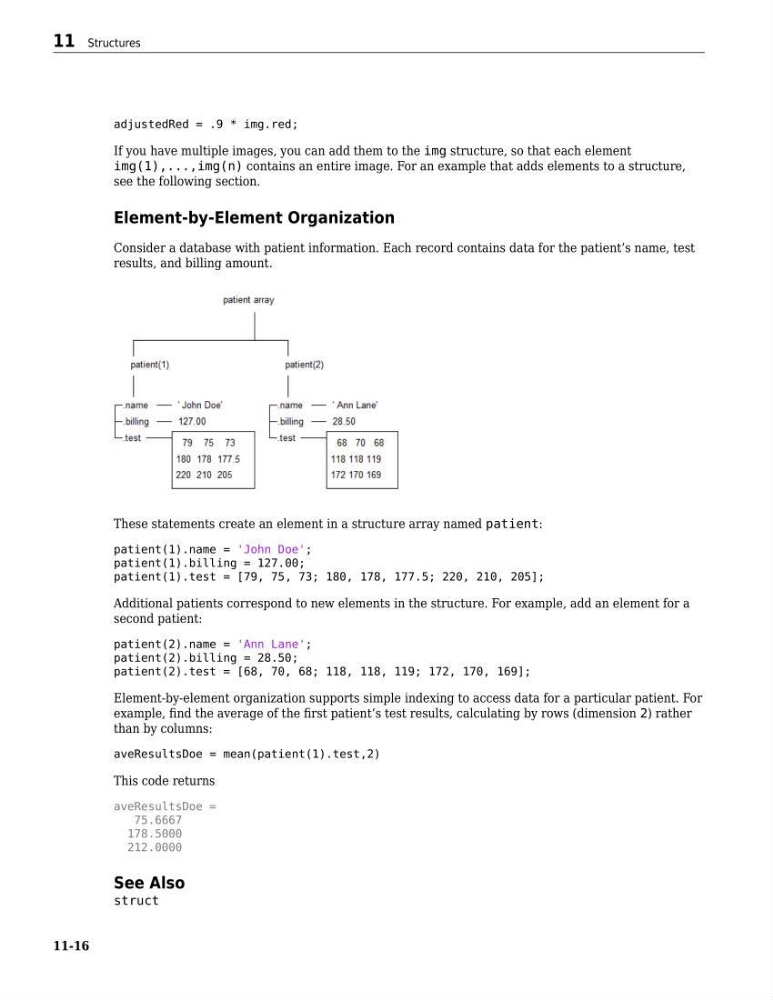
Consider a database with patient information. Each record contains data for the patient’s name, test
results, and billing amount.
These statements create an element in a structure array named patient:
patient(1).name = 'John Doe';
patient(1).billing = 127.00;
patient(1).test = [79, 75, 73; 180, 178, 177.5; 220, 210, 205];
Additional patients correspond to new elements in the structure. For example, add an element for a
second patient:
patient(2).name = 'Ann Lane';
patient(2).billing = 28.50;
patient(2).test = [68, 70, 68; 118, 118, 119; 172, 170, 169];
Element-by-element organization supports simple indexing to access data for a particular patient. For
example, find the average of the first patient’s test results, calculating by rows (dimension 2) rather
than by columns:
aveResultsDoe = mean(patient(1).test,2)
This code returns
aveResultsDoe =
75.6667
178.5000
212.0000
See Also
struct
11 Structures
11-16
If you have multiple images, you can add them to the img structure, so that each element
img(1),...,img(n) contains an entire image. For an example that adds elements to a structure,
see the following section.
Element-by-Element Organization
Consider a database with patient information. Each record contains data for the patient’s name, test
results, and billing amount.
These statements create an element in a structure array named patient:
patient(1).name = 'John Doe';
patient(1).billing = 127.00;
patient(1).test = [79, 75, 73; 180, 178, 177.5; 220, 210, 205];
Additional patients correspond to new elements in the structure. For example, add an element for a
second patient:
patient(2).name = 'Ann Lane';
patient(2).billing = 28.50;
patient(2).test = [68, 70, 68; 118, 118, 119; 172, 170, 169];
Element-by-element organization supports simple indexing to access data for a particular patient. For
example, find the average of the first patient’s test results, calculating by rows (dimension 2) rather
than by columns:
aveResultsDoe = mean(patient(1).test,2)
This code returns
aveResultsDoe =
75.6667
178.5000
212.0000
See Also
struct
11 Structures
11-16