

09-Jun-2016 09:53:57
67
0.03
3.4
09-Jun-2016 09:53:57
67
0.03
3.4
09-Jun-2016 08:49:10
62
0.01
2.7
09-Jun-2016 08:49:10
75.8
0.01
2.7
09-Jun-2016 08:49:10
82
0.01
2.7
09-Jun-2016 05:03:11
66.2
0.05
3
09-Jun-2016 08:49:10
67.2
0.01
2.7
Sort Timetable and Determine if It Is Regular
After dealing with missing values, you can go on to sort your timetable and then determine if the
sorted timetable is regular.
To determine if goodValuesTT is already sorted, use the issorted function.
tf = issorted(goodValuesTT)
tf = logical
0
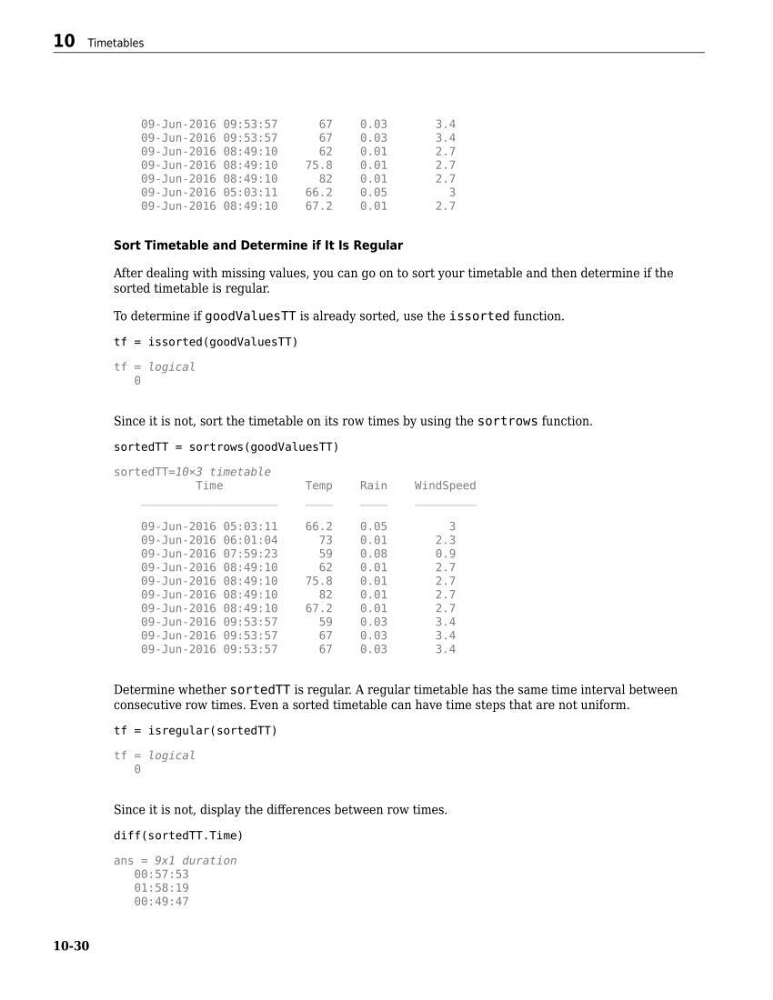
Since it is not, sort the timetable on its row times by using the sortrows function.
sortedTT = sortrows(goodValuesTT)
sortedTT=10×3 timetable
Time
Temp
Rain
WindSpeed
____________________
____
____
_________
09-Jun-2016 05:03:11
66.2
0.05
3
09-Jun-2016 06:01:04
73
0.01
2.3
09-Jun-2016 07:59:23
59
0.08
0.9
09-Jun-2016 08:49:10
62
0.01
2.7
09-Jun-2016 08:49:10
75.8
0.01
2.7
09-Jun-2016 08:49:10
82
0.01
2.7
09-Jun-2016 08:49:10
67.2
0.01
2.7
09-Jun-2016 09:53:57
59
0.03
3.4
09-Jun-2016 09:53:57
67
0.03
3.4
09-Jun-2016 09:53:57
67
0.03
3.4
Determine whether sortedTT is regular. A regular timetable has the same time interval between
consecutive row times. Even a sorted timetable can have time steps that are not uniform.
tf = isregular(sortedTT)
tf = logical
0
Since it is not, display the differences between row times.
diff(sortedTT.Time)
ans = 9x1 duration
00:57:53
01:58:19
00:49:47
10 Timetables
10-30
67
0.03
3.4
09-Jun-2016 09:53:57
67
0.03
3.4
09-Jun-2016 08:49:10
62
0.01
2.7
09-Jun-2016 08:49:10
75.8
0.01
2.7
09-Jun-2016 08:49:10
82
0.01
2.7
09-Jun-2016 05:03:11
66.2
0.05
3
09-Jun-2016 08:49:10
67.2
0.01
2.7
Sort Timetable and Determine if It Is Regular
After dealing with missing values, you can go on to sort your timetable and then determine if the
sorted timetable is regular.
To determine if goodValuesTT is already sorted, use the issorted function.
tf = issorted(goodValuesTT)
tf = logical
0
Since it is not, sort the timetable on its row times by using the sortrows function.
sortedTT = sortrows(goodValuesTT)
sortedTT=10×3 timetable
Time
Temp
Rain
WindSpeed
____________________
____
____
_________
09-Jun-2016 05:03:11
66.2
0.05
3
09-Jun-2016 06:01:04
73
0.01
2.3
09-Jun-2016 07:59:23
59
0.08
0.9
09-Jun-2016 08:49:10
62
0.01
2.7
09-Jun-2016 08:49:10
75.8
0.01
2.7
09-Jun-2016 08:49:10
82
0.01
2.7
09-Jun-2016 08:49:10
67.2
0.01
2.7
09-Jun-2016 09:53:57
59
0.03
3.4
09-Jun-2016 09:53:57
67
0.03
3.4
09-Jun-2016 09:53:57
67
0.03
3.4
Determine whether sortedTT is regular. A regular timetable has the same time interval between
consecutive row times. Even a sorted timetable can have time steps that are not uniform.
tf = isregular(sortedTT)
tf = logical
0
Since it is not, display the differences between row times.
diff(sortedTT.Time)
ans = 9x1 duration
00:57:53
01:58:19
00:49:47
10 Timetables
10-30