

logical
0
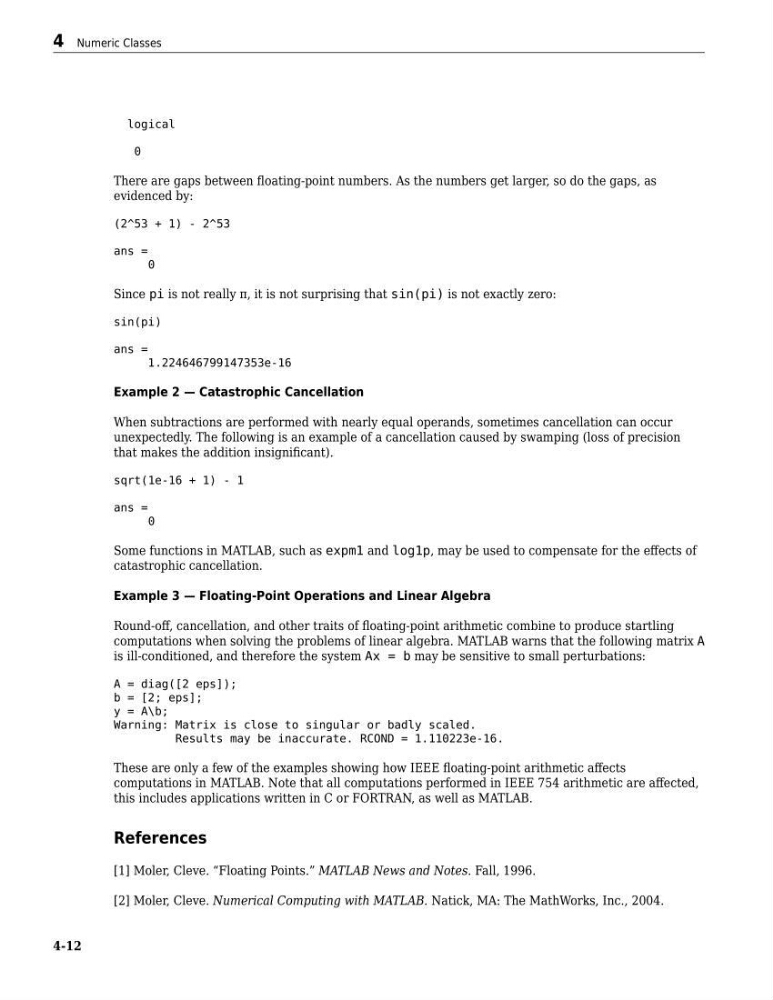
There are gaps between floating-point numbers. As the numbers get larger, so do the gaps, as
evidenced by:
(2^53 + 1) - 2^53
ans =
0
Since pi is not really π, it is not surprising that sin(pi) is not exactly zero:
sin(pi)
ans =
1.224646799147353e-16
Example 2 — Catastrophic Cancellation
When subtractions are performed with nearly equal operands, sometimes cancellation can occur
unexpectedly. The following is an example of a cancellation caused by swamping (loss of precision
that makes the addition insignificant).
sqrt(1e-16 + 1) - 1
ans =
0
Some functions in MATLAB, such as expm1 and log1p, may be used to compensate for the effects of
catastrophic cancellation.
Example 3 — Floating-Point Operations and Linear Algebra
Round-off, cancellation, and other traits of floating-point arithmetic combine to produce startling
computations when solving the problems of linear algebra. MATLAB warns that the following matrix A
is ill-conditioned, and therefore the system Ax = b may be sensitive to small perturbations:
A = diag([2 eps]);
b = [2; eps];
y = A\b;
Warning: Matrix is close to singular or badly scaled.
Results may be inaccurate. RCOND = 1.110223e-16.
These are only a few of the examples showing how IEEE floating-point arithmetic affects
computations in MATLAB. Note that all computations performed in IEEE 754 arithmetic are affected,
this includes applications written in C or FORTRAN, as well as MATLAB.
References
[1] Moler, Cleve. “Floating Points.” MATLAB News and Notes. Fall, 1996.
[2] Moler, Cleve. Numerical Computing with MATLAB. Natick, MA: The MathWorks, Inc., 2004.
4 Numeric Classes
4-12
0
There are gaps between floating-point numbers. As the numbers get larger, so do the gaps, as
evidenced by:
(2^53 + 1) - 2^53
ans =
0
Since pi is not really π, it is not surprising that sin(pi) is not exactly zero:
sin(pi)
ans =
1.224646799147353e-16
Example 2 — Catastrophic Cancellation
When subtractions are performed with nearly equal operands, sometimes cancellation can occur
unexpectedly. The following is an example of a cancellation caused by swamping (loss of precision
that makes the addition insignificant).
sqrt(1e-16 + 1) - 1
ans =
0
Some functions in MATLAB, such as expm1 and log1p, may be used to compensate for the effects of
catastrophic cancellation.
Example 3 — Floating-Point Operations and Linear Algebra
Round-off, cancellation, and other traits of floating-point arithmetic combine to produce startling
computations when solving the problems of linear algebra. MATLAB warns that the following matrix A
is ill-conditioned, and therefore the system Ax = b may be sensitive to small perturbations:
A = diag([2 eps]);
b = [2; eps];
y = A\b;
Warning: Matrix is close to singular or badly scaled.
Results may be inaccurate. RCOND = 1.110223e-16.
These are only a few of the examples showing how IEEE floating-point arithmetic affects
computations in MATLAB. Note that all computations performed in IEEE 754 arithmetic are affected,
this includes applications written in C or FORTRAN, as well as MATLAB.
References
[1] Moler, Cleve. “Floating Points.” MATLAB News and Notes. Fall, 1996.
[2] Moler, Cleve. Numerical Computing with MATLAB. Natick, MA: The MathWorks, Inc., 2004.
4 Numeric Classes
4-12