

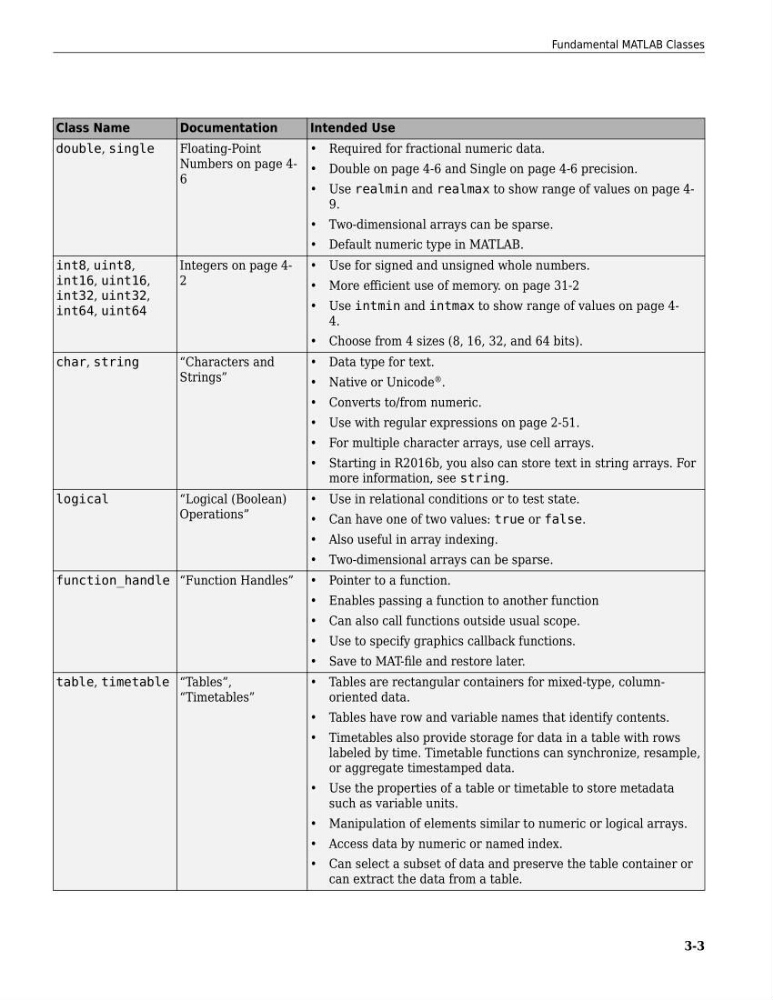
Class Name
Documentation
Intended Use
double, single
Floating-Point
Numbers on page 46
• Required for fractional numeric data.
• Double on page 4-6 and Single on page 4-6 precision.
• Use realmin and realmax to show range of values on page 49.
• Two-dimensional arrays can be sparse.
• Default numeric type in MATLAB.
int8, uint8,
int16, uint16,
int32, uint32,
int64, uint64
Integers on page 42
• Use for signed and unsigned whole numbers.
• More efficient use of memory. on page 31-2
• Use intmin and intmax to show range of values on page 44.
• Choose from 4 sizes (8, 16, 32, and 64 bits).
char, string
“Characters and
Strings”
• Data type for text.
• Native or Unicode
®
.
• Converts to/from numeric.
• Use with regular expressions on page 2-51.
• For multiple character arrays, use cell arrays.
• Starting in R2016b, you also can store text in string arrays. For
more information, see string.
logical
“Logical (Boolean)
Operations”
• Use in relational conditions or to test state.
• Can have one of two values: true or false.
• Also useful in array indexing.
• Two-dimensional arrays can be sparse.
function_handle “Function Handles” • Pointer to a function.
• Enables passing a function to another function
• Can also call functions outside usual scope.
• Use to specify graphics callback functions.
• Save to MAT-file and restore later.
table, timetable “Tables”,
“Timetables”
• Tables are rectangular containers for mixed-type, columnoriented data.
• Tables have row and variable names that identify contents.
• Timetables also provide storage for data in a table with rows
labeled by time. Timetable functions can synchronize, resample,
or aggregate timestamped data.
• Use the properties of a table or timetable to store metadata
such as variable units.
• Manipulation of elements similar to numeric or logical arrays.
• Access data by numeric or named index.
• Can select a subset of data and preserve the table container or
can extract the data from a table.
Fundamental MATLAB Classes
3-3
Documentation
Intended Use
double, single
Floating-Point
Numbers on page 46
• Required for fractional numeric data.
• Double on page 4-6 and Single on page 4-6 precision.
• Use realmin and realmax to show range of values on page 49.
• Two-dimensional arrays can be sparse.
• Default numeric type in MATLAB.
int8, uint8,
int16, uint16,
int32, uint32,
int64, uint64
Integers on page 42
• Use for signed and unsigned whole numbers.
• More efficient use of memory. on page 31-2
• Use intmin and intmax to show range of values on page 44.
• Choose from 4 sizes (8, 16, 32, and 64 bits).
char, string
“Characters and
Strings”
• Data type for text.
• Native or Unicode
®
.
• Converts to/from numeric.
• Use with regular expressions on page 2-51.
• For multiple character arrays, use cell arrays.
• Starting in R2016b, you also can store text in string arrays. For
more information, see string.
logical
“Logical (Boolean)
Operations”
• Use in relational conditions or to test state.
• Can have one of two values: true or false.
• Also useful in array indexing.
• Two-dimensional arrays can be sparse.
function_handle “Function Handles” • Pointer to a function.
• Enables passing a function to another function
• Can also call functions outside usual scope.
• Use to specify graphics callback functions.
• Save to MAT-file and restore later.
table, timetable “Tables”,
“Timetables”
• Tables are rectangular containers for mixed-type, columnoriented data.
• Tables have row and variable names that identify contents.
• Timetables also provide storage for data in a table with rows
labeled by time. Timetable functions can synchronize, resample,
or aggregate timestamped data.
• Use the properties of a table or timetable to store metadata
such as variable units.
• Manipulation of elements similar to numeric or logical arrays.
• Access data by numeric or named index.
• Can select a subset of data and preserve the table container or
can extract the data from a table.
Fundamental MATLAB Classes
3-3