

Fundamental MATLAB Classes
There are many different data types, or classes, that you can work with in MATLAB. You can build
matrices and arrays of floating-point and integer data, characters and strings, logical true and
false values, and so on. Function handles connect your code with any MATLAB function regardless
of the current scope. Tables, timetables, structures, and cell arrays provide a way to store dissimilar
types of data in the same container.
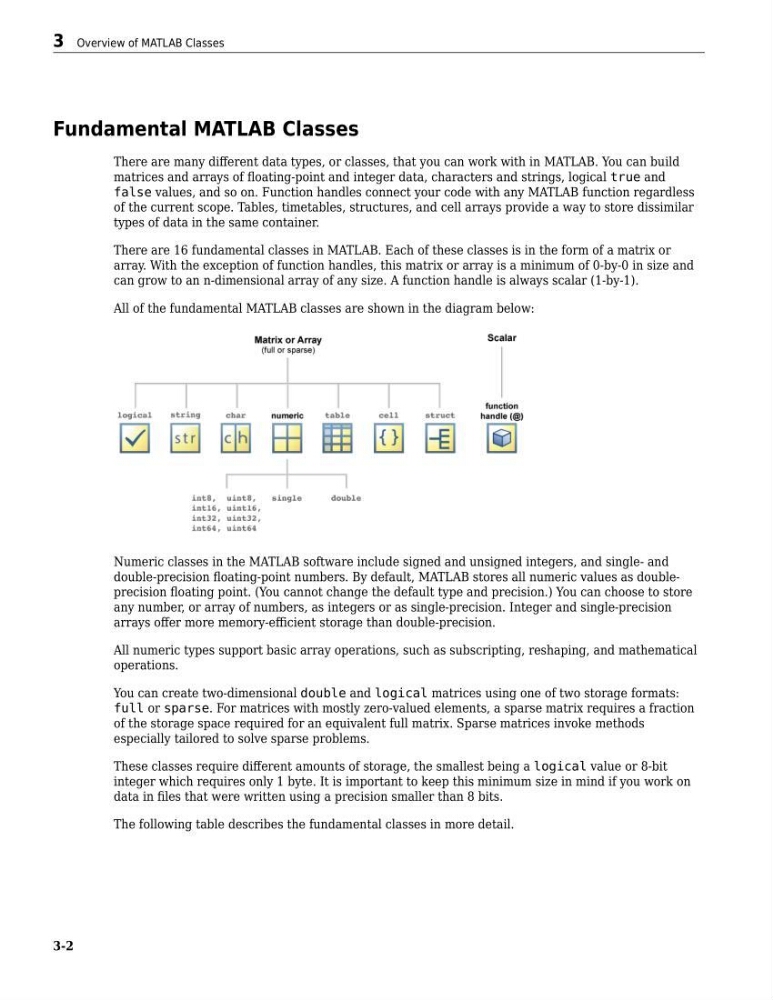
There are 16 fundamental classes in MATLAB. Each of these classes is in the form of a matrix or
array. With the exception of function handles, this matrix or array is a minimum of 0-by-0 in size and
can grow to an n-dimensional array of any size. A function handle is always scalar (1-by-1).
All of the fundamental MATLAB classes are shown in the diagram below:
Numeric classes in the MATLAB software include signed and unsigned integers, and single- and
double-precision floating-point numbers. By default, MATLAB stores all numeric values as doubleprecision floating point. (You cannot change the default type and precision.) You can choose to store
any number, or array of numbers, as integers or as single-precision. Integer and single-precision
arrays offer more memory-efficient storage than double-precision.
All numeric types support basic array operations, such as subscripting, reshaping, and mathematical
operations.
You can create two-dimensional double and logical matrices using one of two storage formats:
full or sparse. For matrices with mostly zero-valued elements, a sparse matrix requires a fraction
of the storage space required for an equivalent full matrix. Sparse matrices invoke methods
especially tailored to solve sparse problems.
These classes require different amounts of storage, the smallest being a logical value or 8-bit
integer which requires only 1 byte. It is important to keep this minimum size in mind if you work on
data in files that were written using a precision smaller than 8 bits.
The following table describes the fundamental classes in more detail.
3 Overview of MATLAB Classes
3-2
There are many different data types, or classes, that you can work with in MATLAB. You can build
matrices and arrays of floating-point and integer data, characters and strings, logical true and
false values, and so on. Function handles connect your code with any MATLAB function regardless
of the current scope. Tables, timetables, structures, and cell arrays provide a way to store dissimilar
types of data in the same container.
There are 16 fundamental classes in MATLAB. Each of these classes is in the form of a matrix or
array. With the exception of function handles, this matrix or array is a minimum of 0-by-0 in size and
can grow to an n-dimensional array of any size. A function handle is always scalar (1-by-1).
All of the fundamental MATLAB classes are shown in the diagram below:
Numeric classes in the MATLAB software include signed and unsigned integers, and single- and
double-precision floating-point numbers. By default, MATLAB stores all numeric values as doubleprecision floating point. (You cannot change the default type and precision.) You can choose to store
any number, or array of numbers, as integers or as single-precision. Integer and single-precision
arrays offer more memory-efficient storage than double-precision.
All numeric types support basic array operations, such as subscripting, reshaping, and mathematical
operations.
You can create two-dimensional double and logical matrices using one of two storage formats:
full or sparse. For matrices with mostly zero-valued elements, a sparse matrix requires a fraction
of the storage space required for an equivalent full matrix. Sparse matrices invoke methods
especially tailored to solve sparse problems.
These classes require different amounts of storage, the smallest being a logical value or 8-bit
integer which requires only 1 byte. It is important to keep this minimum size in mind if you work on
data in files that were written using a precision smaller than 8 bits.
The following table describes the fundamental classes in more detail.
3 Overview of MATLAB Classes
3-2