

function y = fftshift(x)
numDims = ndims(x);
idx = cell(1,numDims);
for k = 1:numDims
m = size(x,k);
p = ceil(m/2);
idx{k} = [p+1:m 1:p];
end
y = x(idx{:});
end
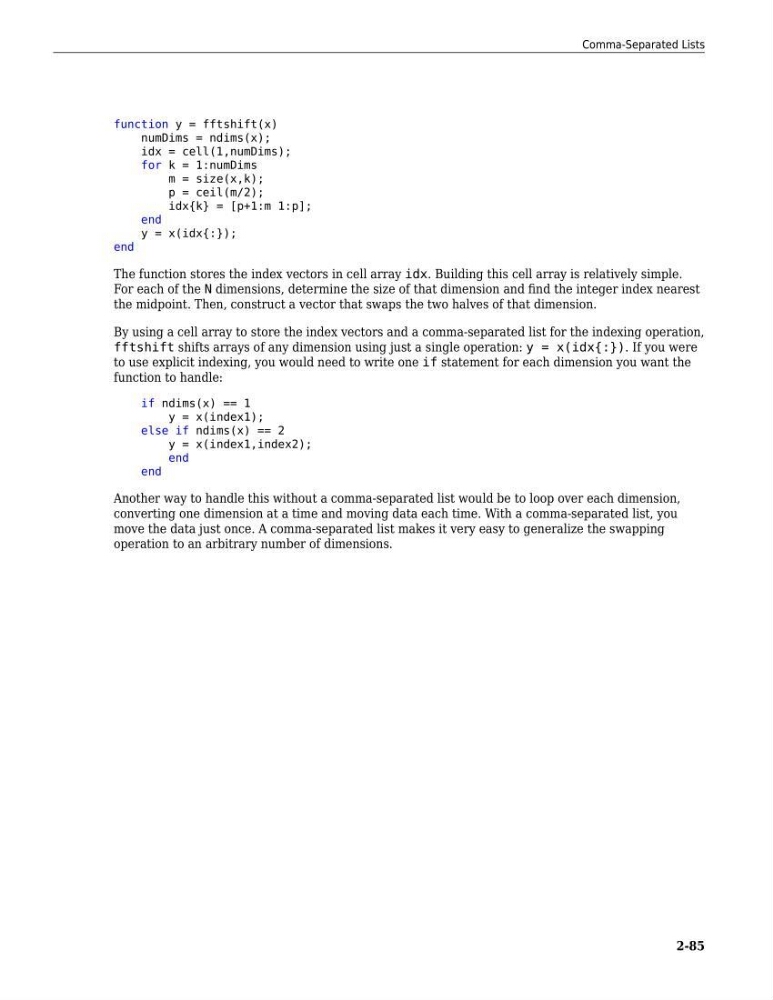
The function stores the index vectors in cell array idx. Building this cell array is relatively simple.
For each of the N dimensions, determine the size of that dimension and find the integer index nearest
the midpoint. Then, construct a vector that swaps the two halves of that dimension.
By using a cell array to store the index vectors and a comma-separated list for the indexing operation,
fftshift shifts arrays of any dimension using just a single operation: y = x(idx{:}). If you were
to use explicit indexing, you would need to write one if statement for each dimension you want the
function to handle:
if ndims(x) == 1
y = x(index1);
else if ndims(x) == 2
y = x(index1,index2);
end
end
Another way to handle this without a comma-separated list would be to loop over each dimension,
converting one dimension at a time and moving data each time. With a comma-separated list, you
move the data just once. A comma-separated list makes it very easy to generalize the swapping
operation to an arbitrary number of dimensions.
Comma-Separated Lists
2-85
numDims = ndims(x);
idx = cell(1,numDims);
for k = 1:numDims
m = size(x,k);
p = ceil(m/2);
idx{k} = [p+1:m 1:p];
end
y = x(idx{:});
end
The function stores the index vectors in cell array idx. Building this cell array is relatively simple.
For each of the N dimensions, determine the size of that dimension and find the integer index nearest
the midpoint. Then, construct a vector that swaps the two halves of that dimension.
By using a cell array to store the index vectors and a comma-separated list for the indexing operation,
fftshift shifts arrays of any dimension using just a single operation: y = x(idx{:}). If you were
to use explicit indexing, you would need to write one if statement for each dimension you want the
function to handle:
if ndims(x) == 1
y = x(index1);
else if ndims(x) == 2
y = x(index1,index2);
end
end
Another way to handle this without a comma-separated list would be to loop over each dimension,
converting one dimension at a time and moving data each time. With a comma-separated list, you
move the data just once. A comma-separated list makes it very easy to generalize the swapping
operation to an arbitrary number of dimensions.
Comma-Separated Lists
2-85