

[mat,tok] = regexp(hstr, expr, 'match', 'tokens');
mat{:}
ans =
''
ans =
'Default'
tok{:}
ans =
1×1 cell array
{'a'}
ans =
1×1 cell array
{'b'}
Multiple Tokens
Here is an example of how tokens are assigned values. Suppose that you are going to search the
following text:
andy ted bob jim andrew andy ted mark
You choose to search the above text with the following search pattern:
and(y|rew)|(t)e(d)
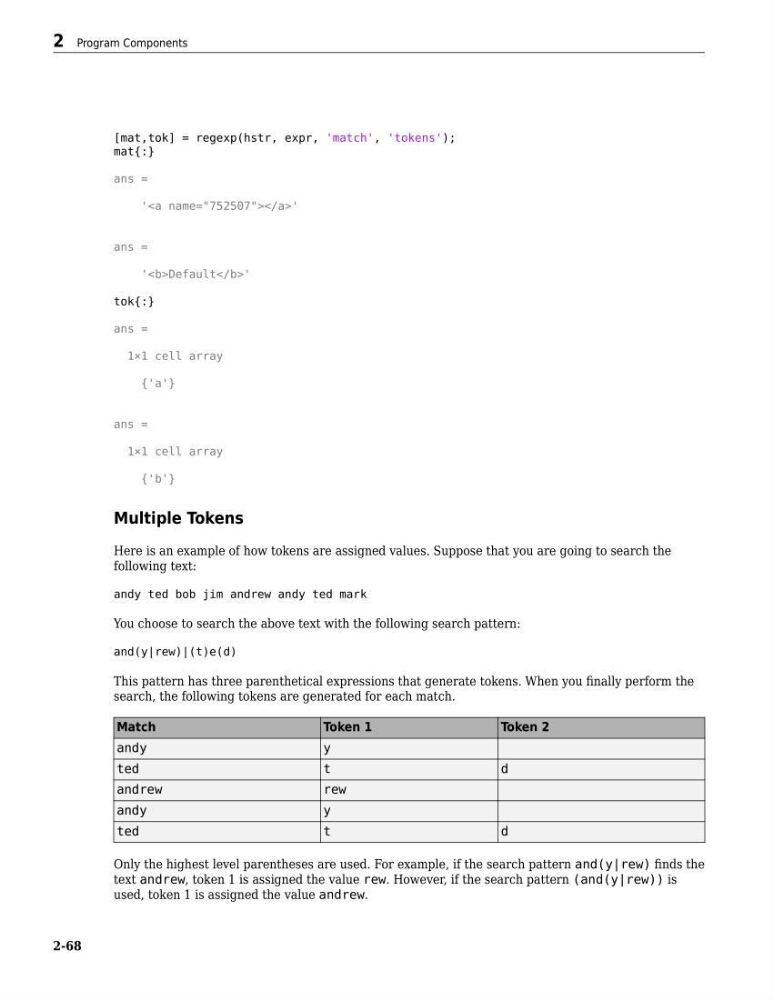
This pattern has three parenthetical expressions that generate tokens. When you finally perform the
search, the following tokens are generated for each match.
Match
Token 1
Token 2
andy
y
ted
t
d
andrew
rew
andy
y
ted
t
d
Only the highest level parentheses are used. For example, if the search pattern and(y|rew) finds the
text andrew, token 1 is assigned the value rew. However, if the search pattern (and(y|rew)) is
used, token 1 is assigned the value andrew.
2 Program Components
2-68
mat{:}
ans =
''
ans =
'Default'
tok{:}
ans =
1×1 cell array
{'a'}
ans =
1×1 cell array
{'b'}
Multiple Tokens
Here is an example of how tokens are assigned values. Suppose that you are going to search the
following text:
andy ted bob jim andrew andy ted mark
You choose to search the above text with the following search pattern:
and(y|rew)|(t)e(d)
This pattern has three parenthetical expressions that generate tokens. When you finally perform the
search, the following tokens are generated for each match.
Match
Token 1
Token 2
andy
y
ted
t
d
andrew
rew
andy
y
ted
t
d
Only the highest level parentheses are used. For example, if the search pattern and(y|rew) finds the
text andrew, token 1 is assigned the value rew. However, if the search pattern (and(y|rew)) is
used, token 1 is assigned the value andrew.
2 Program Components
2-68