

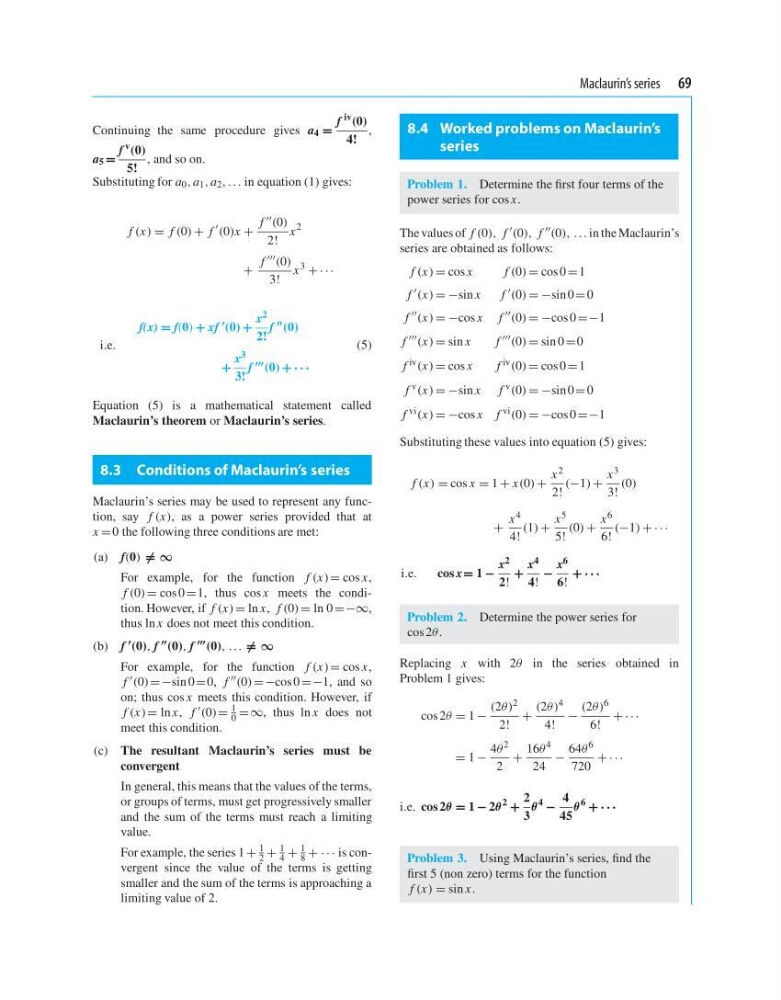
Maclaurin’ s series 69
Continuing the same procedure gives a 4 =
f
iv (0)
4!
,
a 5 =
f
v (0)
5!
, and so on.
Substituting for a 0 , a 1 , a 2 , ... in equation (1) gives:
f (x) = f (0) + f
(0)x +
f (0)
2!
x
2
+
f (0)
3!
x
3
+ · · ·
i.e.
f(x) = f(0) + xf (0) +
x 2
2!
f (0)
+
x 3
3!
f (0) + · · ·
(5)
Equation (5) is a mathematical statement called
Maclaurin’s theorem or Maclaurin’s series.
8.3 Conditions of Maclaurin’s series
Maclaurin’s series may be used to represent any function, say f (x), as a power series provided that at
x = 0 the following three conditions are met:
(a) f(0) = ∞
For example, for the function f (x) = cos x,
f (0) = cos 0 =1, thus cos x meets the condition. However, if f (x) = ln x, f (0) = ln 0 =−∞,
thus ln x does not meet this condition.
(b) f (0), f (0), f (0), ... = ∞
For example, for the function f (x) = cos x,
f (0) = −sin 0 =0, f (0) = −cos 0 =−1, and so
on; thus cos x meets this condition. However, if
f (x) = ln x, f (0) =
1
0 =∞, thus ln x does not
meet this condition.
(c) The resultant Maclaurin’s series must be
convergent
In general, this means that the values of the terms,
or groups of terms, must get progressively smaller
and the sum of the terms must reach a limiting
value.
For example, the series 1 +
1
2 +
1
4 +
1
8 + · · · is convergent since the value of the terms is getting
smaller and the sum of the terms is approaching a
limiting value of 2.
8.4 Worked problems on Maclaurin’s
series
Problem 1. Determine the first four terms of the
power series for cos x.
The values of f (0), f (0), f (0), ... in the Maclaurin’s
series are obtained as follows:
f (x) = cos x
f(0) = cos 0 = 1
f (x) = −sin x
f (0) = −sin 0 = 0
f
(x) = −cos x f
(0) = −cos 0 =−1
f (x) = sin x
f (0) = sin 0 =0
f iv (x) = cos x
f iv (0) = cos 0 = 1
f v (x) = −sin x f v (0) = −sin 0 = 0
f vi (x) = −cos x f vi (0) = −cos 0 =−1
Substituting these values into equation (5) gives:
f (x) = cos x = 1 + x(0) +
x 2
2!
(−1) +
x 3
3!
(0)
+
x 4
4!
(1) +
x 5
5!
(0) +
x 6
6!
(−1) + · · ·
i.e.
cos x = 1 −
x 2
2!
+
x 4
4!
−
x 6
6!
+ · · ·
Problem 2. Determine the power series for
cos 2θ.
Replacing x with 2θ in the series obtained in
Problem 1 gives:
cos 2θ = 1 −
(2θ) 2
2!
+
(2θ) 4
4!
−
(2θ) 6
6!
+ · · ·
= 1 −
4θ
2
2
+
16θ
4
24
−
64θ
6
720
+ · · ·
i.e. cos 2θ = 1 − 2θ
2
+
2
3
θ
4
−
4
45
θ
6
+ · · ·
Problem 3. Using Maclaurin’s series, find the
first 5 (non zero) terms for the function
f (x) = sin x.
Continuing the same procedure gives a 4 =
f
iv (0)
4!
,
a 5 =
f
v (0)
5!
, and so on.
Substituting for a 0 , a 1 , a 2 , ... in equation (1) gives:
f (x) = f (0) + f
(0)x +
f (0)
2!
x
2
+
f (0)
3!
x
3
+ · · ·
i.e.
f(x) = f(0) + xf (0) +
x 2
2!
f (0)
+
x 3
3!
f (0) + · · ·
(5)
Equation (5) is a mathematical statement called
Maclaurin’s theorem or Maclaurin’s series.
8.3 Conditions of Maclaurin’s series
Maclaurin’s series may be used to represent any function, say f (x), as a power series provided that at
x = 0 the following three conditions are met:
(a) f(0) = ∞
For example, for the function f (x) = cos x,
f (0) = cos 0 =1, thus cos x meets the condition. However, if f (x) = ln x, f (0) = ln 0 =−∞,
thus ln x does not meet this condition.
(b) f (0), f (0), f (0), ... = ∞
For example, for the function f (x) = cos x,
f (0) = −sin 0 =0, f (0) = −cos 0 =−1, and so
on; thus cos x meets this condition. However, if
f (x) = ln x, f (0) =
1
0 =∞, thus ln x does not
meet this condition.
(c) The resultant Maclaurin’s series must be
convergent
In general, this means that the values of the terms,
or groups of terms, must get progressively smaller
and the sum of the terms must reach a limiting
value.
For example, the series 1 +
1
2 +
1
4 +
1
8 + · · · is convergent since the value of the terms is getting
smaller and the sum of the terms is approaching a
limiting value of 2.
8.4 Worked problems on Maclaurin’s
series
Problem 1. Determine the first four terms of the
power series for cos x.
The values of f (0), f (0), f (0), ... in the Maclaurin’s
series are obtained as follows:
f (x) = cos x
f(0) = cos 0 = 1
f (x) = −sin x
f (0) = −sin 0 = 0
f
(x) = −cos x f
(0) = −cos 0 =−1
f (x) = sin x
f (0) = sin 0 =0
f iv (x) = cos x
f iv (0) = cos 0 = 1
f v (x) = −sin x f v (0) = −sin 0 = 0
f vi (x) = −cos x f vi (0) = −cos 0 =−1
Substituting these values into equation (5) gives:
f (x) = cos x = 1 + x(0) +
x 2
2!
(−1) +
x 3
3!
(0)
+
x 4
4!
(1) +
x 5
5!
(0) +
x 6
6!
(−1) + · · ·
i.e.
cos x = 1 −
x 2
2!
+
x 4
4!
−
x 6
6!
+ · · ·
Problem 2. Determine the power series for
cos 2θ.
Replacing x with 2θ in the series obtained in
Problem 1 gives:
cos 2θ = 1 −
(2θ) 2
2!
+
(2θ) 4
4!
−
(2θ) 6
6!
+ · · ·
= 1 −
4θ
2
2
+
16θ
4
24
−
64θ
6
720
+ · · ·
i.e. cos 2θ = 1 − 2θ
2
+
2
3
θ
4
−
4
45
θ
6
+ · · ·
Problem 3. Using Maclaurin’s series, find the
first 5 (non zero) terms for the function
f (x) = sin x.