

Essential formulae 661
Triangle formulae:
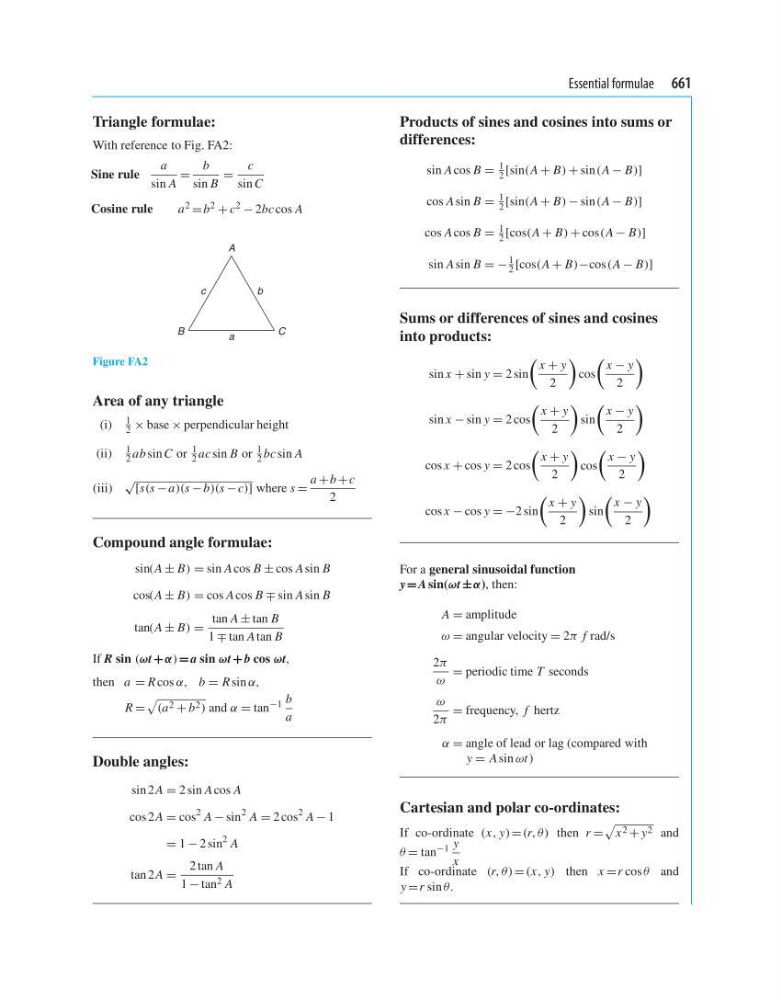
With reference to Fig. FA2:
Sine rule
a
sin A
=
b
sin B
=
c
sin C
Cosine rule
a 2 = b 2 + c 2 − 2bc cos A
A
B
C
c
a
b
Figure FA2
Area of any triangle
(i)
1
2 × base × perpendicular height
(ii)
1
2 ab sin C or
1
2 ac sin B or
1
2 bc sin A
(iii)
√
[s(s − a)(s − b)(s − c)] where s =
a + b + c
2
Compound angle formulae:
sin(A ± B) = sin A cos B ± cos A sin B
cos(A ± B) = cos A cos B ∓ sin A sin B
tan(A ± B) =
tan A ± tan B
1 ∓ tan A tan B
If R sin (ωt + α) = a sin ωt +b cos ωt,
then a = R cos α, b = R sin α,
R =
(a 2 + b 2 ) and α = tan −1 b
a
Double angles:
sin 2 A = 2 sin A cos A
cos 2 A = cos
2 A − sin
2 A = 2 cos
2 A − 1
= 1 − 2 sin
2 A
tan 2 A =
2 tan A
1 − tan 2 A
Products of sines and cosines into sums or
differences:
sin A cos B =
1
2 [sin(A + B) + sin(A − B)]
cos A sin B =
1
2 [sin(A + B) − sin(A − B)]
cos A cos B =
1
2 [cos(A + B) + cos(A − B)]
sin A sin B = −
1
2 [cos(A + B)−cos(A − B)]
Sums or differences of sines and cosines
into products:
sin x + sin y = 2 sin
x + y
2
cos
x − y
2
sin x − sin y = 2 cos
x + y
2
sin
x − y
2
cos x + cos y = 2 cos
x + y
2
cos
x − y
2
cos x − cos y = −2 sin
x + y
2
sin
x − y
2
For a general sinusoidal function
y = A sin(ωt ±α), then:
A = amplitude
ω = angular velocity = 2π f rad/s
2π
ω
= periodic time T seconds
ω
2π
= frequency, f hertz
α = angle of lead or lag (compared with
y = A sin ωt )
Cartesian and polar co-ordinates:
If co-ordinate (x, y) = (r, θ) then r =
x 2 + y 2 and
θ = tan −1 y
x
If co-ordinate (r, θ)= (x, y) then x =r cos θ and
y =r sin θ.