

660 Higher Engineering Mathematics
Arithmetic progression:
If a = first term and d = common difference, then the
arithmetic progression is: a, a + d, a + 2d, ...
The n’th term is: a + (n − 1)d
Sum of n terms, S n =
n
2
[2a + (n −1)d]
Geometric progression:
If a = first term and r = common ratio, then the geometric progression is: a, ar, ar
2 , ...
The n’th term is: ar n−1
Sum of n terms, S n =
a(1 −r n )
(1 −r)
or
a(r n − 1)
(r − 1)
If −1
(1 −r)
Binomial series:
(a + b)
n
= a
n
+ na
n−1 b +
n(n − 1)
2!
a
n−2 b
2
+
n(n − 1)(n − 2)
3!
a
n−3 b
3
+ · · ·
(1 + x)
n
= 1 + nx +
n(n − 1)
2!
x
2
+
n(n − 1)(n − 2)
3!
x
3
+ · · ·
Maclaurin’s series:
f (x) = f (0) + x f
(0) +
x 2
2!
f
(0)
+
x 3
3!
f
(0) + · · ·
Newton Raphson iterative method:
If r 1 is the approximate value for a real root of the equation f (x) = 0, then a closer approximation to the root,
r 2 , is given by:
r 2 = r 1 −
f (r 1 )
f (r 1 )
Boolean algebra:
Laws and rules of Boolean algebra
Commutative Laws: A + B = B + A
A · B = B · A
Associative Laws:
A + B + C = (A + B) + C
A · B · C = (A · B) · C
Distributive Laws: A · (B + C) = A · B + A · C
A + (B · C) = (A + B) · (A+C)
Sum rules:
A + A = 1
A + 1 = 1
A + 0 = A
A + A = A
Product rules:
A · A = 0
A · 0 = 0
A · 1 = A
A · A = A
Absorption rules:
A + A · B = A
A · (A + B) = A
A + A · B = A + B
De Morgan’s Laws:
A + B = A · B
A · B = A + B
Geometry and Trigonometry
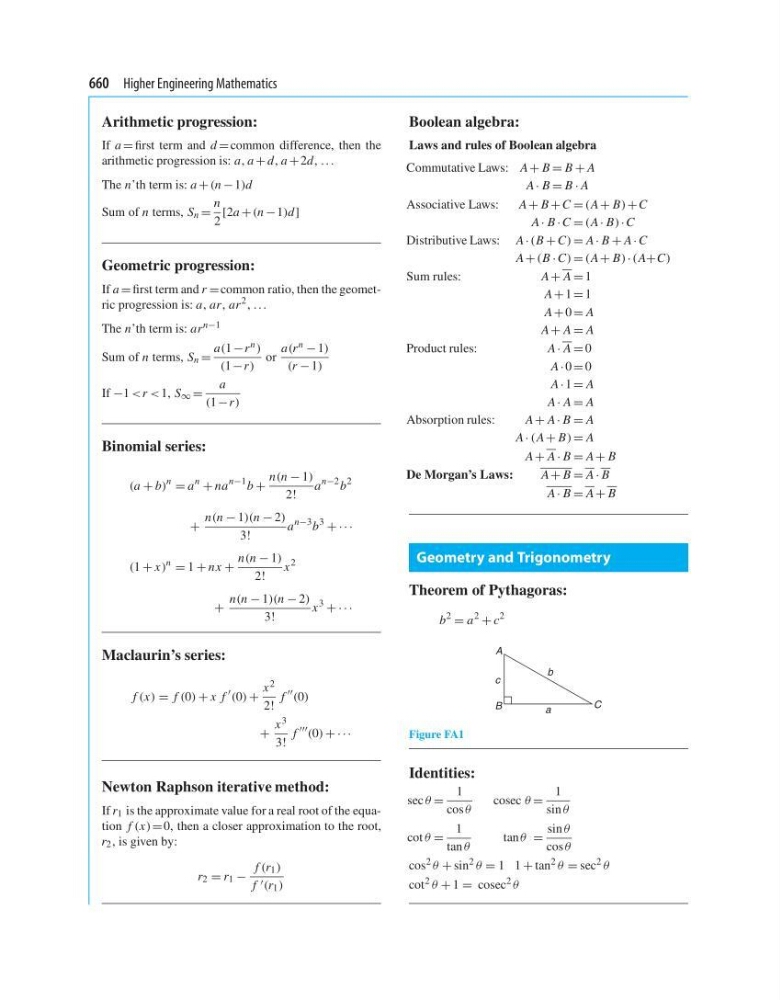
Theorem of Pythagoras:
b
2
= a
2
+ c
2
A
B
C
c
b
a
Figure FA1
Identities:
sec θ =
1
cos θ
cosec θ =
1
sin θ
cot θ =
1
tan θ
tan θ =
sin θ
cos θ
cos 2 θ + sin 2 θ = 1 1+ tan 2 θ = sec 2 θ
cot 2 θ + 1 = cosec 2 θ