

656 Higher Engineering Mathematics
ϭ 2 rad/s
ϭ 2 rad/s
Real axis
Imaginary axis
0
2 4
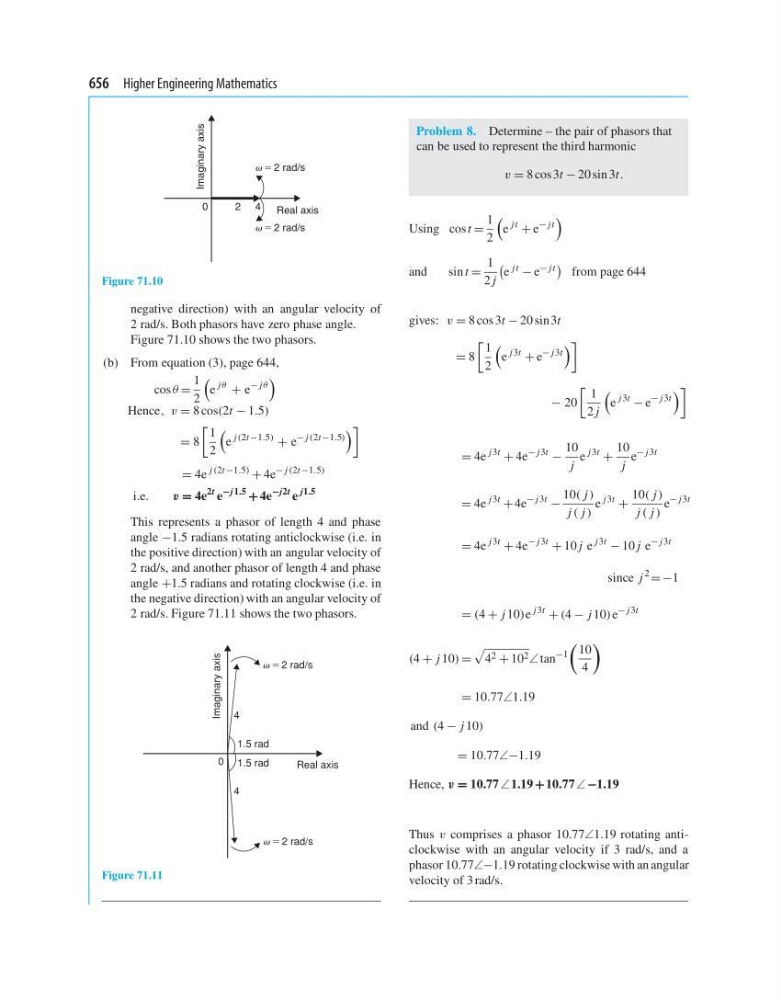
Figure 71.10
negative direction) with an angular velocity of
2 rad/s. Both phasors have zero phase angle.
Figure 71.10 shows the two phasors.
(b) From equation (3), page 644,
cos θ =
1
2
e
j θ
+ e
− j θ
Hence, v = 8 cos(2t − 1.5)
= 8
1
2
e
j (2t −1.5)
+ e
− j (2t −1.5)
= 4e
j (2t −1.5)
+ 4e
− j (2t −1.5)
i.e.
v = 4e
2t e
−j 1.5
+ 4e
−j2t e
j1.5
This represents a phasor of length 4 and phase
angle −1.5 radians rotating anticlockwise (i.e. in
the positive direction) with an angular velocity of
2 rad/s, and another phasor of length 4 and phase
angle +1.5 radians and rotating clockwise (i.e. in
the negative direction) with an angular velocity of
2 rad/s. Figure 71.11 shows the two phasors.
Real axis
4
4
Imaginary axis
0
5 2 rad/s
5 2 rad/s
1.5 rad
1.5 rad
Figure 71.11
Problem 8. Determine – the pair of phasors that
can be used to represent the third harmonic
v = 8 cos3t − 20 sin 3t.
Using cos t =
1
2
e
jt
+ e
− jt
and
sin t =
1
2 j
e jt − e − jt
from page 644
gives: v = 8 cos 3t − 20 sin 3t
= 8
1
2
e
j 3t
+ e
− j 3t
− 20
1
2 j
e
j 3t
− e
− j 3t
= 4e
j 3t
+ 4e
− j 3t
−
10
j
e
j 3t
+
10
j
e
− j 3t
= 4e
j 3t
+ 4e
− j 3t
−
10( j )
j ( j )
e
j 3t
+
10( j )
j ( j )
e
− j 3t
= 4e
j 3t
+ 4e
− j 3t
+ 10 j e
j 3t
− 10 j e
− j 3t
since j
2
=−1
= (4 + j 10)e
j 3t
+ (4 − j 10) e
− j 3t
(4 + j 10) =
4 2 + 10 2 ∠ tan
−1
10
4
= 10.77∠1.19
and (4 − j 10)
= 10.77∠−1.19
Hence, v = 10.77 ∠1.19 +10.77 ∠ −1.19
Thus v comprises a phasor 10.77∠1.19 rotating anticlockwise with an angular velocity if 3 rad/s, and a
phasor 10.77∠−1.19 rotating clockwise with an angular
velocity of 3 rad/s.
ϭ 2 rad/s
ϭ 2 rad/s
Real axis
Imaginary axis
0
2 4
Figure 71.10
negative direction) with an angular velocity of
2 rad/s. Both phasors have zero phase angle.
Figure 71.10 shows the two phasors.
(b) From equation (3), page 644,
cos θ =
1
2
e
j θ
+ e
− j θ
Hence, v = 8 cos(2t − 1.5)
= 8
1
2
e
j (2t −1.5)
+ e
− j (2t −1.5)
= 4e
j (2t −1.5)
+ 4e
− j (2t −1.5)
i.e.
v = 4e
2t e
−j 1.5
+ 4e
−j2t e
j1.5
This represents a phasor of length 4 and phase
angle −1.5 radians rotating anticlockwise (i.e. in
the positive direction) with an angular velocity of
2 rad/s, and another phasor of length 4 and phase
angle +1.5 radians and rotating clockwise (i.e. in
the negative direction) with an angular velocity of
2 rad/s. Figure 71.11 shows the two phasors.
Real axis
4
4
Imaginary axis
0
5 2 rad/s
5 2 rad/s
1.5 rad
1.5 rad
Figure 71.11
Problem 8. Determine – the pair of phasors that
can be used to represent the third harmonic
v = 8 cos3t − 20 sin 3t.
Using cos t =
1
2
e
jt
+ e
− jt
and
sin t =
1
2 j
e jt − e − jt
from page 644
gives: v = 8 cos 3t − 20 sin 3t
= 8
1
2
e
j 3t
+ e
− j 3t
− 20
1
2 j
e
j 3t
− e
− j 3t
= 4e
j 3t
+ 4e
− j 3t
−
10
j
e
j 3t
+
10
j
e
− j 3t
= 4e
j 3t
+ 4e
− j 3t
−
10( j )
j ( j )
e
j 3t
+
10( j )
j ( j )
e
− j 3t
= 4e
j 3t
+ 4e
− j 3t
+ 10 j e
j 3t
− 10 j e
− j 3t
since j
2
=−1
= (4 + j 10)e
j 3t
+ (4 − j 10) e
− j 3t
(4 + j 10) =
4 2 + 10 2 ∠ tan
−1
10
4
= 10.77∠1.19
and (4 − j 10)
= 10.77∠−1.19
Hence, v = 10.77 ∠1.19 +10.77 ∠ −1.19
Thus v comprises a phasor 10.77∠1.19 rotating anticlockwise with an angular velocity if 3 rad/s, and a
phasor 10.77∠−1.19 rotating clockwise with an angular
velocity of 3 rad/s.