

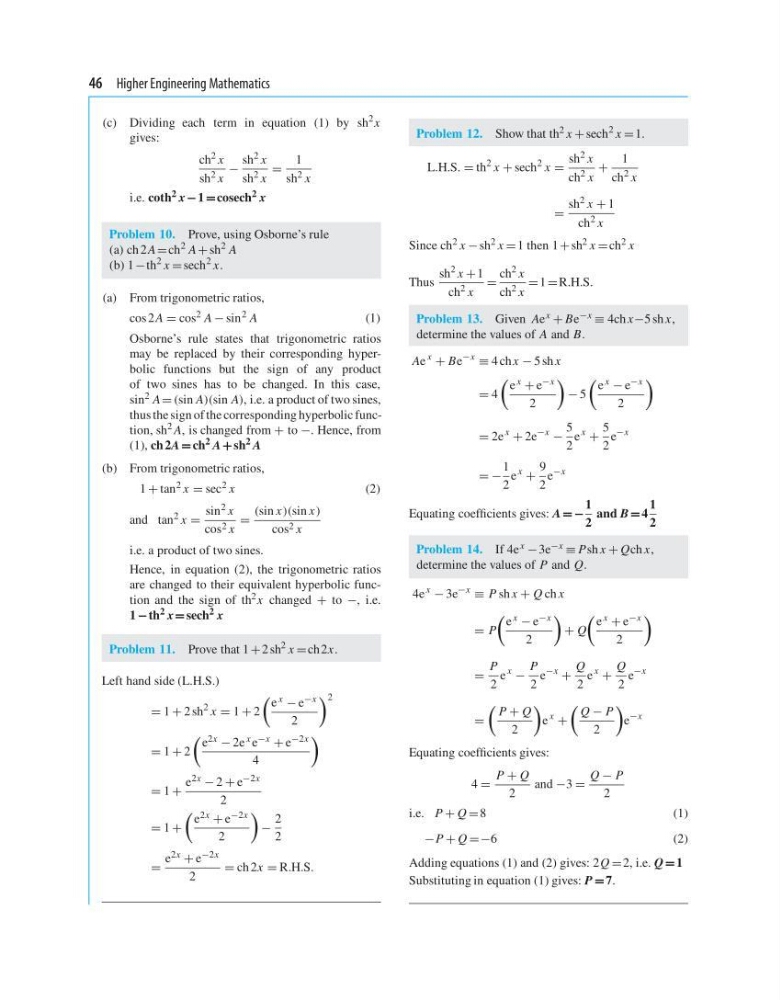
46 Higher Engineering Mathematics
(c) Dividing each term in equation (1) by sh
2 x
gives:
ch
2 x
sh 2 x
−
sh
2 x
sh 2 x
=
1
sh 2 x
i.e. coth 2 x − 1 =cosech 2 x
Problem 10. Prove, using Osborne’s rule
(a) ch 2 A = ch
2 A + sh
2 A
(b) 1 −th
2 x = sech
2 x.
(a) From trigonometric ratios,
cos 2 A = cos 2 A − sin 2 A
(1)
Osborne’s rule states that trigonometric ratios
may be replaced by their corresponding hyperbolic functions but the sign of any product
of two sines has to be changed. In this case,
sin 2 A = (sin A)(sin A), i.e. a product of two sines,
thus the sign of the corresponding hyperbolic function, sh
2 A, is changed from + to −. Hence, from
(1), ch 2A = ch 2 A + sh 2 A
(b) From trigonometric ratios,
1 + tan 2 x = sec 2 x
(2)
and tan 2 x =
sin 2 x
cos 2 x
=
(sin x)(sin x)
cos 2 x
i.e. a product of two sines.
Hence, in equation (2), the trigonometric ratios
are changed to their equivalent hyperbolic function and the sign of th 2 x changed + to −, i.e.
1 −th 2 x = sech 2 x
Problem 11. Prove that 1 + 2 sh
2 x = ch 2x.
Left hand side (L.H.S.)
= 1 + 2 sh
2 x = 1 + 2
e x − e −x
2
2
= 1 + 2
e 2x − 2e x e −x + e −2x
4
= 1 +
e 2x − 2 + e −2x
2
= 1 +
e 2x + e −2x
2
−
2
2
=
e 2x + e −2x
2
= ch 2x = R.H.S.
Problem 12. Show that th 2 x + sech
2 x = 1.
L.H.S. = th
2 x + sech
2 x =
sh 2 x
ch
2 x
+
1
ch
2 x
=
sh 2 x + 1
ch 2 x
Since ch 2 x − sh 2 x = 1 then 1 + sh 2 x = ch 2 x
Thus
sh
2 x + 1
ch 2 x
=
ch
2 x
ch 2 x
= 1 = R.H.S.
Problem 13. Given Ae x + Be −x ≡ 4ch x−5 sh x,
determine the values of A and B.
Ae
x
+ Be
−x
≡ 4 ch x − 5 sh x
= 4
e x + e −x
2
− 5
e x − e −x
2
= 2e
x
+ 2e
−x
−
5
2
e
x
+
5
2
e
−x
= −
1
2
e
x
+
9
2
e
−x
Equating coefficients gives: A =−
1
2
and B = 4
1
2
Problem 14. If 4e x − 3e −x ≡ Psh x + Qch x,
determine the values of P and Q.
4e
x
− 3e
−x
≡ P sh x + Q ch x
= P
e x − e −x
2
+ Q
e x + e −x
2
=
P
2
e
x
−
P
2
e
−x
+
Q
2
e
x
+
Q
2
e
−x
=
P + Q
2
e
x
+
Q − P
2
e
−x
Equating coefficients gives:
4 =
P + Q
2
and −3 =
Q − P
2
i.e. P + Q = 8
( 1 )
−P + Q =−6
( 2 )
Adding equations (1) and (2) gives: 2Q = 2, i.e. Q = 1
Substituting in equation (1) gives: P = 7.
(c) Dividing each term in equation (1) by sh
2 x
gives:
ch
2 x
sh 2 x
−
sh
2 x
sh 2 x
=
1
sh 2 x
i.e. coth 2 x − 1 =cosech 2 x
Problem 10. Prove, using Osborne’s rule
(a) ch 2 A = ch
2 A + sh
2 A
(b) 1 −th
2 x = sech
2 x.
(a) From trigonometric ratios,
cos 2 A = cos 2 A − sin 2 A
(1)
Osborne’s rule states that trigonometric ratios
may be replaced by their corresponding hyperbolic functions but the sign of any product
of two sines has to be changed. In this case,
sin 2 A = (sin A)(sin A), i.e. a product of two sines,
thus the sign of the corresponding hyperbolic function, sh
2 A, is changed from + to −. Hence, from
(1), ch 2A = ch 2 A + sh 2 A
(b) From trigonometric ratios,
1 + tan 2 x = sec 2 x
(2)
and tan 2 x =
sin 2 x
cos 2 x
=
(sin x)(sin x)
cos 2 x
i.e. a product of two sines.
Hence, in equation (2), the trigonometric ratios
are changed to their equivalent hyperbolic function and the sign of th 2 x changed + to −, i.e.
1 −th 2 x = sech 2 x
Problem 11. Prove that 1 + 2 sh
2 x = ch 2x.
Left hand side (L.H.S.)
= 1 + 2 sh
2 x = 1 + 2
e x − e −x
2
2
= 1 + 2
e 2x − 2e x e −x + e −2x
4
= 1 +
e 2x − 2 + e −2x
2
= 1 +
e 2x + e −2x
2
−
2
2
=
e 2x + e −2x
2
= ch 2x = R.H.S.
Problem 12. Show that th 2 x + sech
2 x = 1.
L.H.S. = th
2 x + sech
2 x =
sh 2 x
ch
2 x
+
1
ch
2 x
=
sh 2 x + 1
ch 2 x
Since ch 2 x − sh 2 x = 1 then 1 + sh 2 x = ch 2 x
Thus
sh
2 x + 1
ch 2 x
=
ch
2 x
ch 2 x
= 1 = R.H.S.
Problem 13. Given Ae x + Be −x ≡ 4ch x−5 sh x,
determine the values of A and B.
Ae
x
+ Be
−x
≡ 4 ch x − 5 sh x
= 4
e x + e −x
2
− 5
e x − e −x
2
= 2e
x
+ 2e
−x
−
5
2
e
x
+
5
2
e
−x
= −
1
2
e
x
+
9
2
e
−x
Equating coefficients gives: A =−
1
2
and B = 4
1
2
Problem 14. If 4e x − 3e −x ≡ Psh x + Qch x,
determine the values of P and Q.
4e
x
− 3e
−x
≡ P sh x + Q ch x
= P
e x − e −x
2
+ Q
e x + e −x
2
=
P
2
e
x
−
P
2
e
−x
+
Q
2
e
x
+
Q
2
e
−x
=
P + Q
2
e
x
+
Q − P
2
e
−x
Equating coefficients gives:
4 =
P + Q
2
and −3 =
Q − P
2
i.e. P + Q = 8
( 1 )
−P + Q =−6
( 2 )
Adding equations (1) and (2) gives: 2Q = 2, i.e. Q = 1
Substituting in equation (1) gives: P = 7.