

Hyperbolic functions 45
5.3 Hyperbolic identities
For every trigonometric identity there is a corresponding hyperbolic identity. Hyperbolic identities may
be proved by either
(i) replacing sh x by
e x − e −x
2
and ch x by
e x + e −x
2
, or
(ii) by using Osborne’s rule, which states: ‘the six
trigonometric ratios used in trigonometrical identities relating general angles may be replaced by
their corresponding hyperbolic functions, but the
sign of any direct or implied product of two sines
must be changed’.
For example, since cos 2 x + sin 2 x = 1 then, by
Osborne’s rule, ch 2 x − sh 2 x = 1, i.e. the trigonometric functions have been changed to their corresponding
hyperbolic functions and since sin
2 x is a product of two
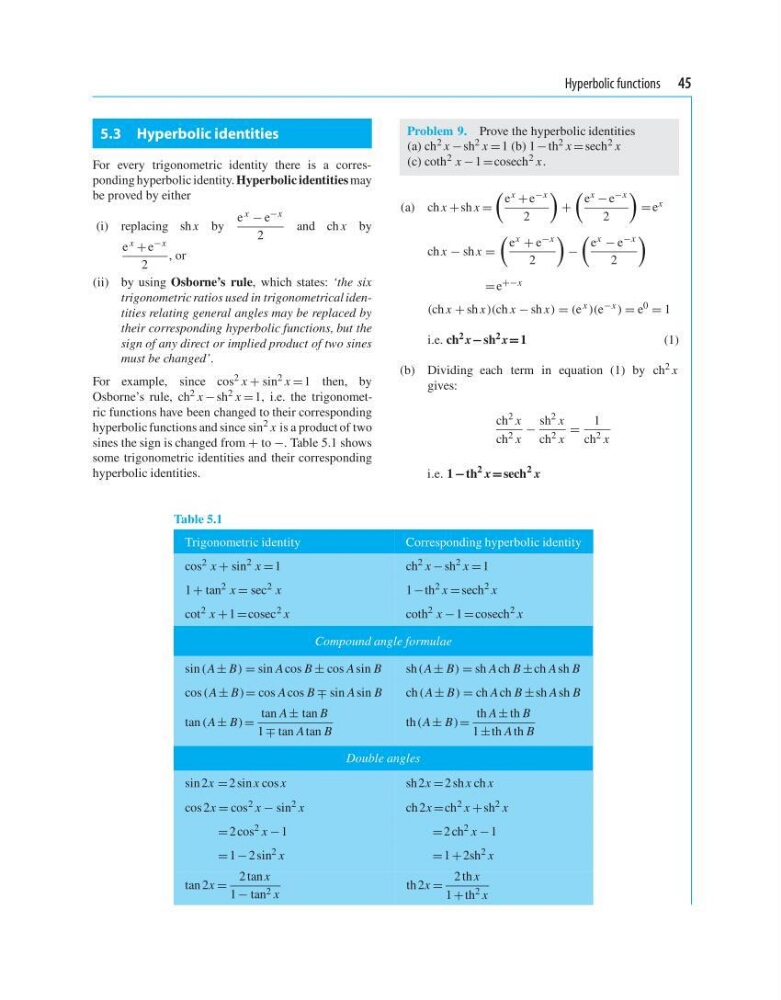
sines the sign is changed from + to −. Table 5.1 shows
some trigonometric identities and their corresponding
hyperbolic identities.
Problem 9. Prove the hyperbolic identities
(a) ch 2 x − sh 2 x = 1 (b) 1 − th 2 x = sech 2 x
(c) coth 2 x − 1 =cosech 2 x.
(a) ch x + sh x =
e x + e −x
2
+
e x − e −x
2
= e x
ch x − sh x =
e x + e −x
2
−
e x − e −x
2
= e +−x
(ch x + sh x)(ch x − sh x) = (e x )(e −x ) = e 0 = 1
i.e. ch 2 x − sh 2 x = 1
(1)
(b) Dividing each term in equation (1) by ch 2 x
gives:
ch
2 x
ch 2 x
−
sh
2 x
ch 2 x
=
1
ch 2 x
i.e. 1 −th
2 x = sech
2 x
Table 5.1
Trigonometric identity
Corresponding hyperbolic identity
cos 2 x + sin
2 x = 1
ch
2 x − sh
2 x = 1
1 + tan 2 x = sec 2 x
1 −th 2 x = sech
2 x
cot 2 x + 1 =cosec 2 x
coth
2 x − 1 = cosech
2 x
Compound angle formulae
sin (A ± B) = sin A cos B ± cos A sin B
sh (A ± B) = sh A ch B ± ch A sh B
cos (A ± B) = cos A cos B ∓ sin A sin B
ch (A ± B) = ch A ch B ± sh A sh B
tan (A ± B) =
tan A ± tan B
1 ∓ tan A tan B
th (A ± B) =
th A ± th B
1 ±th A th B
Double angles
sin 2x = 2 sin x cos x
sh 2x = 2 sh x ch x
cos 2x = cos 2 x − sin 2 x
ch 2x =ch 2 x + sh 2 x
= 2 cos 2 x − 1
= 2 ch 2 x − 1
= 1 − 2 sin 2 x
= 1 + 2sh 2 x
tan 2x =
2 tan x
1 − tan 2 x
th 2x =
2 th x
1 + th 2 x
5.3 Hyperbolic identities
For every trigonometric identity there is a corresponding hyperbolic identity. Hyperbolic identities may
be proved by either
(i) replacing sh x by
e x − e −x
2
and ch x by
e x + e −x
2
, or
(ii) by using Osborne’s rule, which states: ‘the six
trigonometric ratios used in trigonometrical identities relating general angles may be replaced by
their corresponding hyperbolic functions, but the
sign of any direct or implied product of two sines
must be changed’.
For example, since cos 2 x + sin 2 x = 1 then, by
Osborne’s rule, ch 2 x − sh 2 x = 1, i.e. the trigonometric functions have been changed to their corresponding
hyperbolic functions and since sin
2 x is a product of two
sines the sign is changed from + to −. Table 5.1 shows
some trigonometric identities and their corresponding
hyperbolic identities.
Problem 9. Prove the hyperbolic identities
(a) ch 2 x − sh 2 x = 1 (b) 1 − th 2 x = sech 2 x
(c) coth 2 x − 1 =cosech 2 x.
(a) ch x + sh x =
e x + e −x
2
+
e x − e −x
2
= e x
ch x − sh x =
e x + e −x
2
−
e x − e −x
2
= e +−x
(ch x + sh x)(ch x − sh x) = (e x )(e −x ) = e 0 = 1
i.e. ch 2 x − sh 2 x = 1
(1)
(b) Dividing each term in equation (1) by ch 2 x
gives:
ch
2 x
ch 2 x
−
sh
2 x
ch 2 x
=
1
ch 2 x
i.e. 1 −th
2 x = sech
2 x
Table 5.1
Trigonometric identity
Corresponding hyperbolic identity
cos 2 x + sin
2 x = 1
ch
2 x − sh
2 x = 1
1 + tan 2 x = sec 2 x
1 −th 2 x = sech
2 x
cot 2 x + 1 =cosec 2 x
coth
2 x − 1 = cosech
2 x
Compound angle formulae
sin (A ± B) = sin A cos B ± cos A sin B
sh (A ± B) = sh A ch B ± ch A sh B
cos (A ± B) = cos A cos B ∓ sin A sin B
ch (A ± B) = ch A ch B ± sh A sh B
tan (A ± B) =
tan A ± tan B
1 ∓ tan A tan B
th (A ± B) =
th A ± th B
1 ±th A th B
Double angles
sin 2x = 2 sin x cos x
sh 2x = 2 sh x ch x
cos 2x = cos 2 x − sin 2 x
ch 2x =ch 2 x + sh 2 x
= 2 cos 2 x − 1
= 2 ch 2 x − 1
= 1 − 2 sin 2 x
= 1 + 2sh 2 x
tan 2x =
2 tan x
1 − tan 2 x
th 2x =
2 th x
1 + th 2 x