

Chapter 67
Fourier series for a
non-periodic function
over range 2π
67.1 Expansion of non-periodic
functions
If a function f (x) is not periodic then it cannot be
expanded in a Fourier series for all values of x. However,
it is possible to determine a Fourier series to represent
the function over any range of width 2π .
Given a non-periodic function, a new function may
be constructed by taking the values of f (x) in the
given range and then repeating them outside of the
given range at intervals of 2π. Since this new function is, by construction, periodic with period 2π,
it may then be expanded in a Fourier series for
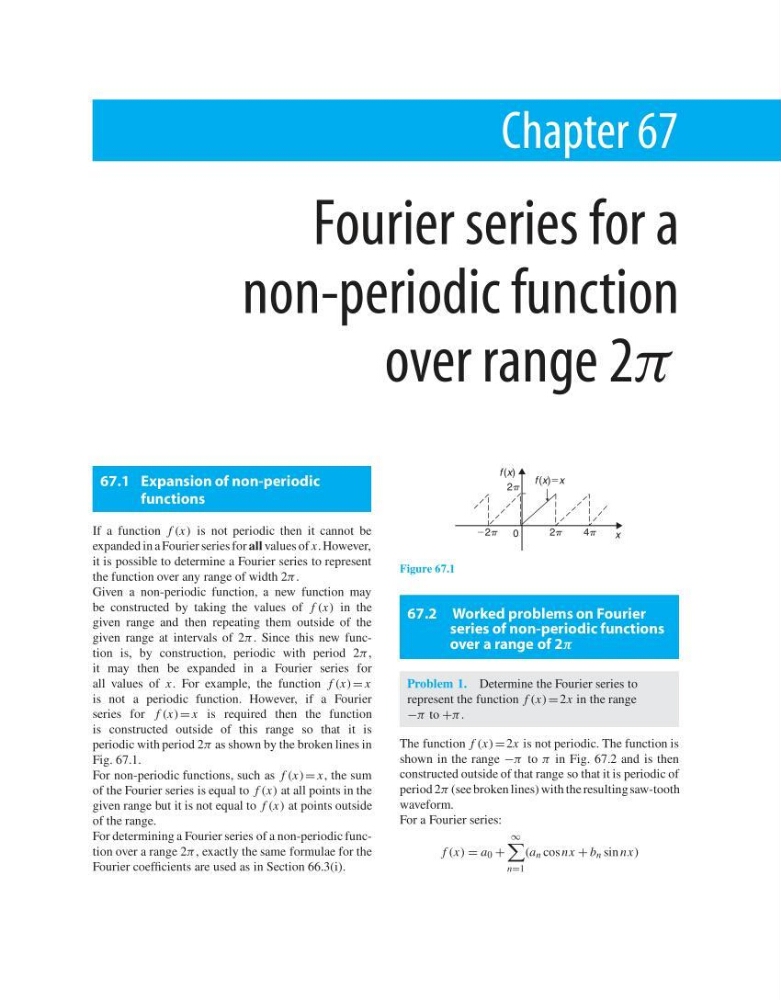
all values of x. For example, the function f (x) = x
is not a periodic function. However, if a Fourier
series for f (x) = x is required then the function
is constructed outside of this range so that it is
periodic with period 2π as shown by the broken lines in
Fig. 67.1.
For non-periodic functions, such as f (x) = x, the sum
of the Fourier series is equal to f (x) at all points in the
given range but it is not equal to f (x) at points outside
of the range.
For determining a Fourier series of a non-periodic function over a range 2π, exactly the same formulae for the
Fourier coefficients are used as in Section 66.3(i).
x
f (x)
f (x)5x
0
22
2
2
4
Figure 67.1
67.2 Worked problems on Fourier
series of non-periodic functions
over a range of 2π
Problem 1. Determine the Fourier series to
represent the function f (x) = 2x in the range
−π to +π.
The function f (x) = 2x is not periodic. The function is
shown in the range −π to π in Fig. 67.2 and is then
constructed outside of that range so that it is periodic of
period 2π (see broken lines) with the resulting saw-tooth
waveform.
For a Fourier series:
f (x) = a 0 +
∞
n=1
(a n cos nx + b n sin nx)