

616 Higher Engineering Mathematics
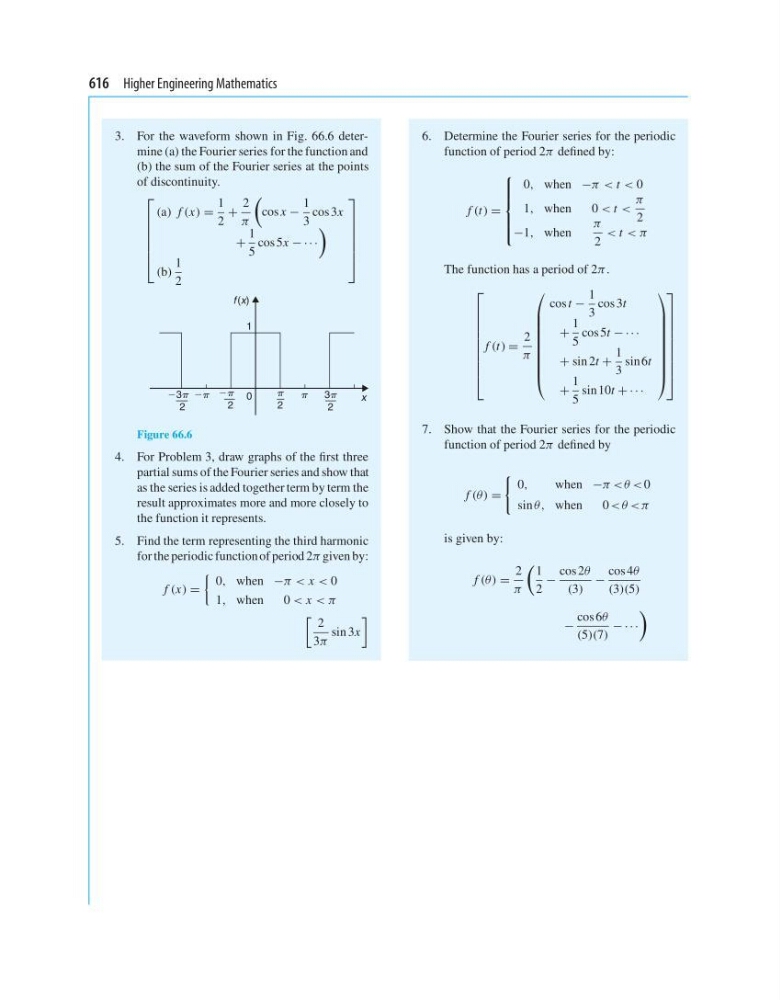
3. For the waveform shown in Fig. 66.6 determine (a) the Fourier series for the function and
(b) the sum of the Fourier series at the points
of discontinuity.
⎡
⎢
⎢
⎢
⎢
⎢
⎣
(a) f (x) =
1
2
+
2
π
cos x −
1
3
cos 3x
+
1
5
cos 5x − · · ·
(b)
1
2
⎤
⎥
⎥
⎥
⎥
⎥
⎦
x
f (x)
0
1
2
3
2
23
2
2
2
2
Figure 66.6
4. For Problem 3, draw graphs of the first three
partial sums of the Fourier series and show that
as the series is added together term by term the
result approximates more and more closely to
the function it represents.
5. Find the term representing the third harmonic
for the periodic function of period 2π given by:
f (x) =
0, when −π < x < 0
1, when
0 < x < π
2
3π
sin 3x
6. Determine the Fourier series for the periodic
function of period 2π defined by:
f (t ) =
⎧
⎪ ⎪ ⎪ ⎨
⎪ ⎪ ⎪ ⎩
0, when −π < t < 0
1, when
0 < t <
π
2
−1, when
π
2
< t < π
The function has a period of 2π.
⎡
⎢
⎢
⎢
⎢
⎢
⎢
⎢
⎢
⎣
f (t ) =
2
π
⎛
⎜
⎜
⎜
⎜
⎜
⎜
⎜
⎜
⎝
cos t −
1
3
cos 3t
+
1
5
cos 5t − · · ·
+ sin 2t +
1
3
sin 6t
+
1
5
sin 10t + · · ·
⎞
⎟
⎟
⎟
⎟
⎟
⎟
⎟
⎟
⎠
⎤
⎥
⎥
⎥
⎥
⎥
⎥
⎥
⎥
⎦
7. Show that the Fourier series for the periodic
function of period 2π defined by
f (θ) =
0,
when −π <θ <0
sin θ, when
0 <θ <π
is given by:
f (θ) =
2
π
1
2
−
cos 2θ
(3)
−
cos 4θ
(3)(5)
−
cos 6θ
(5)(7)
− · · ·