

Chapter 66
Fourier series for periodic
functions of period 2π
66.1 Introduction
Fourier series provides a method of analysing periodic
functions into their constituent components. Alternating currents and voltages, displacement, velocity and
acceleration of slider-crank mechanisms and acoustic
waves are typical practical examples in engineering and
science where periodic functions are involved and often
requiring analysis.
66.2 Periodic functions
A function f (x) is said to be periodic if
f (x + T ) = f (x) for all values of x, where T is
some positive number. T is the interval between two
successive repetitions and is called the period of
the functions f (x). For example, y = sin x is periodic in x with period 2π since sin x = sin(x + 2π)
= sin(x + 4π), and so on. In general, if y = sin ωt then
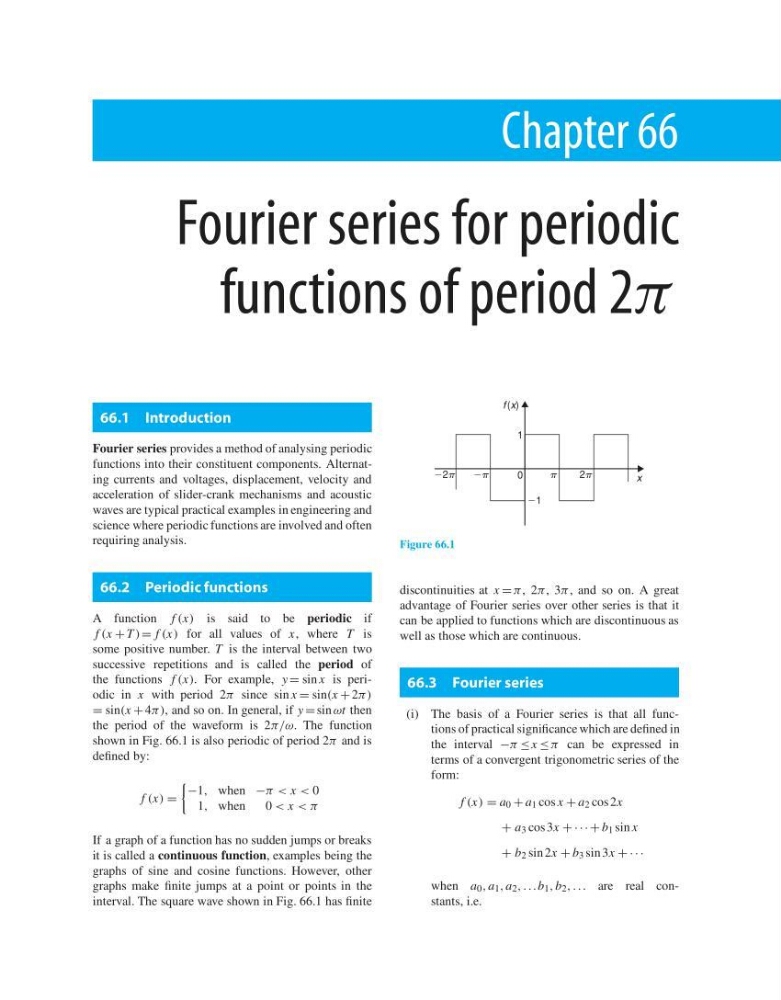
the period of the waveform is 2π/ω. The function
shown in Fig. 66.1 is also periodic of period 2π and is
defined by:
f (x) =
−1, when −π < x < 0
1, when
0 < x < π
If a graph of a function has no sudden jumps or breaks
it is called a continuous function, examples being the
graphs of sine and cosine functions. However, other
graphs make finite jumps at a point or points in the
interval. The square wave shown in Fig. 66.1 has finite
x
f (x)
2
0
1
21
22
2
Figure 66.1
discontinuities at x = π, 2π, 3π, and so on. A great
advantage of Fourier series over other series is that it
can be applied to functions which are discontinuous as
well as those which are continuous.
66.3 Fourier series
(i) The basis of a Fourier series is that all functions of practical significance which are defined in
the interval −π ≤ x ≤ π can be expressed in
terms of a convergent trigonometric series of the
form:
f (x) = a 0 + a 1 cos x + a 2 cos 2x
+ a 3 cos 3x + · · · + b 1 sin x
+ b 2 sin 2x + b 3 sin 3x + · · ·
when a 0 , a 1 , a 2 , ...b 1 , b 2 , ... are real constants, i.e.
Fourier series for periodic
functions of period 2π
66.1 Introduction
Fourier series provides a method of analysing periodic
functions into their constituent components. Alternating currents and voltages, displacement, velocity and
acceleration of slider-crank mechanisms and acoustic
waves are typical practical examples in engineering and
science where periodic functions are involved and often
requiring analysis.
66.2 Periodic functions
A function f (x) is said to be periodic if
f (x + T ) = f (x) for all values of x, where T is
some positive number. T is the interval between two
successive repetitions and is called the period of
the functions f (x). For example, y = sin x is periodic in x with period 2π since sin x = sin(x + 2π)
= sin(x + 4π), and so on. In general, if y = sin ωt then
the period of the waveform is 2π/ω. The function
shown in Fig. 66.1 is also periodic of period 2π and is
defined by:
f (x) =
−1, when −π < x < 0
1, when
0 < x < π
If a graph of a function has no sudden jumps or breaks
it is called a continuous function, examples being the
graphs of sine and cosine functions. However, other
graphs make finite jumps at a point or points in the
interval. The square wave shown in Fig. 66.1 has finite
x
f (x)
2
0
1
21
22
2
Figure 66.1
discontinuities at x = π, 2π, 3π, and so on. A great
advantage of Fourier series over other series is that it
can be applied to functions which are discontinuous as
well as those which are continuous.
66.3 Fourier series
(i) The basis of a Fourier series is that all functions of practical significance which are defined in
the interval −π ≤ x ≤ π can be expressed in
terms of a convergent trigonometric series of the
form:
f (x) = a 0 + a 1 cos x + a 2 cos 2x
+ a 3 cos 3x + · · · + b 1 sin x
+ b 2 sin 2x + b 3 sin 3x + · · ·
when a 0 , a 1 , a 2 , ...b 1 , b 2 , ... are real constants, i.e.