

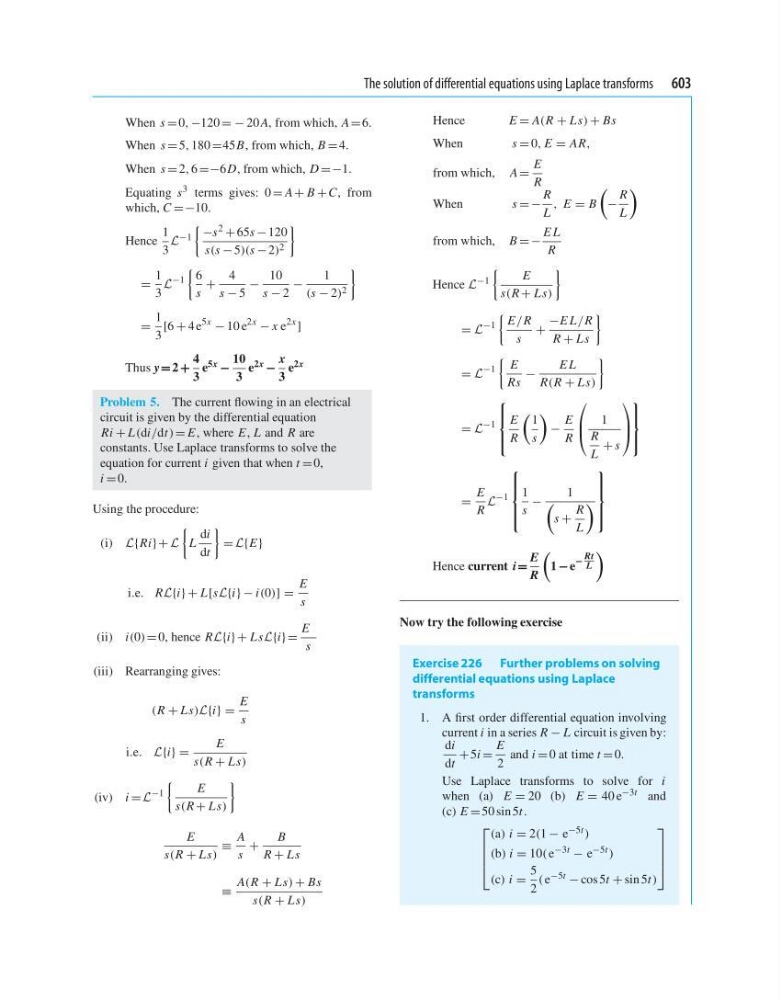
The solution of differential equations using Laplace transforms 603
When s = 0, −120 = − 20 A, from which, A = 6.
When s = 5, 180 =45B, from which, B = 4.
When s = 2, 6 =−6D, from which, D =−1.
Equating s 3 terms gives: 0 = A + B + C, from
which, C =−10.
Hence
1
3
L −1
−s 2 + 65s − 120
s(s − 5)(s − 2) 2
=
1
3
L
−1
6
s
+
4
s − 5
−
10
s − 2
−
1
(s − 2) 2
=
1
3
[6 + 4 e
5x
− 10 e
2x
− x e
2x ]
Thus y = 2 +
4
3
e 5x −
10
3
e 2x −
x
3
e 2x
Problem 5. The current flowing in an electrical
circuit is given by the differential equation
Ri + L(di/dt ) = E, where E, L and R are
constants. Use Laplace transforms to solve the
equation for current i given that when t = 0,
i = 0.
Using the procedure:
(i) L{Ri} + L
L
di
dt
= L{E}
i.e. RL{i} + L[sL{i} − i(0)] =
E
s
(ii) i(0) = 0, hence RL{i} + LsL{i} =
E
s
(iii) Rearranging gives:
(R + Ls)L{i} =
E
s
i.e. L{i} =
E
s(R + Ls)
(iv) i = L
−1
E
s(R + Ls)
E
s(R + Ls)
≡
A
s
+
B
R + Ls
≡
A(R + Ls) + Bs
s(R + Ls)
Hence
E = A(R + Ls) + Bs
When
s = 0, E = AR,
from which, A =
E
R
When
s = −
R
L
, E = B
−
R
L
from which, B = −
E L
R
Hence L −1
E
s(R + Ls)
= L
−1
E/R
s
+
−E L/R
R + Ls
= L
−1
E
Rs
−
E L
R(R + Ls)
= L
−1
⎧
⎪ ⎨
⎪ ⎩
E
R
1
s
−
E
R
⎛
⎜
⎝
1
R
L
+ s
⎞
⎟
⎠
⎫
⎪ ⎬
⎪ ⎭
=
E
R
L
−1
⎧
⎪ ⎪ ⎨
⎪ ⎪ ⎩
1
s
−
1
s +
R
L
⎫
⎪ ⎪ ⎬
⎪ ⎪ ⎭
Hence current i =
E
R
1 − e
−
Rt
L
Now try the following exercise
Exercise 226 Further problems on solving
differential equations using Laplace
transforms
1. A first order differential equation involving
current i in a series R − L circuit is given by:
di
dt
+ 5i =
E
2
and i = 0 at time t = 0.
Use Laplace transforms to solve for i
when (a) E = 20 (b) E = 40 e −3t and
(c) E = 50 sin 5t .
⎡
⎢
⎢
⎣
(a) i = 2(1 − e −5t )
(b) i = 10( e −3t − e −5t )
(c) i =
5
2
( e −5t − cos 5t + sin 5t )
⎤
⎥
⎥
⎦
When s = 0, −120 = − 20 A, from which, A = 6.
When s = 5, 180 =45B, from which, B = 4.
When s = 2, 6 =−6D, from which, D =−1.
Equating s 3 terms gives: 0 = A + B + C, from
which, C =−10.
Hence
1
3
L −1
−s 2 + 65s − 120
s(s − 5)(s − 2) 2
=
1
3
L
−1
6
s
+
4
s − 5
−
10
s − 2
−
1
(s − 2) 2
=
1
3
[6 + 4 e
5x
− 10 e
2x
− x e
2x ]
Thus y = 2 +
4
3
e 5x −
10
3
e 2x −
x
3
e 2x
Problem 5. The current flowing in an electrical
circuit is given by the differential equation
Ri + L(di/dt ) = E, where E, L and R are
constants. Use Laplace transforms to solve the
equation for current i given that when t = 0,
i = 0.
Using the procedure:
(i) L{Ri} + L
L
di
dt
= L{E}
i.e. RL{i} + L[sL{i} − i(0)] =
E
s
(ii) i(0) = 0, hence RL{i} + LsL{i} =
E
s
(iii) Rearranging gives:
(R + Ls)L{i} =
E
s
i.e. L{i} =
E
s(R + Ls)
(iv) i = L
−1
E
s(R + Ls)
E
s(R + Ls)
≡
A
s
+
B
R + Ls
≡
A(R + Ls) + Bs
s(R + Ls)
Hence
E = A(R + Ls) + Bs
When
s = 0, E = AR,
from which, A =
E
R
When
s = −
R
L
, E = B
−
R
L
from which, B = −
E L
R
Hence L −1
E
s(R + Ls)
= L
−1
E/R
s
+
−E L/R
R + Ls
= L
−1
E
Rs
−
E L
R(R + Ls)
= L
−1
⎧
⎪ ⎨
⎪ ⎩
E
R
1
s
−
E
R
⎛
⎜
⎝
1
R
L
+ s
⎞
⎟
⎠
⎫
⎪ ⎬
⎪ ⎭
=
E
R
L
−1
⎧
⎪ ⎪ ⎨
⎪ ⎪ ⎩
1
s
−
1
s +
R
L
⎫
⎪ ⎪ ⎬
⎪ ⎪ ⎭
Hence current i =
E
R
1 − e
−
Rt
L
Now try the following exercise
Exercise 226 Further problems on solving
differential equations using Laplace
transforms
1. A first order differential equation involving
current i in a series R − L circuit is given by:
di
dt
+ 5i =
E
2
and i = 0 at time t = 0.
Use Laplace transforms to solve for i
when (a) E = 20 (b) E = 40 e −3t and
(c) E = 50 sin 5t .
⎡
⎢
⎢
⎣
(a) i = 2(1 − e −5t )
(b) i = 10( e −3t − e −5t )
(c) i =
5
2
( e −5t − cos 5t + sin 5t )
⎤
⎥
⎥
⎦