

The solution of differential equations using Laplace transforms 601
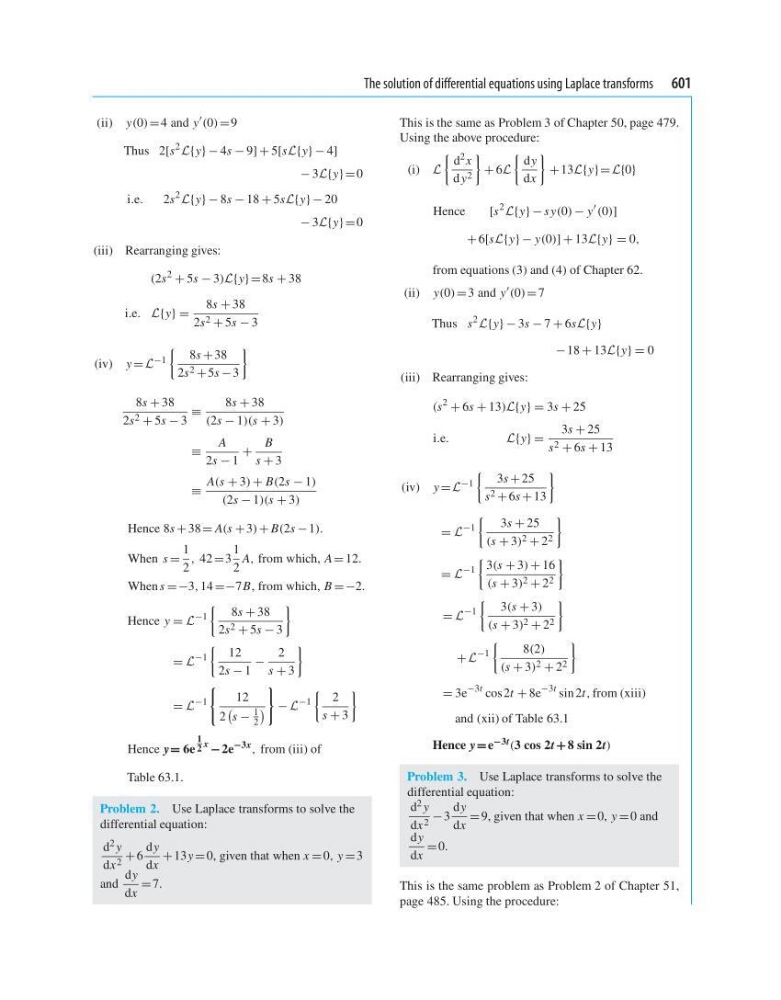
(ii) y(0) = 4 and y
(0) = 9
Thus 2[s
2
L{y} − 4s − 9] + 5[sL{y} − 4]
− 3L{y} =0
i.e.
2s
2
L{y} − 8s − 18 + 5sL{y} − 20
− 3L{y} =0
(iii) Rearranging gives:
(2s
2
+ 5s − 3)L{y} =8s + 38
i.e. L{y} =
8s + 38
2s 2 + 5s − 3
(iv) y = L −1
8s + 38
2s 2 + 5s − 3
8s + 38
2s 2 + 5s − 3
≡
8s + 38
(2s − 1)(s + 3)
≡
A
2s − 1
+
B
s + 3
≡
A(s + 3) + B(2s − 1)
(2s − 1)(s + 3)
Hence 8s + 38 = A(s + 3) + B(2s − 1).
When s =
1
2
, 42 =3
1
2
A, from which, A = 12.
When s =−3, 14 =−7B, from which, B =−2.
Hence y = L
−1
8s + 38
2s 2 + 5s − 3
= L
−1
12
2s − 1
−
2
s + 3
= L
−1
12
2
s −
1
2
− L
−1
2
s + 3
Hence y = 6e
1
2 x − 2e
−3x
, from (iii) of
Table 63.1.
Problem 2. Use Laplace transforms to solve the
differential equation:
d 2 y
dx 2 + 6
dy
dx
+ 13y = 0, given that when x = 0, y = 3
and
dy
dx
= 7.
This is the same as Problem 3 of Chapter 50, page 479.
Using the above procedure:
(i) L
d
2 x
d y 2
+ 6L
dy
dx
+ 13L{y} =L{0}
Hence
[s
2
L{y} − sy(0) − y
(0)]
+ 6[sL{y} − y(0)] + 13L{y} = 0,
from equations (3) and (4) of Chapter 62.
(ii) y(0) = 3 and y (0) = 7
Thus s
2
L{y} − 3s − 7 + 6sL{y}
− 18 + 13L{y} = 0
(iii) Rearranging gives:
(s
2
+ 6s + 13)L{y} = 3s + 25
i.e.
L{y} =
3s + 25
s 2 + 6s + 13
(iv) y = L −1
3s + 25
s 2 + 6s + 13
= L
−1
3s + 25
(s + 3) 2 + 2 2
= L
−1
3(s + 3) + 16
(s + 3) 2 + 2 2
= L
−1
3(s + 3)
(s + 3) 2 + 2 2
+ L
−1
8(2)
(s + 3) 2 + 2 2
= 3e
−3t cos2t + 8e
−3t sin 2t, from (xiii)
and (xii) of Table 63.1
Hence y = e −3t (3 cos 2t + 8 sin 2t)
Problem 3. Use Laplace transforms to solve the
differential equation:
d 2 y
dx 2 − 3
dy
dx
= 9, given that when x = 0, y = 0 and
dy
dx
= 0.
This is the same problem as Problem 2 of Chapter 51,
page 485. Using the procedure:
(ii) y(0) = 4 and y
(0) = 9
Thus 2[s
2
L{y} − 4s − 9] + 5[sL{y} − 4]
− 3L{y} =0
i.e.
2s
2
L{y} − 8s − 18 + 5sL{y} − 20
− 3L{y} =0
(iii) Rearranging gives:
(2s
2
+ 5s − 3)L{y} =8s + 38
i.e. L{y} =
8s + 38
2s 2 + 5s − 3
(iv) y = L −1
8s + 38
2s 2 + 5s − 3
8s + 38
2s 2 + 5s − 3
≡
8s + 38
(2s − 1)(s + 3)
≡
A
2s − 1
+
B
s + 3
≡
A(s + 3) + B(2s − 1)
(2s − 1)(s + 3)
Hence 8s + 38 = A(s + 3) + B(2s − 1).
When s =
1
2
, 42 =3
1
2
A, from which, A = 12.
When s =−3, 14 =−7B, from which, B =−2.
Hence y = L
−1
8s + 38
2s 2 + 5s − 3
= L
−1
12
2s − 1
−
2
s + 3
= L
−1
12
2
s −
1
2
− L
−1
2
s + 3
Hence y = 6e
1
2 x − 2e
−3x
, from (iii) of
Table 63.1.
Problem 2. Use Laplace transforms to solve the
differential equation:
d 2 y
dx 2 + 6
dy
dx
+ 13y = 0, given that when x = 0, y = 3
and
dy
dx
= 7.
This is the same as Problem 3 of Chapter 50, page 479.
Using the above procedure:
(i) L
d
2 x
d y 2
+ 6L
dy
dx
+ 13L{y} =L{0}
Hence
[s
2
L{y} − sy(0) − y
(0)]
+ 6[sL{y} − y(0)] + 13L{y} = 0,
from equations (3) and (4) of Chapter 62.
(ii) y(0) = 3 and y (0) = 7
Thus s
2
L{y} − 3s − 7 + 6sL{y}
− 18 + 13L{y} = 0
(iii) Rearranging gives:
(s
2
+ 6s + 13)L{y} = 3s + 25
i.e.
L{y} =
3s + 25
s 2 + 6s + 13
(iv) y = L −1
3s + 25
s 2 + 6s + 13
= L
−1
3s + 25
(s + 3) 2 + 2 2
= L
−1
3(s + 3) + 16
(s + 3) 2 + 2 2
= L
−1
3(s + 3)
(s + 3) 2 + 2 2
+ L
−1
8(2)
(s + 3) 2 + 2 2
= 3e
−3t cos2t + 8e
−3t sin 2t, from (xiii)
and (xii) of Table 63.1
Hence y = e −3t (3 cos 2t + 8 sin 2t)
Problem 3. Use Laplace transforms to solve the
differential equation:
d 2 y
dx 2 − 3
dy
dx
= 9, given that when x = 0, y = 0 and
dy
dx
= 0.
This is the same problem as Problem 2 of Chapter 51,
page 485. Using the procedure: