

Inverse Laplace transforms 599
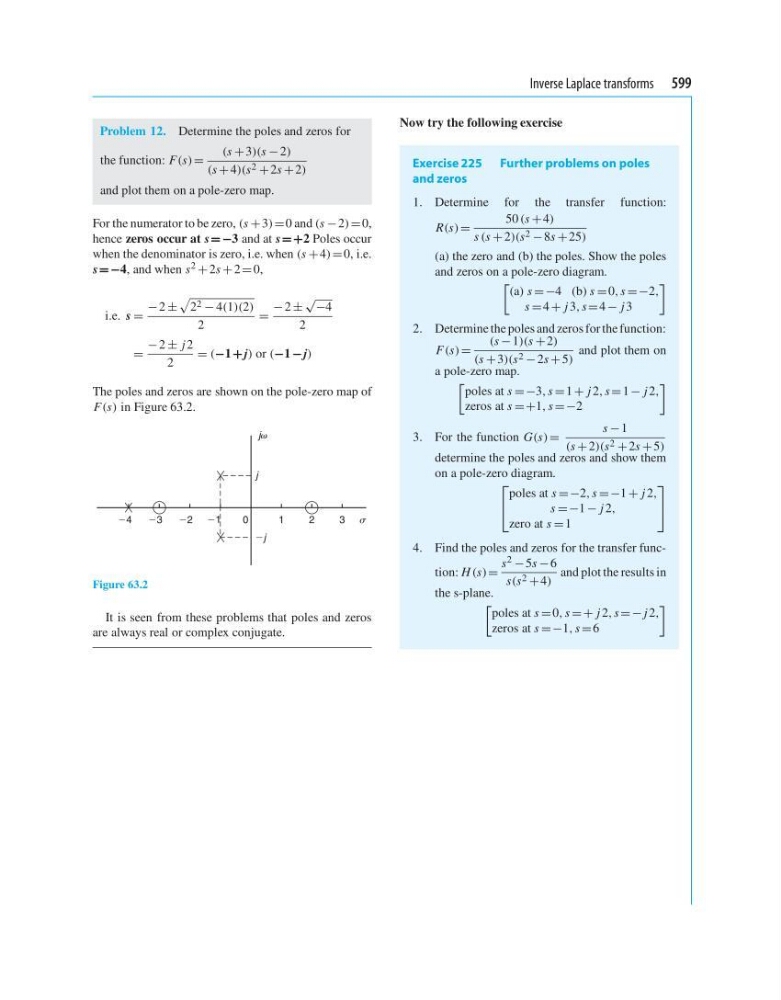
Problem 12. Determine the poles and zeros for
the function: F(s) =
(s + 3)(s − 2)
(s + 4)(s 2 + 2s + 2)
and plot them on a pole-zero map.
For the numerator to be zero, (s + 3) =0 and (s − 2) = 0,
hence zeros occur at s =−3 and at s =+2 Poles occur
when the denominator is zero, i.e. when (s + 4) = 0, i.e.
s =−4, and when s 2 + 2s + 2 = 0,
i.e. s =
− 2 ±
2 2 − 4(1)(2)
2
=
− 2 ±
√ −4
2
=
− 2 ± j 2
2
= (−1 +j) or (−1 −j)
The poles and zeros are shown on the pole-zero map of
F(s) in Figure 63.2.
2j
j
j
24
23
22 21
1
2
3
0
Figure 63.2
It is seen from these problems that poles and zeros
are always real or complex conjugate.
Now try the following exercise
Exercise 225 Further problems on poles
and zeros
1. Determine for the transfer function:
R(s) =
50 (s + 4)
s (s + 2)(s 2 − 8s + 25)
(a) the zero and (b) the poles. Show the poles
and zeros on a pole-zero diagram.
(a) s =−4 (b) s = 0, s =−2,
s = 4 + j 3, s= 4 − j 3
2. Determine the poles and zeros for the function:
F(s) =
(s − 1)(s + 2)
(s + 3)(s 2 − 2s + 5)
and plot them on
a pole-zero map.
poles at s =−3, s = 1 + j 2, s = 1 − j 2,
zeros at s =+1, s =−2
3. For the function G(s) =
s − 1
(s + 2)(s 2 + 2s + 5)
determine the poles and zeros and show them
on a pole-zero diagram.
⎡
⎣
poles at s =−2, s =−1 + j 2,
s =−1 − j 2,
zero at s = 1
⎤
⎦
4. Find the poles and zeros for the transfer function: H (s) =
s 2 − 5s − 6
s(s 2 + 4)
and plot the results in
the s-plane.
poles at s = 0, s =+ j 2, s =− j 2,
zeros at s =−1, s = 6
Problem 12. Determine the poles and zeros for
the function: F(s) =
(s + 3)(s − 2)
(s + 4)(s 2 + 2s + 2)
and plot them on a pole-zero map.
For the numerator to be zero, (s + 3) =0 and (s − 2) = 0,
hence zeros occur at s =−3 and at s =+2 Poles occur
when the denominator is zero, i.e. when (s + 4) = 0, i.e.
s =−4, and when s 2 + 2s + 2 = 0,
i.e. s =
− 2 ±
2 2 − 4(1)(2)
2
=
− 2 ±
√ −4
2
=
− 2 ± j 2
2
= (−1 +j) or (−1 −j)
The poles and zeros are shown on the pole-zero map of
F(s) in Figure 63.2.
2j
j
j
24
23
22 21
1
2
3
0
Figure 63.2
It is seen from these problems that poles and zeros
are always real or complex conjugate.
Now try the following exercise
Exercise 225 Further problems on poles
and zeros
1. Determine for the transfer function:
R(s) =
50 (s + 4)
s (s + 2)(s 2 − 8s + 25)
(a) the zero and (b) the poles. Show the poles
and zeros on a pole-zero diagram.
(a) s =−4 (b) s = 0, s =−2,
s = 4 + j 3, s= 4 − j 3
2. Determine the poles and zeros for the function:
F(s) =
(s − 1)(s + 2)
(s + 3)(s 2 − 2s + 5)
and plot them on
a pole-zero map.
poles at s =−3, s = 1 + j 2, s = 1 − j 2,
zeros at s =+1, s =−2
3. For the function G(s) =
s − 1
(s + 2)(s 2 + 2s + 5)
determine the poles and zeros and show them
on a pole-zero diagram.
⎡
⎣
poles at s =−2, s =−1 + j 2,
s =−1 − j 2,
zero at s = 1
⎤
⎦
4. Find the poles and zeros for the transfer function: H (s) =
s 2 − 5s − 6
s(s 2 + 4)
and plot the results in
the s-plane.
poles at s = 0, s =+ j 2, s =− j 2,
zeros at s =−1, s = 6