

592 Higher Engineering Mathematics
i.e.
3e −∞ = (0)
3
0 + 4
i.e. 0 = 0, which illustrates the theorem.
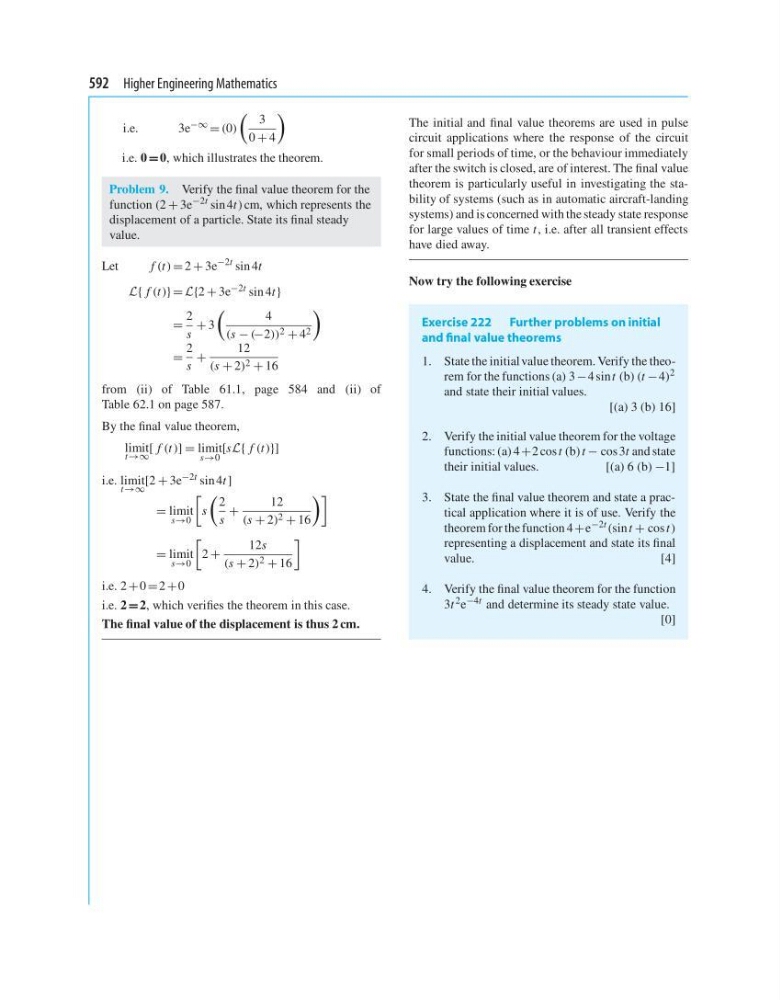
Problem 9. Verify the final value theorem for the
function (2 + 3e
−2t sin 4t ) cm, which represents the
displacement of a particle. State its final steady
value.
Let
f (t ) = 2 + 3e
−2t sin 4t
L{ f (t )} = L{2 + 3e −2t sin 4t }
=
2
s
+ 3
4
(s − (−2)) 2 + 4 2
=
2
s
+
12
(s + 2) 2 + 16
from (ii) of Table 61.1, page 584 and (ii) of
Table 62.1 on page 587.
By the final value theorem,
limit
t →∞
[ f (t )] = limit
s→0
[sL{ f (t )}]
i.e. limit
t →∞
[2 + 3e −2t sin 4t ]
= limit
s→0
s
2
s
+
12
(s + 2) 2 + 16
= limit
s→0
2 +
12s
(s + 2) 2 + 16
i.e. 2 + 0 = 2 +0
i.e. 2 = 2, which verifies the theorem in this case.
The final value of the displacement is thus 2 cm.
The initial and final value theorems are used in pulse
circuit applications where the response of the circuit
for small periods of time, or the behaviour immediately
after the switch is closed, are of interest. The final value
theorem is particularly useful in investigating the stability of systems (such as in automatic aircraft-landing
systems) and is concerned with the steady state response
for large values of time t , i.e. after all transient effects
have died away.
Now try the following exercise
Exercise 222 Further problems on initial
and final value theorems
1. State the initial value theorem. Verify the theorem for the functions (a) 3 −4 sint (b) (t − 4) 2
and state their initial values.
[(a) 3 (b) 16]
2. Verify the initial value theorem for the voltage
functions: (a) 4 +2 cos t (b) t − cos 3t and state
their initial values.
[(a) 6 (b) −1]
3. State the final value theorem and state a practical application where it is of use. Verify the
theorem for the function 4 +e −2t (sin t + cos t )
representing a displacement and state its final
value.
[4]
4. Verify the final value theorem for the function
3t 2 e −4t and determine its steady state value.
[0]
i.e.
3e −∞ = (0)
3
0 + 4
i.e. 0 = 0, which illustrates the theorem.
Problem 9. Verify the final value theorem for the
function (2 + 3e
−2t sin 4t ) cm, which represents the
displacement of a particle. State its final steady
value.
Let
f (t ) = 2 + 3e
−2t sin 4t
L{ f (t )} = L{2 + 3e −2t sin 4t }
=
2
s
+ 3
4
(s − (−2)) 2 + 4 2
=
2
s
+
12
(s + 2) 2 + 16
from (ii) of Table 61.1, page 584 and (ii) of
Table 62.1 on page 587.
By the final value theorem,
limit
t →∞
[ f (t )] = limit
s→0
[sL{ f (t )}]
i.e. limit
t →∞
[2 + 3e −2t sin 4t ]
= limit
s→0
s
2
s
+
12
(s + 2) 2 + 16
= limit
s→0
2 +
12s
(s + 2) 2 + 16
i.e. 2 + 0 = 2 +0
i.e. 2 = 2, which verifies the theorem in this case.
The final value of the displacement is thus 2 cm.
The initial and final value theorems are used in pulse
circuit applications where the response of the circuit
for small periods of time, or the behaviour immediately
after the switch is closed, are of interest. The final value
theorem is particularly useful in investigating the stability of systems (such as in automatic aircraft-landing
systems) and is concerned with the steady state response
for large values of time t , i.e. after all transient effects
have died away.
Now try the following exercise
Exercise 222 Further problems on initial
and final value theorems
1. State the initial value theorem. Verify the theorem for the functions (a) 3 −4 sint (b) (t − 4) 2
and state their initial values.
[(a) 3 (b) 16]
2. Verify the initial value theorem for the voltage
functions: (a) 4 +2 cos t (b) t − cos 3t and state
their initial values.
[(a) 6 (b) −1]
3. State the final value theorem and state a practical application where it is of use. Verify the
theorem for the function 4 +e −2t (sin t + cos t )
representing a displacement and state its final
value.
[4]
4. Verify the final value theorem for the function
3t 2 e −4t and determine its steady state value.
[0]