

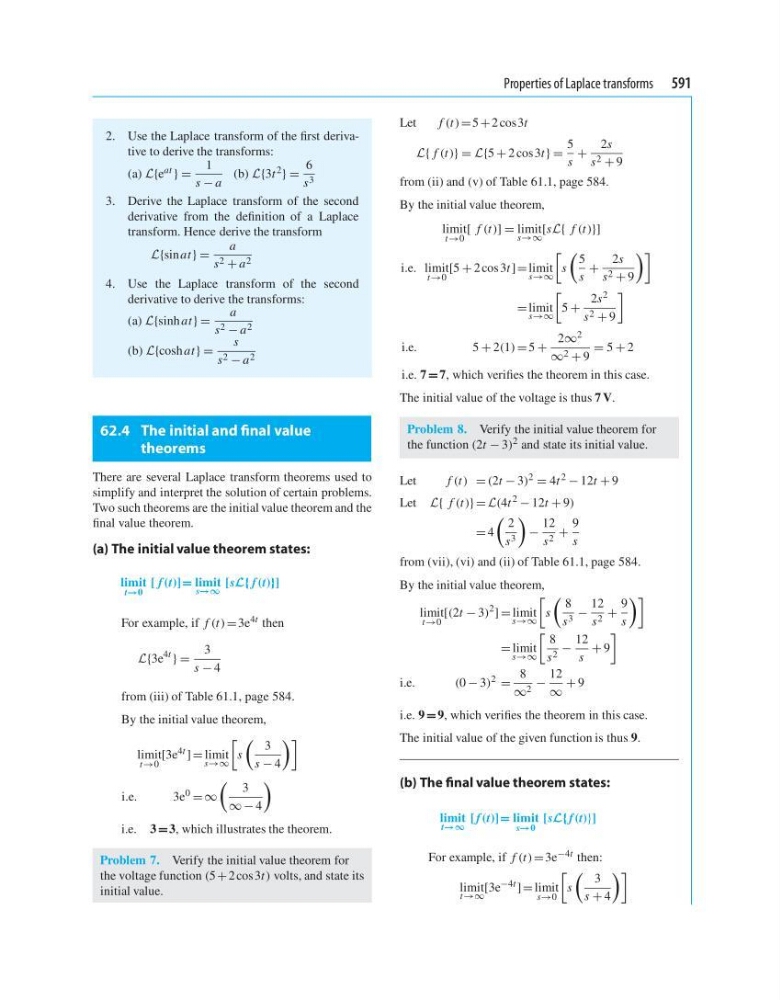
Properties of Laplace transforms 591
2. Use the Laplace transform of the first derivative to derive the transforms:
(a) L{e at } =
1
s − a
(b) L{3t 2 } =
6
s 3
3. Derive the Laplace transform of the second
derivative from the definition of a Laplace
transform. Hence derive the transform
L{sin at } =
a
s 2 + a 2
4. Use the Laplace transform of the second
derivative to derive the transforms:
(a) L{sinh at } =
a
s 2 − a 2
(b) L{cosh at } =
s
s 2 − a 2
62.4 The initial and final value
theorems
There are several Laplace transform theorems used to
simplify and interpret the solution of certain problems.
Two such theorems are the initial value theorem and the
final value theorem.
(a) The initial value theorem states:
limit
t→0
[ f (t)]= limit
s→∞
[sL{ f (t)}]
For example, if f (t ) = 3e 4t then
L{3e
4t
} =
3
s − 4
from (iii) of Table 61.1, page 584.
By the initial value theorem,
limit
t →0
[3e 4t ] = limit
s→∞
s
3
s − 4
i.e.
3e 0 = ∞
3
∞ − 4
i.e. 3 =3, which illustrates the theorem.
Problem 7. Verify the initial value theorem for
the voltage function (5 + 2 cos3t ) volts, and state its
initial value.
Let
f (t ) = 5 + 2 cos3t
L{ f (t )} = L{5 + 2 cos3t } =
5
s
+
2s
s 2 + 9
from (ii) and (v) of Table 61.1, page 584.
By the initial value theorem,
limit
t →0
[ f (t )] = limit
s→∞
[sL{ f (t )}]
i.e. limit
t →0
[5 + 2 cos 3t ]= limit
s→∞
s
5
s
+
2s
s 2 + 9
= limit
s→∞
5 +
2s 2
s 2 + 9
i.e.
5 + 2(1) = 5 +
2∞ 2
∞ 2 + 9
= 5 + 2
i.e. 7 = 7, which verifies the theorem in this case.
The initial value of the voltage is thus 7 V.
Problem 8. Verify the initial value theorem for
the function (2t − 3) 2 and state its initial value.
Let
f (t ) = (2t − 3) 2 = 4t 2 − 12t + 9
Let L{ f (t )} = L(4t
2
− 12t + 9)
= 4
2
s 3
−
12
s 2 +
9
s
from (vii), (vi) and (ii) of Table 61.1, page 584.
By the initial value theorem,
limit
t →0
[(2t − 3)
2 ] = limit
s→∞
s
8
s 3 −
12
s 2 +
9
s
= limit
s→∞
8
s 2 −
12
s
+ 9
i.e.
(0 − 3) 2 =
8
∞ 2 −
12
∞
+ 9
i.e. 9 = 9, which verifies the theorem in this case.
The initial value of the given function is thus 9.
(b) The final value theorem states:
limit
t→∞
[f (t)]= limit
s→0
[sL{ f (t)}]
For example, if f (t ) = 3e −4t then:
limit
t →∞
[3e −4t ] = limit
s→0
s
3
s + 4
2. Use the Laplace transform of the first derivative to derive the transforms:
(a) L{e at } =
1
s − a
(b) L{3t 2 } =
6
s 3
3. Derive the Laplace transform of the second
derivative from the definition of a Laplace
transform. Hence derive the transform
L{sin at } =
a
s 2 + a 2
4. Use the Laplace transform of the second
derivative to derive the transforms:
(a) L{sinh at } =
a
s 2 − a 2
(b) L{cosh at } =
s
s 2 − a 2
62.4 The initial and final value
theorems
There are several Laplace transform theorems used to
simplify and interpret the solution of certain problems.
Two such theorems are the initial value theorem and the
final value theorem.
(a) The initial value theorem states:
limit
t→0
[ f (t)]= limit
s→∞
[sL{ f (t)}]
For example, if f (t ) = 3e 4t then
L{3e
4t
} =
3
s − 4
from (iii) of Table 61.1, page 584.
By the initial value theorem,
limit
t →0
[3e 4t ] = limit
s→∞
s
3
s − 4
i.e.
3e 0 = ∞
3
∞ − 4
i.e. 3 =3, which illustrates the theorem.
Problem 7. Verify the initial value theorem for
the voltage function (5 + 2 cos3t ) volts, and state its
initial value.
Let
f (t ) = 5 + 2 cos3t
L{ f (t )} = L{5 + 2 cos3t } =
5
s
+
2s
s 2 + 9
from (ii) and (v) of Table 61.1, page 584.
By the initial value theorem,
limit
t →0
[ f (t )] = limit
s→∞
[sL{ f (t )}]
i.e. limit
t →0
[5 + 2 cos 3t ]= limit
s→∞
s
5
s
+
2s
s 2 + 9
= limit
s→∞
5 +
2s 2
s 2 + 9
i.e.
5 + 2(1) = 5 +
2∞ 2
∞ 2 + 9
= 5 + 2
i.e. 7 = 7, which verifies the theorem in this case.
The initial value of the voltage is thus 7 V.
Problem 8. Verify the initial value theorem for
the function (2t − 3) 2 and state its initial value.
Let
f (t ) = (2t − 3) 2 = 4t 2 − 12t + 9
Let L{ f (t )} = L(4t
2
− 12t + 9)
= 4
2
s 3
−
12
s 2 +
9
s
from (vii), (vi) and (ii) of Table 61.1, page 584.
By the initial value theorem,
limit
t →0
[(2t − 3)
2 ] = limit
s→∞
s
8
s 3 −
12
s 2 +
9
s
= limit
s→∞
8
s 2 −
12
s
+ 9
i.e.
(0 − 3) 2 =
8
∞ 2 −
12
∞
+ 9
i.e. 9 = 9, which verifies the theorem in this case.
The initial value of the given function is thus 9.
(b) The final value theorem states:
limit
t→∞
[f (t)]= limit
s→0
[sL{ f (t)}]
For example, if f (t ) = 3e −4t then:
limit
t →∞
[3e −4t ] = limit
s→0
s
3
s + 4