

Power series methods of solving ordinary differential equations 509
+
x
2
−v
1
(1 − v)
−
x
2
2 2 (1! ))(2 − v)
+
x 4
2 4 (2! ))(3 − v)
− · · ·
From Problem 10 above, when c =+v,
a 2 =
−a 0
2 2 (v + 1)
If we let a 0 =
1
2 v (v + 1)
then
a 2 =
−1
2 2 (v + 1) 2 v (v + 1)
=
−1
2 v+2 (v + 1))(v + 1)
=
−1
2 v+2 (v + 2)
from equation (41)
Similarly, a 4 =
a 2
v 2 − (c + 4) 2 from equation (37)
=
a 2
(v − c − 4)(v + c + 4)
=
a 2
−4(2v + 4)
since c = v
=
−a 2
2 3 (v + 2)
=
−1
2 3 (v + 2)
−1
2 v+2 (v + 2)
=
1
2 v+4 (2! ))(v + 3)
since (v + 2))(v + 2) = (v + 3)
and a 6 =
−1
2 v+6 (3! ))(v + 4)
and so on.
The recurrence relation is:
a r =
(−1) r/2
2 v+r
r
2
!
v +
r
2
+ 1
And if we let r = 2k, then
a 2k =
(−1) k
2 v+2k (k!)(v + k + 1)
(42)
for k = 1, 2, 3, ...
Hence, it is possible to write the new form for equation
(38) as:
y = Ax
v
1
2 v + 1)
−
x 2
2 v+2 (1! ))(v + 2)
+
x 4
2 v+4 (2! ))(v + 3)
− · · ·
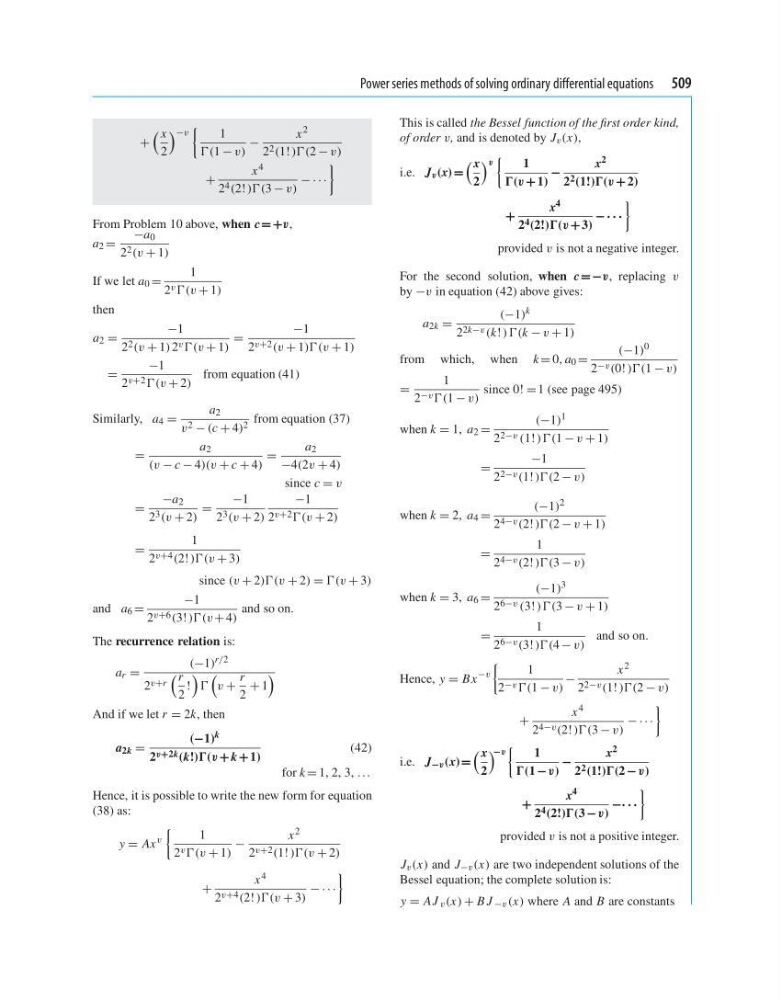
This is called the Bessel function of the first order kind,
of order v, and is denoted by J v (x),
i.e. J v (x) =
x
2
v
1
(v + 1)
−
x 2
2 2 (1!)(v + 2)
+
x 4
2 4 (2!)(v + 3)
−· · ·
provided v is not a negative integer.
For the second solution, when c =−v, replacing v
by −v in equation (42) above gives:
a 2k =
(−1) k
2 2k−v (k! ))(k − v + 1)
from which, when k = 0, a 0 =
(−1)
0
2 −v (0! ))(1 − v)
=
1
2 −v (1 − v)
since 0! = 1 (see page 495)
when k = 1, a 2 =
(−1) 1
2 2−v (1! ))(1 − v + 1)
=
−1
2 2−v (1! ))(2 − v)
when k = 2, a 4 =
(−1) 2
2 4−v (2! ))(2 − v + 1)
=
1
2 4−v (2! ))(3 − v)
when k = 3, a 6 =
(−1) 3
2 6−v (3! ))(3 − v + 1)
=
1
2 6−v (3! ))(4 − v)
and so on.
Hence, y = Bx
−v
1
2 −v (1 − v)
−
x 2
2 2−v (1! ))(2 − v)
+
x 4
2 4−v (2! ))(3 − v)
− · · ·
i.e. J −v (x)=
x
2
−v
1
(1 −v)
−
x 2
2 2 (1!)(2 − v)
+
x
4
2 4 (2!)(3 −v)
−· · ·
provided v is not a positive integer.
J v (x) and J −v (x) are two independent solutions of the
Bessel equation; the complete solution is:
y = AJ v (x) + B J −v (x) where A and B are constants
+
x
2
−v
1
(1 − v)
−
x
2
2 2 (1! ))(2 − v)
+
x 4
2 4 (2! ))(3 − v)
− · · ·
From Problem 10 above, when c =+v,
a 2 =
−a 0
2 2 (v + 1)
If we let a 0 =
1
2 v (v + 1)
then
a 2 =
−1
2 2 (v + 1) 2 v (v + 1)
=
−1
2 v+2 (v + 1))(v + 1)
=
−1
2 v+2 (v + 2)
from equation (41)
Similarly, a 4 =
a 2
v 2 − (c + 4) 2 from equation (37)
=
a 2
(v − c − 4)(v + c + 4)
=
a 2
−4(2v + 4)
since c = v
=
−a 2
2 3 (v + 2)
=
−1
2 3 (v + 2)
−1
2 v+2 (v + 2)
=
1
2 v+4 (2! ))(v + 3)
since (v + 2))(v + 2) = (v + 3)
and a 6 =
−1
2 v+6 (3! ))(v + 4)
and so on.
The recurrence relation is:
a r =
(−1) r/2
2 v+r
r
2
!
v +
r
2
+ 1
And if we let r = 2k, then
a 2k =
(−1) k
2 v+2k (k!)(v + k + 1)
(42)
for k = 1, 2, 3, ...
Hence, it is possible to write the new form for equation
(38) as:
y = Ax
v
1
2 v + 1)
−
x 2
2 v+2 (1! ))(v + 2)
+
x 4
2 v+4 (2! ))(v + 3)
− · · ·
This is called the Bessel function of the first order kind,
of order v, and is denoted by J v (x),
i.e. J v (x) =
x
2
v
1
(v + 1)
−
x 2
2 2 (1!)(v + 2)
+
x 4
2 4 (2!)(v + 3)
−· · ·
provided v is not a negative integer.
For the second solution, when c =−v, replacing v
by −v in equation (42) above gives:
a 2k =
(−1) k
2 2k−v (k! ))(k − v + 1)
from which, when k = 0, a 0 =
(−1)
0
2 −v (0! ))(1 − v)
=
1
2 −v (1 − v)
since 0! = 1 (see page 495)
when k = 1, a 2 =
(−1) 1
2 2−v (1! ))(1 − v + 1)
=
−1
2 2−v (1! ))(2 − v)
when k = 2, a 4 =
(−1) 2
2 4−v (2! ))(2 − v + 1)
=
1
2 4−v (2! ))(3 − v)
when k = 3, a 6 =
(−1) 3
2 6−v (3! ))(3 − v + 1)
=
1
2 6−v (3! ))(4 − v)
and so on.
Hence, y = Bx
−v
1
2 −v (1 − v)
−
x 2
2 2−v (1! ))(2 − v)
+
x 4
2 4−v (2! ))(3 − v)
− · · ·
i.e. J −v (x)=
x
2
−v
1
(1 −v)
−
x 2
2 2 (1!)(2 − v)
+
x
4
2 4 (2!)(3 −v)
−· · ·
provided v is not a positive integer.
J v (x) and J −v (x) are two independent solutions of the
Bessel equation; the complete solution is:
y = AJ v (x) + B J −v (x) where A and B are constants