

470 Higher Engineering Mathematics
From Table 49.11 of Problem 5, by the Euler-Cauchy
method, when x = 1.6, y = 5.351368
% error in the Euler-Cauchy method
=
5.348811636 − 5.351368
5.348811636
× 100%
= −0.048%
The Euler-Cauchy method is seen to be more accurate
than the Euler method when x = 1.6.
Now try the following exercise
Exercise 185 Further problems on an
improved Euler method
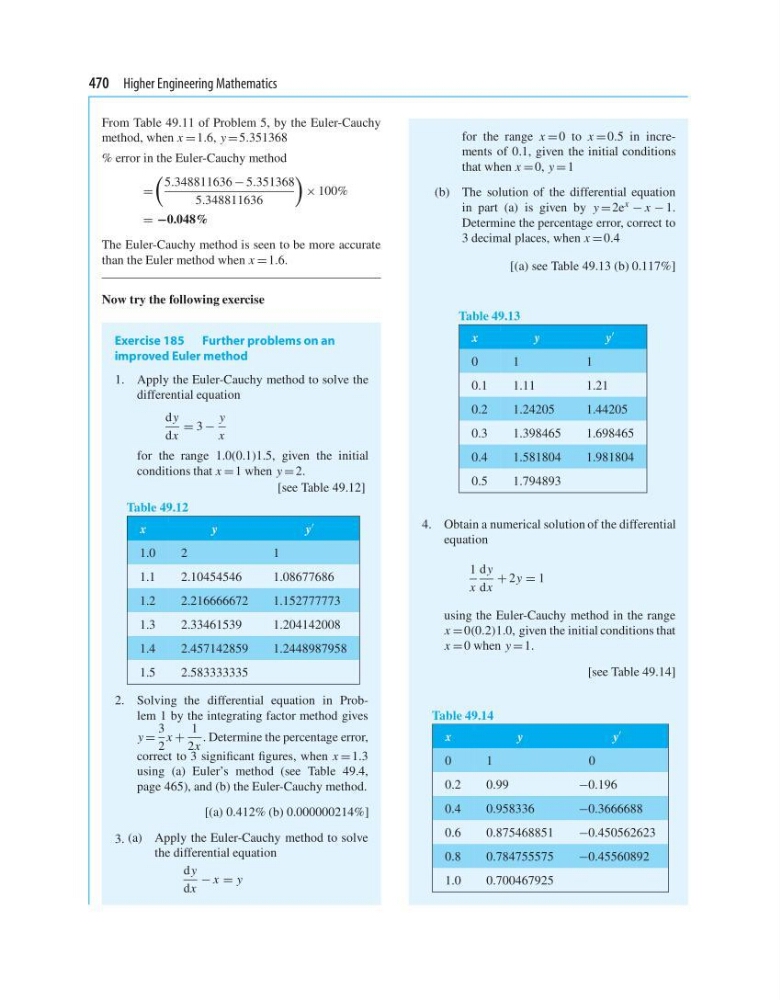
1. Apply the Euler-Cauchy method to solve the
differential equation
d y
dx
= 3 −
y
x
for the range 1.0(0.1)1.5, given the initial
conditions that x = 1 when y = 2.
[see Table 49.12]
Table 49.12
x
y
y
1.0
2
1
1.1
2.10454546
1.08677686
1.2
2.216666672
1.152777773
1.3
2.33461539
1.204142008
1.4
2.457142859
1.2448987958
1.5
2.583333335
2. Solving the differential equation in Problem 1 by the integrating factor method gives
y =
3
2
x +
1
2x
. Determine the percentage error,
correct to 3 significant figures, when x = 1.3
using (a) Euler’s method (see Table 49.4,
page 465), and (b) the Euler-Cauchy method.
[(a) 0.412% (b) 0.000000214%]
3. (a) Apply the Euler-Cauchy method to solve
the differential equation
d y
dx
− x = y
for the range x = 0 to x = 0.5 in increments of 0.1, given the initial conditions
that when x = 0, y = 1
(b) The solution of the differential equation
in part (a) is given by y = 2e x − x − 1.
Determine the percentage error, correct to
3 decimal places, when x = 0.4
[(a) see Table 49.13 (b) 0.117%]
Table 49.13
x
y
y
0
1
1
0.1
1.11
1.21
0.2
1.24205
1.44205
0.3
1.398465
1.698465
0.4
1.581804
1.981804
0.5
1.794893
4. Obtain a numerical solution of the differential
equation
1
x
d y
dx
+ 2y = 1
using the Euler-Cauchy method in the range
x = 0(0.2)1.0, given the initial conditions that
x = 0 when y = 1.
[see Table 49.14]
Table 49.14
x
y
y
0
1
0
0.2
0.99
−0.196
0.4
0.958336
−0.3666688
0.6
0.875468851
−0.450562623
0.8
0.784755575
−0.45560892
1.0
0.700467925
From Table 49.11 of Problem 5, by the Euler-Cauchy
method, when x = 1.6, y = 5.351368
% error in the Euler-Cauchy method
=
5.348811636 − 5.351368
5.348811636
× 100%
= −0.048%
The Euler-Cauchy method is seen to be more accurate
than the Euler method when x = 1.6.
Now try the following exercise
Exercise 185 Further problems on an
improved Euler method
1. Apply the Euler-Cauchy method to solve the
differential equation
d y
dx
= 3 −
y
x
for the range 1.0(0.1)1.5, given the initial
conditions that x = 1 when y = 2.
[see Table 49.12]
Table 49.12
x
y
y
1.0
2
1
1.1
2.10454546
1.08677686
1.2
2.216666672
1.152777773
1.3
2.33461539
1.204142008
1.4
2.457142859
1.2448987958
1.5
2.583333335
2. Solving the differential equation in Problem 1 by the integrating factor method gives
y =
3
2
x +
1
2x
. Determine the percentage error,
correct to 3 significant figures, when x = 1.3
using (a) Euler’s method (see Table 49.4,
page 465), and (b) the Euler-Cauchy method.
[(a) 0.412% (b) 0.000000214%]
3. (a) Apply the Euler-Cauchy method to solve
the differential equation
d y
dx
− x = y
for the range x = 0 to x = 0.5 in increments of 0.1, given the initial conditions
that when x = 0, y = 1
(b) The solution of the differential equation
in part (a) is given by y = 2e x − x − 1.
Determine the percentage error, correct to
3 decimal places, when x = 0.4
[(a) see Table 49.13 (b) 0.117%]
Table 49.13
x
y
y
0
1
1
0.1
1.11
1.21
0.2
1.24205
1.44205
0.3
1.398465
1.698465
0.4
1.581804
1.981804
0.5
1.794893
4. Obtain a numerical solution of the differential
equation
1
x
d y
dx
+ 2y = 1
using the Euler-Cauchy method in the range
x = 0(0.2)1.0, given the initial conditions that
x = 0 when y = 1.
[see Table 49.14]
Table 49.14
x
y
y
0
1
0
0.2
0.99
−0.196
0.4
0.958336
−0.3666688
0.6
0.875468851
−0.450562623
0.8
0.784755575
−0.45560892
1.0
0.700467925