

Some applications of integration 385
b
C
x
P
G
G
P
␦x
l
2
l
2
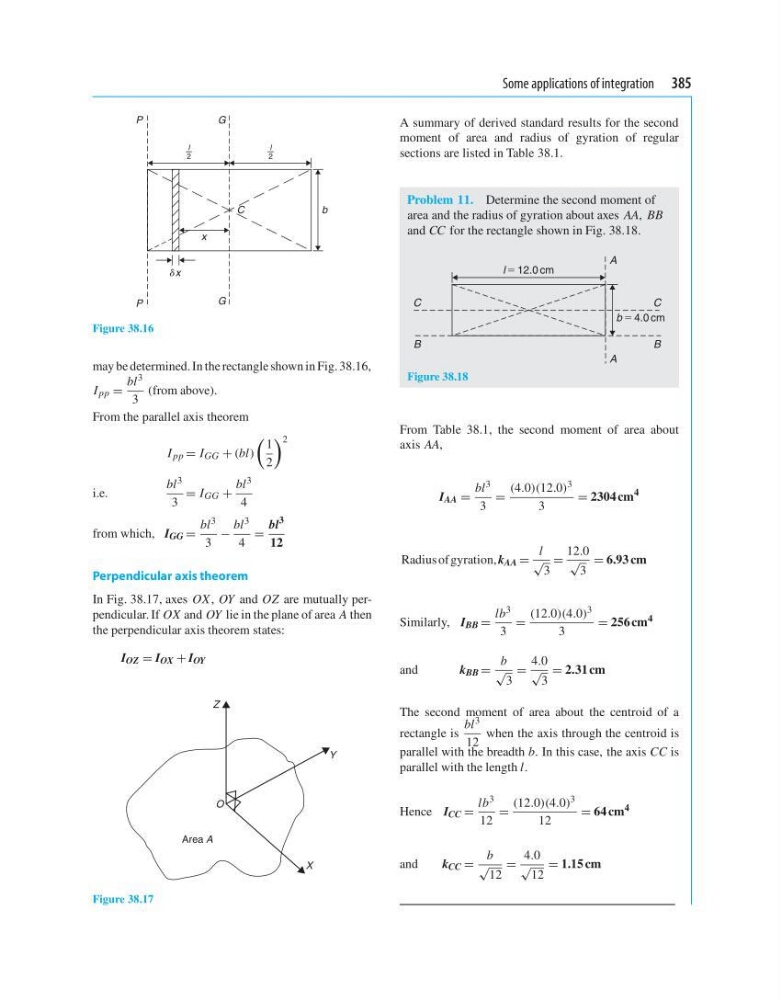
Figure 38.16
may be determined. In the rectangle shown in Fig. 38.16,
I pp =
bl
3
3
(from above).
From the parallel axis theorem
I pp = I GG + (bl)
1
2
2
i.e.
bl 3
3
= I GG +
bl 3
4
from which, I GG =
bl 3
3
−
bl 3
4
=
bl
3
12
Perpendicular axis theorem
In Fig. 38.17, axes OX , OY and OZ are mutually perpendicular. If OX and OY lie in the plane of area A then
the perpendicular axis theorem states:
I OZ = I OX + I OY
Z
Y
X
O
Area A
Figure 38.17
A summary of derived standard results for the second
moment of area and radius of gyration of regular
sections are listed in Table 38.1.
Problem 11. Determine the second moment of
area and the radius of gyration about axes AA, BB
and CC for the rectangle shown in Fig. 38.18.
A
A
B
b 5 4.0 cm
l 5 12.0 cm
B
C
C
Figure 38.18
From Table 38.1, the second moment of area about
axis AA,
I AA =
bl 3
3
=
(4.0)(12.0) 3
3
= 2304 cm
4
Radius of gyration,k AA =
l
√
3
=
12.0
√
3
= 6.93 cm
Similarly, I BB =
lb 3
3
=
(12.0)(4.0) 3
3
= 256 cm 4
and
k BB =
b
√
3
=
4.0
√
3
= 2.31 cm
The second moment of area about the centroid of a
rectangle is
bl 3
12
when the axis through the centroid is
parallel with the breadth b. In this case, the axis CC is
parallel with the length l.
Hence I CC =
lb 3
12
=
(12.0)(4.0) 3
12
= 64 cm 4
and
k CC =
b
√
12
=
4.0
√
12
= 1.15 cm
b
C
x
P
G
G
P
␦x
l
2
l
2
Figure 38.16
may be determined. In the rectangle shown in Fig. 38.16,
I pp =
bl
3
3
(from above).
From the parallel axis theorem
I pp = I GG + (bl)
1
2
2
i.e.
bl 3
3
= I GG +
bl 3
4
from which, I GG =
bl 3
3
−
bl 3
4
=
bl
3
12
Perpendicular axis theorem
In Fig. 38.17, axes OX , OY and OZ are mutually perpendicular. If OX and OY lie in the plane of area A then
the perpendicular axis theorem states:
I OZ = I OX + I OY
Z
Y
X
O
Area A
Figure 38.17
A summary of derived standard results for the second
moment of area and radius of gyration of regular
sections are listed in Table 38.1.
Problem 11. Determine the second moment of
area and the radius of gyration about axes AA, BB
and CC for the rectangle shown in Fig. 38.18.
A
A
B
b 5 4.0 cm
l 5 12.0 cm
B
C
C
Figure 38.18
From Table 38.1, the second moment of area about
axis AA,
I AA =
bl 3
3
=
(4.0)(12.0) 3
3
= 2304 cm
4
Radius of gyration,k AA =
l
√
3
=
12.0
√
3
= 6.93 cm
Similarly, I BB =
lb 3
3
=
(12.0)(4.0) 3
3
= 256 cm 4
and
k BB =
b
√
3
=
4.0
√
3
= 2.31 cm
The second moment of area about the centroid of a
rectangle is
bl 3
12
when the axis through the centroid is
parallel with the breadth b. In this case, the axis CC is
parallel with the length l.
Hence I CC =
lb 3
12
=
(12.0)(4.0) 3
12
= 64 cm 4
and
k CC =
b
√
12
=
4.0
√
12
= 1.15 cm