

384 Higher Engineering Mathematics
Second moments of areas are usually denoted by I and
have units of mm 4 , cm 4 , and so on.
Radius of gyration
Several areas, a 1 , a 2 , a 3 , ... at distances y 1 , y 2 , y 3 , ...
from a fixed axis, may be replaced by a single area
A, where A = a 1 + a 2 + a 3 + · · · at distance k from the
axis, such that Ak 2 =
ay 2 .
k is called the radius of gyration of area A about the
given axis. Since Ak 2 =
ay 2 = I then the radius of
gyration,
k =
I
A
The second moment of area is a quantity much used in
the theory of bending of beams, in the torsion of shafts,
and in calculations involving water planes and centres
of pressure.
The procedure to determine the second moment of
area of regular sections about a given axis is (i) to find the
second moment of area of a typical element and (ii) to
sum all such second moments of area by integrating
between appropriate limits.
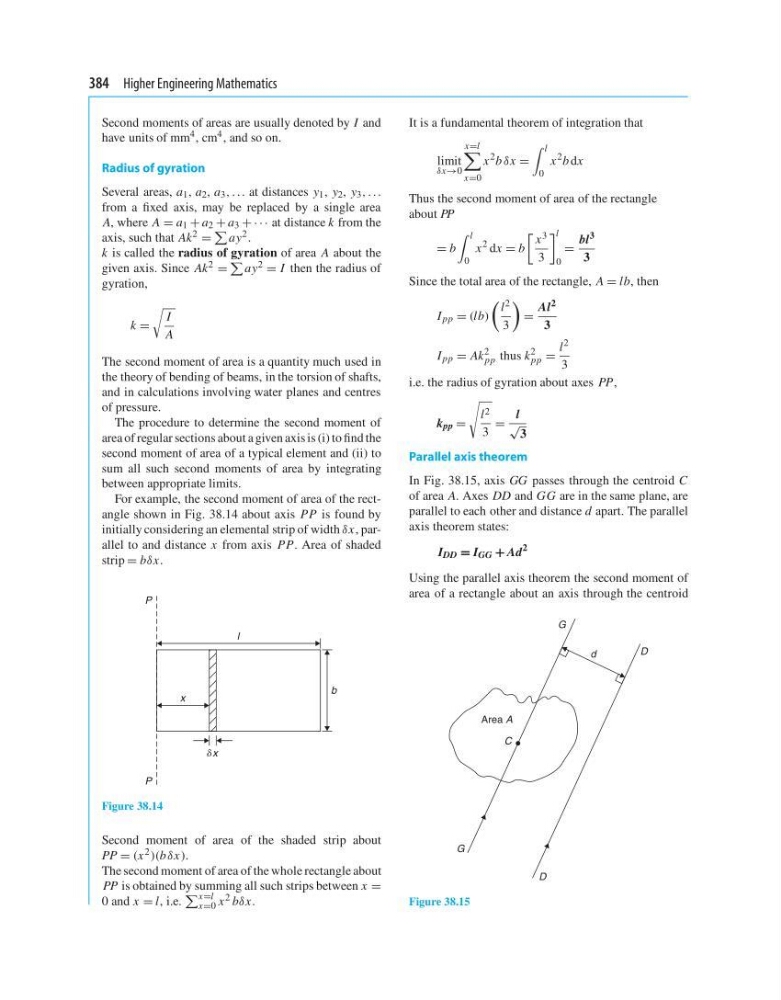
For example, the second moment of area of the rectangle shown in Fig. 38.14 about axis PP is found by
initially considering an elemental strip of width δx, parallel to and distance x from axis PP. Area of shaded
strip = bδx.
b
l
x
P
P
␦x
Figure 38.14
Second moment of area of the shaded strip about
PP = (x 2 )(b δx).
The second moment of area of the whole rectangle about
PP is obtained by summing all such strips between x =
0 and x = l, i.e.
x=l
x=0 x 2 bδx.
It is a fundamental theorem of integration that
limit
δx→0
x=l
x=0
x
2 b δx =
l
0
x
2 b dx
Thus the second moment of area of the rectangle
about PP
= b
l
0
x
2 dx = b
x 3
3
l
0
=
bl 3
3
Since the total area of the rectangle, A = lb, then
I pp = (lb)
l 2
3
=
Al 2
3
I pp = Ak
2
pp thus k
2
pp =
l
2
3
i.e. the radius of gyration about axes PP,
k pp =
l 2
3
=
l
√
3
Parallel axis theorem
In Fig. 38.15, axis GG passes through the centroid C
of area A. Axes DD and GG are in the same plane, are
parallel to each other and distance d apart. The parallel
axis theorem states:
I DD = I GG + Ad
2
Using the parallel axis theorem the second moment of
area of a rectangle about an axis through the centroid
d
G
C
Area A
G
D
D
Figure 38.15
Second moments of areas are usually denoted by I and
have units of mm 4 , cm 4 , and so on.
Radius of gyration
Several areas, a 1 , a 2 , a 3 , ... at distances y 1 , y 2 , y 3 , ...
from a fixed axis, may be replaced by a single area
A, where A = a 1 + a 2 + a 3 + · · · at distance k from the
axis, such that Ak 2 =
ay 2 .
k is called the radius of gyration of area A about the
given axis. Since Ak 2 =
ay 2 = I then the radius of
gyration,
k =
I
A
The second moment of area is a quantity much used in
the theory of bending of beams, in the torsion of shafts,
and in calculations involving water planes and centres
of pressure.
The procedure to determine the second moment of
area of regular sections about a given axis is (i) to find the
second moment of area of a typical element and (ii) to
sum all such second moments of area by integrating
between appropriate limits.
For example, the second moment of area of the rectangle shown in Fig. 38.14 about axis PP is found by
initially considering an elemental strip of width δx, parallel to and distance x from axis PP. Area of shaded
strip = bδx.
b
l
x
P
P
␦x
Figure 38.14
Second moment of area of the shaded strip about
PP = (x 2 )(b δx).
The second moment of area of the whole rectangle about
PP is obtained by summing all such strips between x =
0 and x = l, i.e.
x=l
x=0 x 2 bδx.
It is a fundamental theorem of integration that
limit
δx→0
x=l
x=0
x
2 b δx =
l
0
x
2 b dx
Thus the second moment of area of the rectangle
about PP
= b
l
0
x
2 dx = b
x 3
3
l
0
=
bl 3
3
Since the total area of the rectangle, A = lb, then
I pp = (lb)
l 2
3
=
Al 2
3
I pp = Ak
2
pp thus k
2
pp =
l
2
3
i.e. the radius of gyration about axes PP,
k pp =
l 2
3
=
l
√
3
Parallel axis theorem
In Fig. 38.15, axis GG passes through the centroid C
of area A. Axes DD and GG are in the same plane, are
parallel to each other and distance d apart. The parallel
axis theorem states:
I DD = I GG + Ad
2
Using the parallel axis theorem the second moment of
area of a rectangle about an axis through the centroid
d
G
C
Area A
G
D
D
Figure 38.15