

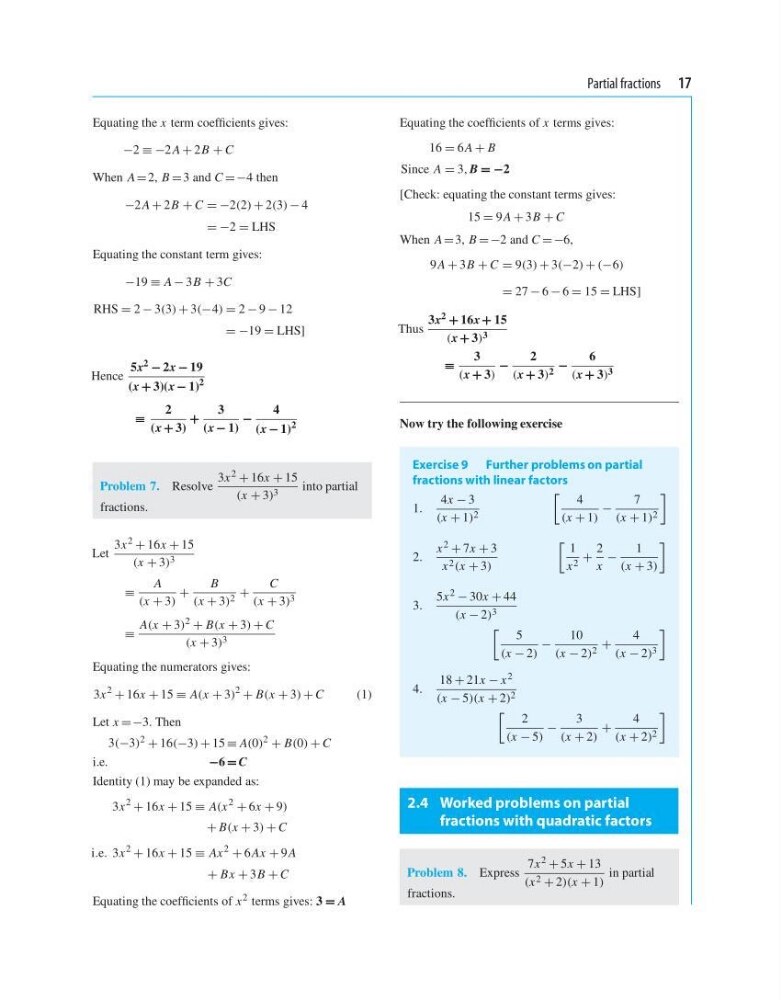
Partial fractions 17
Equating the x term coefficients gives:
−2 ≡ −2 A + 2B + C
When A = 2, B = 3 and C =−4 then
−2 A + 2B + C = −2(2) + 2(3) − 4
= −2 = LHS
Equating the constant term gives:
−19 ≡ A − 3B + 3C
RHS = 2 − 3(3) + 3(−4) = 2 − 9 − 12
= −19 = LHS]
Hence
5x 2 − 2x − 19
(x + 3)(x − 1)
2
≡
2
(x + 3)
+
3
(x − 1)
−
4
(x − 1)
2
Problem 7. Resolve
3x 2 + 16x + 15
(x + 3) 3
into partial
fractions.
Let
3x 2 + 16x + 15
(x + 3) 3
≡
A
(x + 3)
+
B
(x + 3) 2 +
C
(x + 3) 3
≡
A(x + 3) 2 + B(x + 3) + C
(x + 3) 3
Equating the numerators gives:
3x
2
+ 16x + 15 ≡ A(x + 3)
2
+ B(x + 3) + C
(1)
Let x =−3. Then
3(−3) 2 + 16(−3) + 15 ≡ A(0) 2 + B(0) + C
i.e.
−6 = C
Identity (1) may be expanded as:
3x
2
+ 16x + 15 ≡ A(x
2
+ 6x + 9)
+ B(x + 3) + C
i.e. 3x
2
+ 16x + 15 ≡ Ax
2
+ 6 Ax + 9 A
+ Bx + 3B + C
Equating the coefficients of x 2 terms gives: 3 = A
Equating the coefficients of x terms gives:
16 = 6 A + B
Since A = 3, B = −2
[Check: equating the constant terms gives:
15 = 9 A + 3B + C
When A = 3, B =−2 and C =−6,
9 A + 3B + C = 9(3) + 3(−2) + (−6)
= 27 − 6 − 6 = 15 = LHS]
Thus
3x 2 + 16x + 15
(x + 3) 3
≡
3
(x + 3)
−
2
(x + 3) 2 −
6
(x + 3) 3
Now try the following exercise
Exercise 9 Further problems on partial
fractions with linear factors
1.
4x − 3
(x + 1) 2
4
(x + 1)
−
7
(x + 1) 2
2.
x 2 + 7x + 3
x 2 (x + 3)
1
x 2 +
2
x
−
1
(x + 3)
3.
5x 2 − 30x + 44
(x − 2) 3
5
(x − 2)
−
10
(x − 2) 2 +
4
(x − 2) 3
4.
18 + 21x − x 2
(x − 5)(x + 2) 2
2
(x − 5)
−
3
(x + 2)
+
4
(x + 2) 2
2.4 Worked problems on partial
fractions with quadratic factors
Problem 8. Express
7x 2 + 5x + 13
(x 2 + 2)(x + 1)
in partial
fractions.
Equating the x term coefficients gives:
−2 ≡ −2 A + 2B + C
When A = 2, B = 3 and C =−4 then
−2 A + 2B + C = −2(2) + 2(3) − 4
= −2 = LHS
Equating the constant term gives:
−19 ≡ A − 3B + 3C
RHS = 2 − 3(3) + 3(−4) = 2 − 9 − 12
= −19 = LHS]
Hence
5x 2 − 2x − 19
(x + 3)(x − 1)
2
≡
2
(x + 3)
+
3
(x − 1)
−
4
(x − 1)
2
Problem 7. Resolve
3x 2 + 16x + 15
(x + 3) 3
into partial
fractions.
Let
3x 2 + 16x + 15
(x + 3) 3
≡
A
(x + 3)
+
B
(x + 3) 2 +
C
(x + 3) 3
≡
A(x + 3) 2 + B(x + 3) + C
(x + 3) 3
Equating the numerators gives:
3x
2
+ 16x + 15 ≡ A(x + 3)
2
+ B(x + 3) + C
(1)
Let x =−3. Then
3(−3) 2 + 16(−3) + 15 ≡ A(0) 2 + B(0) + C
i.e.
−6 = C
Identity (1) may be expanded as:
3x
2
+ 16x + 15 ≡ A(x
2
+ 6x + 9)
+ B(x + 3) + C
i.e. 3x
2
+ 16x + 15 ≡ Ax
2
+ 6 Ax + 9 A
+ Bx + 3B + C
Equating the coefficients of x 2 terms gives: 3 = A
Equating the coefficients of x terms gives:
16 = 6 A + B
Since A = 3, B = −2
[Check: equating the constant terms gives:
15 = 9 A + 3B + C
When A = 3, B =−2 and C =−6,
9 A + 3B + C = 9(3) + 3(−2) + (−6)
= 27 − 6 − 6 = 15 = LHS]
Thus
3x 2 + 16x + 15
(x + 3) 3
≡
3
(x + 3)
−
2
(x + 3) 2 −
6
(x + 3) 3
Now try the following exercise
Exercise 9 Further problems on partial
fractions with linear factors
1.
4x − 3
(x + 1) 2
4
(x + 1)
−
7
(x + 1) 2
2.
x 2 + 7x + 3
x 2 (x + 3)
1
x 2 +
2
x
−
1
(x + 3)
3.
5x 2 − 30x + 44
(x − 2) 3
5
(x − 2)
−
10
(x − 2) 2 +
4
(x − 2) 3
4.
18 + 21x − x 2
(x − 5)(x + 2) 2
2
(x − 5)
−
3
(x + 2)
+
4
(x + 2) 2
2.4 Worked problems on partial
fractions with quadratic factors
Problem 8. Express
7x 2 + 5x + 13
(x 2 + 2)(x + 1)
in partial
fractions.