

16 Higher Engineering Mathematics
5.
x 2 + 9x + 8
x 2 + x − 6
1 +
2
(x + 3)
+
6
(x − 2)
6.
x 2 − x − 14
x 2 − 2x − 3
1 −
2
(x − 3)
+
3
(x + 1)
7.
3x 3 − 2x 2 − 16x + 20
(x − 2)(x + 2)
3x − 2 +
1
(x − 2)
−
5
(x + 2)
2.3 Worked problems on partial
fractions with repeated linear
factors
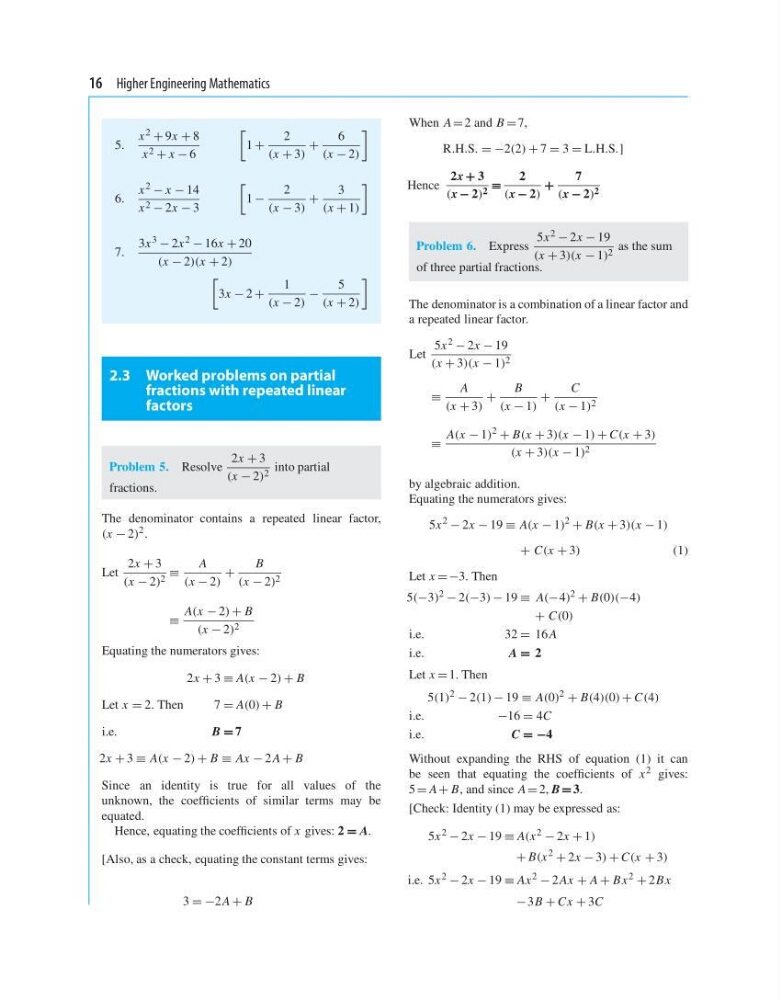
Problem 5. Resolve
2x + 3
(x − 2) 2 into partial
fractions.
The denominator contains a repeated linear factor,
(x − 2) 2 .
Let
2x + 3
(x − 2) 2 ≡
A
(x − 2)
+
B
(x − 2) 2
≡
A(x − 2) + B
(x − 2) 2
Equating the numerators gives:
2x + 3 ≡ A(x − 2) + B
Let x = 2. Then
7 = A(0) + B
i.e.
B = 7
2x + 3 ≡ A(x − 2) + B ≡ Ax − 2 A + B
Since an identity is true for all values of the
unknown, the coefficients of similar terms may be
equated.
Hence, equating the coefficients of x gives: 2 = A.
[Also, as a check, equating the constant terms gives:
3 = −2 A + B
When A = 2 and B = 7,
R.H.S. = −2(2) + 7 = 3 = L.H.S.]
Hence
2x + 3
(x − 2) 2 ≡
2
(x − 2)
+
7
(x − 2) 2
Problem 6. Express
5x 2 − 2x − 19
(x + 3)(x − 1) 2 as the sum
of three partial fractions.
The denominator is a combination of a linear factor and
a repeated linear factor.
Let
5x 2 − 2x − 19
(x + 3)(x − 1) 2
≡
A
(x + 3)
+
B
(x − 1)
+
C
(x − 1) 2
≡
A(x − 1) 2 + B(x + 3)(x − 1) + C(x + 3)
(x + 3)(x − 1) 2
by algebraic addition.
Equating the numerators gives:
5x
2
− 2x − 19 ≡ A(x − 1)
2
+ B(x + 3)(x − 1)
+ C(x + 3)
(1)
Let x =−3. Then
5(−3) 2 − 2(−3) − 19 ≡ A(−4) 2 + B(0)(−4)
+ C(0)
i.e.
32 = 16 A
i.e.
A = 2
Let x = 1. Then
5(1) 2 − 2(1) − 19 ≡ A(0) 2 + B(4)(0) + C(4)
i.e.
−16 = 4C
i.e.
C = −4
Without expanding the RHS of equation (1) it can
be seen that equating the coefficients of x 2 gives:
5 = A + B, and since A = 2, B = 3.
[Check: Identity (1) may be expressed as:
5x 2 − 2x − 19 ≡ A(x 2 − 2x + 1)
+ B(x
2
+ 2x − 3) + C(x + 3)
i.e. 5x 2 − 2x − 19 ≡ Ax 2 − 2 Ax + A + Bx 2 + 2Bx
− 3B + Cx + 3C
5.
x 2 + 9x + 8
x 2 + x − 6
1 +
2
(x + 3)
+
6
(x − 2)
6.
x 2 − x − 14
x 2 − 2x − 3
1 −
2
(x − 3)
+
3
(x + 1)
7.
3x 3 − 2x 2 − 16x + 20
(x − 2)(x + 2)
3x − 2 +
1
(x − 2)
−
5
(x + 2)
2.3 Worked problems on partial
fractions with repeated linear
factors
Problem 5. Resolve
2x + 3
(x − 2) 2 into partial
fractions.
The denominator contains a repeated linear factor,
(x − 2) 2 .
Let
2x + 3
(x − 2) 2 ≡
A
(x − 2)
+
B
(x − 2) 2
≡
A(x − 2) + B
(x − 2) 2
Equating the numerators gives:
2x + 3 ≡ A(x − 2) + B
Let x = 2. Then
7 = A(0) + B
i.e.
B = 7
2x + 3 ≡ A(x − 2) + B ≡ Ax − 2 A + B
Since an identity is true for all values of the
unknown, the coefficients of similar terms may be
equated.
Hence, equating the coefficients of x gives: 2 = A.
[Also, as a check, equating the constant terms gives:
3 = −2 A + B
When A = 2 and B = 7,
R.H.S. = −2(2) + 7 = 3 = L.H.S.]
Hence
2x + 3
(x − 2) 2 ≡
2
(x − 2)
+
7
(x − 2) 2
Problem 6. Express
5x 2 − 2x − 19
(x + 3)(x − 1) 2 as the sum
of three partial fractions.
The denominator is a combination of a linear factor and
a repeated linear factor.
Let
5x 2 − 2x − 19
(x + 3)(x − 1) 2
≡
A
(x + 3)
+
B
(x − 1)
+
C
(x − 1) 2
≡
A(x − 1) 2 + B(x + 3)(x − 1) + C(x + 3)
(x + 3)(x − 1) 2
by algebraic addition.
Equating the numerators gives:
5x
2
− 2x − 19 ≡ A(x − 1)
2
+ B(x + 3)(x − 1)
+ C(x + 3)
(1)
Let x =−3. Then
5(−3) 2 − 2(−3) − 19 ≡ A(−4) 2 + B(0)(−4)
+ C(0)
i.e.
32 = 16 A
i.e.
A = 2
Let x = 1. Then
5(1) 2 − 2(1) − 19 ≡ A(0) 2 + B(4)(0) + C(4)
i.e.
−16 = 4C
i.e.
C = −4
Without expanding the RHS of equation (1) it can
be seen that equating the coefficients of x 2 gives:
5 = A + B, and since A = 2, B = 3.
[Check: Identity (1) may be expressed as:
5x 2 − 2x − 19 ≡ A(x 2 − 2x + 1)
+ B(x
2
+ 2x − 3) + C(x + 3)
i.e. 5x 2 − 2x − 19 ≡ Ax 2 − 2 Ax + A + Bx 2 + 2Bx
− 3B + Cx + 3C