

304 Higher Engineering Mathematics
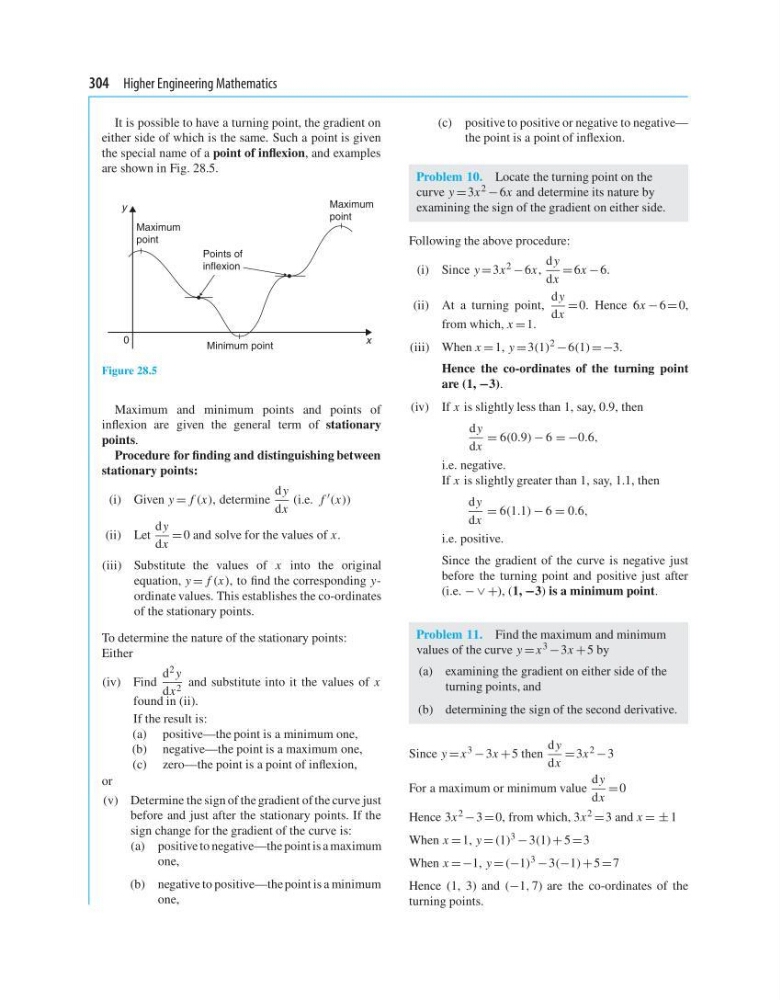
It is possible to have a turning point, the gradient on
either side of which is the same. Such a point is given
the special name of a point of inflexion, and examples
are shown in Fig. 28.5.
0
y
x
Maximum
point
Minimum point
Maximum
point
Points of
inflexion
Figure 28.5
Maximum and minimum points and points of
inflexion are given the general term of stationary
points.
Procedure for finding and distinguishing between
stationary points:
(i) Given y = f (x), determine
d y
dx
(i.e. f (x))
(ii) Let
d y
dx
= 0 and solve for the values of x.
(iii) Substitute the values of x into the original
equation, y = f (x), to find the corresponding yordinate values. This establishes the co-ordinates
of the stationary points.
To determine the nature of the stationary points:
Either
(iv) Find
d 2 y
dx 2 and substitute into it the values of x
found in (ii).
If the result is:
(a) positive—the point is a minimum one,
(b) negative—the point is a maximum one,
(c) zero—the point is a point of inflexion,
or
(v) Determine the sign of the gradient of the curve just
before and just after the stationary points. If the
sign change for the gradient of the curve is:
(a) positive to negative—the point is a maximum
one,
(b) negative to positive—the point is a minimum
one,
(c) positive to positive or negative to negative—
the point is a point of inflexion.
Problem 10. Locate the turning point on the
curve y = 3x 2 − 6x and determine its nature by
examining the sign of the gradient on either side.
Following the above procedure:
(i) Since y = 3x 2 − 6x,
d y
dx
= 6x − 6.
(ii) At a turning point,
d y
dx
= 0. Hence 6x − 6 = 0,
from which, x = 1.
(iii) When x = 1, y = 3(1)
2
− 6(1) =−3.
Hence the co-ordinates of the turning point
are (1, −3).
(iv) If x is slightly less than 1, say, 0.9, then
d y
dx
= 6(0.9) − 6 = −0.6,
i.e. negative.
If x is slightly greater than 1, say, 1.1, then
d y
dx
= 6(1.1) − 6 = 0.6,
i.e. positive.
Since the gradient of the curve is negative just
before the turning point and positive just after
(i.e. − ∨ +), (1, −3) is a minimum point.
Problem 11. Find the maximum and minimum
values of the curve y = x 3 − 3x + 5 by
(a) examining the gradient on either side of the
turning points, and
(b) determining the sign of the second derivative.
Since y = x 3 − 3x + 5 then
d y
dx
= 3x 2 − 3
For a maximum or minimum value
d y
dx
= 0
Hence 3x 2 − 3 = 0, from which, 3x 2 = 3 and x = ± 1
When x = 1, y = (1) 3 − 3(1) + 5 =3
When x =−1, y = (−1) 3 − 3(−1) + 5 =7
Hence (1, 3) and (−1, 7) are the co-ordinates of the
turning points.
It is possible to have a turning point, the gradient on
either side of which is the same. Such a point is given
the special name of a point of inflexion, and examples
are shown in Fig. 28.5.
0
y
x
Maximum
point
Minimum point
Maximum
point
Points of
inflexion
Figure 28.5
Maximum and minimum points and points of
inflexion are given the general term of stationary
points.
Procedure for finding and distinguishing between
stationary points:
(i) Given y = f (x), determine
d y
dx
(i.e. f (x))
(ii) Let
d y
dx
= 0 and solve for the values of x.
(iii) Substitute the values of x into the original
equation, y = f (x), to find the corresponding yordinate values. This establishes the co-ordinates
of the stationary points.
To determine the nature of the stationary points:
Either
(iv) Find
d 2 y
dx 2 and substitute into it the values of x
found in (ii).
If the result is:
(a) positive—the point is a minimum one,
(b) negative—the point is a maximum one,
(c) zero—the point is a point of inflexion,
or
(v) Determine the sign of the gradient of the curve just
before and just after the stationary points. If the
sign change for the gradient of the curve is:
(a) positive to negative—the point is a maximum
one,
(b) negative to positive—the point is a minimum
one,
(c) positive to positive or negative to negative—
the point is a point of inflexion.
Problem 10. Locate the turning point on the
curve y = 3x 2 − 6x and determine its nature by
examining the sign of the gradient on either side.
Following the above procedure:
(i) Since y = 3x 2 − 6x,
d y
dx
= 6x − 6.
(ii) At a turning point,
d y
dx
= 0. Hence 6x − 6 = 0,
from which, x = 1.
(iii) When x = 1, y = 3(1)
2
− 6(1) =−3.
Hence the co-ordinates of the turning point
are (1, −3).
(iv) If x is slightly less than 1, say, 0.9, then
d y
dx
= 6(0.9) − 6 = −0.6,
i.e. negative.
If x is slightly greater than 1, say, 1.1, then
d y
dx
= 6(1.1) − 6 = 0.6,
i.e. positive.
Since the gradient of the curve is negative just
before the turning point and positive just after
(i.e. − ∨ +), (1, −3) is a minimum point.
Problem 11. Find the maximum and minimum
values of the curve y = x 3 − 3x + 5 by
(a) examining the gradient on either side of the
turning points, and
(b) determining the sign of the second derivative.
Since y = x 3 − 3x + 5 then
d y
dx
= 3x 2 − 3
For a maximum or minimum value
d y
dx
= 0
Hence 3x 2 − 3 = 0, from which, 3x 2 = 3 and x = ± 1
When x = 1, y = (1) 3 − 3(1) + 5 =3
When x =−1, y = (−1) 3 − 3(−1) + 5 =7
Hence (1, 3) and (−1, 7) are the co-ordinates of the
turning points.