

Some applications of differentiation 303
Now try the following exercise
Exercise 121 Further problems on velocity
and acceleration
1. A missile fired from ground level rises
x metres vertically upwards in t seconds and
x = 100t −
25
2
t 2 . Find (a) the initial velocity
of the missile, (b) the time when the height of
the missile is a maximum, (c) the maximum
height reached, (d) the velocity with which the
missile strikes the ground.
(a) 100 m/s (b) 4 s
(c) 200 m
(d) −100 m/s
2. The distance s metres travelled by a car
in t seconds after the brakes are applied is
given by s = 25t − 2.5t 2 . Find (a) the speed
of the car (in km/h) when the brakes are
applied, (b) the distance the car travels before it
stops.
[(a) 90 km/h (b) 62.5 m]
3. The equation θ = 10π + 24t − 3t 2 gives the
angle θ, in radians, through which a wheel
turns in t seconds. Determine (a) the time
the wheel takes to come to rest, (b) the
angle turned through in the last second of
movement.
[(a) 4 s (b) 3 rads]
4. At any time t seconds the distance x metres
of a particle moving in a straight line from
a fixed point is given by x = 4t + ln(1 − t ).
Determine (a) the initial velocity and
acceleration (b) the velocity and acceleration
after 1.5 s (c) the time when the velocity is
zero.
⎡
⎢
⎢
⎣
(a) 3 m/s; −1 m/s 2
(b) 6 m/s; −4 m/s 2
(c)
3
4 s
⎤
⎥
⎥
⎦
5. The angular displacement θ of a rotating disc is
given by θ = 6 sin
t
4
, where t is the time in seconds. Determine (a) the angular velocity of the
disc when t is 1.5 s, (b) the angular acceleration
when t is 5.5 s, and (c) the first time when the
angular velocity is zero.
⎡
⎢
⎣
(a)ω = 1.40 rad/s
(b)α = −0.37 rad/s 2
(c) t = 6.28 s
⎤
⎥
⎦
6. x =
20t 3
3
−
23t 2
2
+ 6t + 5 represents the distance, x metres, moved by a body in t seconds.
Determine (a) the velocity and acceleration
at the start, (b) the velocity and acceleration
when t = 3 s, (c) the values of t when the
body is at rest, (d) the value of t when the
acceleration is 37 m/s 2 and (e) the distance
travelled in the third second.
⎡
⎢
⎢
⎢
⎢
⎢
⎢
⎣
(a) 6 m/s; −23 m/s 2
(b) 117 m/s; 97 m/s 2
(c)
3
4 s or
2
5 s
(d) 1
1
2 s
(e) 75
1
6 m
⎤
⎥
⎥
⎥
⎥
⎥
⎥
⎦
28.3 Turning points
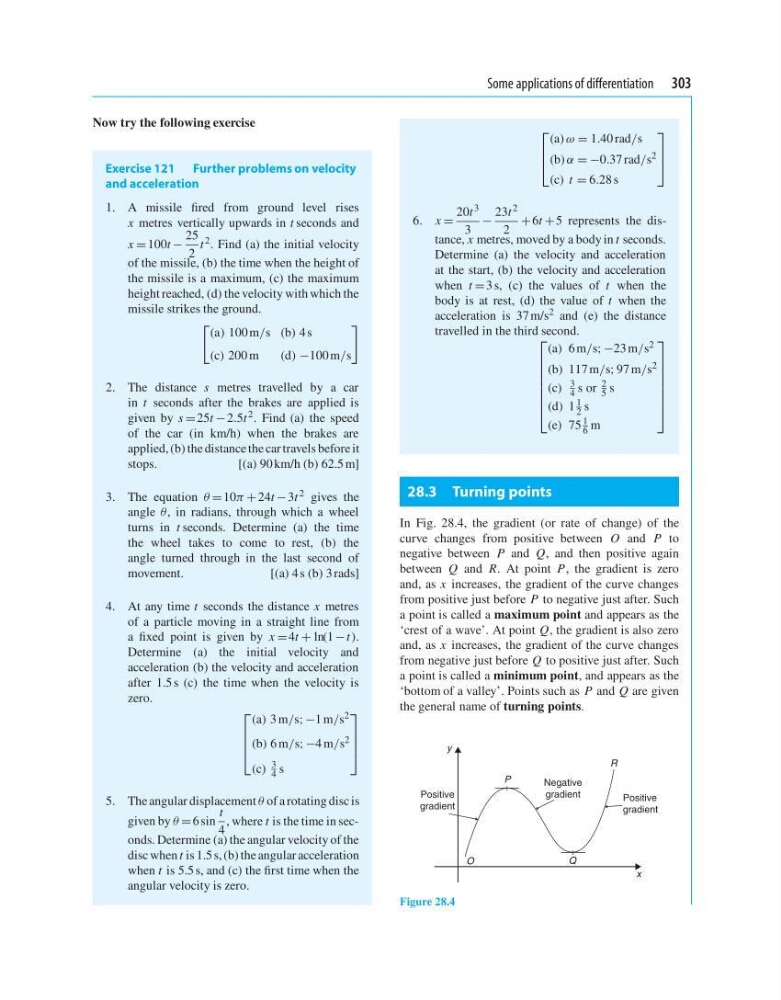
In Fig. 28.4, the gradient (or rate of change) of the
curve changes from positive between O and P to
negative between P and Q, and then positive again
between Q and R. At point P, the gradient is zero
and, as x increases, the gradient of the curve changes
from positive just before P to negative just after. Such
a point is called a maximum point and appears as the
‘crest of a wave’. At point Q, the gradient is also zero
and, as x increases, the gradient of the curve changes
from negative just before Q to positive just after. Such
a point is called a minimum point, and appears as the
‘bottom of a valley’. Points such as P and Q are given
the general name of turning points.
O
Q
y
P
R
x
Positive
gradient
Positive
gradient
Negative
gradient
Figure 28.4
Now try the following exercise
Exercise 121 Further problems on velocity
and acceleration
1. A missile fired from ground level rises
x metres vertically upwards in t seconds and
x = 100t −
25
2
t 2 . Find (a) the initial velocity
of the missile, (b) the time when the height of
the missile is a maximum, (c) the maximum
height reached, (d) the velocity with which the
missile strikes the ground.
(a) 100 m/s (b) 4 s
(c) 200 m
(d) −100 m/s
2. The distance s metres travelled by a car
in t seconds after the brakes are applied is
given by s = 25t − 2.5t 2 . Find (a) the speed
of the car (in km/h) when the brakes are
applied, (b) the distance the car travels before it
stops.
[(a) 90 km/h (b) 62.5 m]
3. The equation θ = 10π + 24t − 3t 2 gives the
angle θ, in radians, through which a wheel
turns in t seconds. Determine (a) the time
the wheel takes to come to rest, (b) the
angle turned through in the last second of
movement.
[(a) 4 s (b) 3 rads]
4. At any time t seconds the distance x metres
of a particle moving in a straight line from
a fixed point is given by x = 4t + ln(1 − t ).
Determine (a) the initial velocity and
acceleration (b) the velocity and acceleration
after 1.5 s (c) the time when the velocity is
zero.
⎡
⎢
⎢
⎣
(a) 3 m/s; −1 m/s 2
(b) 6 m/s; −4 m/s 2
(c)
3
4 s
⎤
⎥
⎥
⎦
5. The angular displacement θ of a rotating disc is
given by θ = 6 sin
t
4
, where t is the time in seconds. Determine (a) the angular velocity of the
disc when t is 1.5 s, (b) the angular acceleration
when t is 5.5 s, and (c) the first time when the
angular velocity is zero.
⎡
⎢
⎣
(a)ω = 1.40 rad/s
(b)α = −0.37 rad/s 2
(c) t = 6.28 s
⎤
⎥
⎦
6. x =
20t 3
3
−
23t 2
2
+ 6t + 5 represents the distance, x metres, moved by a body in t seconds.
Determine (a) the velocity and acceleration
at the start, (b) the velocity and acceleration
when t = 3 s, (c) the values of t when the
body is at rest, (d) the value of t when the
acceleration is 37 m/s 2 and (e) the distance
travelled in the third second.
⎡
⎢
⎢
⎢
⎢
⎢
⎢
⎣
(a) 6 m/s; −23 m/s 2
(b) 117 m/s; 97 m/s 2
(c)
3
4 s or
2
5 s
(d) 1
1
2 s
(e) 75
1
6 m
⎤
⎥
⎥
⎥
⎥
⎥
⎥
⎦
28.3 Turning points
In Fig. 28.4, the gradient (or rate of change) of the
curve changes from positive between O and P to
negative between P and Q, and then positive again
between Q and R. At point P, the gradient is zero
and, as x increases, the gradient of the curve changes
from positive just before P to negative just after. Such
a point is called a maximum point and appears as the
‘crest of a wave’. At point Q, the gradient is also zero
and, as x increases, the gradient of the curve changes
from negative just before Q to positive just after. Such
a point is called a minimum point, and appears as the
‘bottom of a valley’. Points such as P and Q are given
the general name of turning points.
O
Q
y
P
R
x
Positive
gradient
Positive
gradient
Negative
gradient
Figure 28.4