

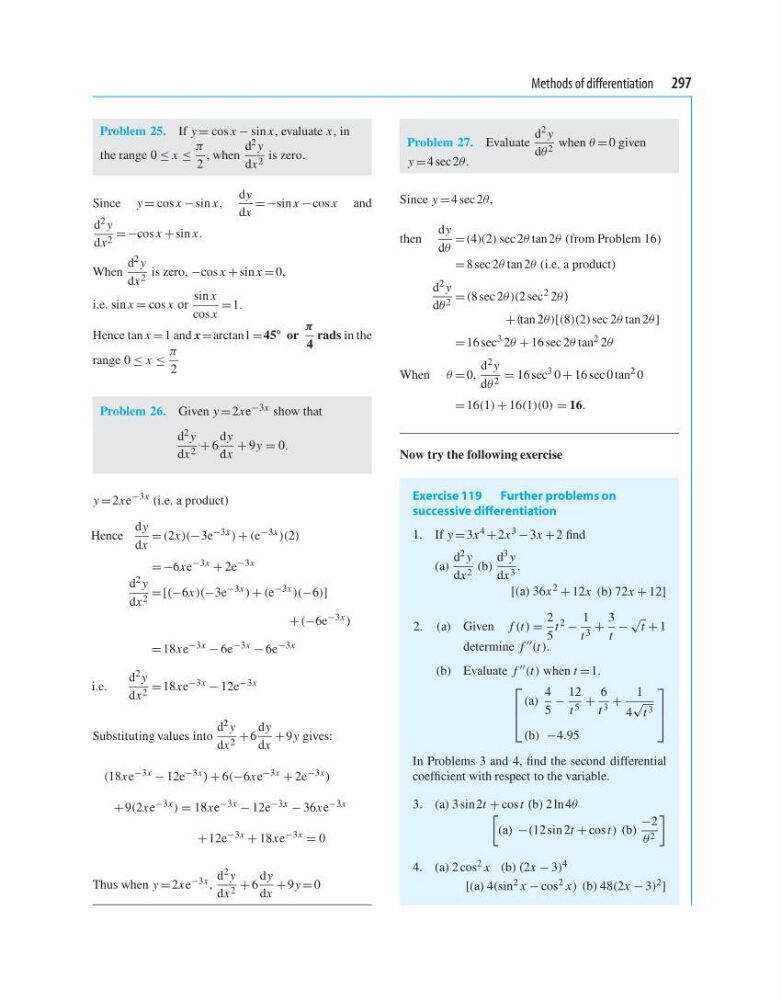
Methods of differentiation 297
Problem 25. If y = cos x − sin x, evaluate x, in
the range 0 ≤ x ≤
π
2
, when
d 2 y
dx 2 is zero.
Since y = cos x − sin x,
dy
dx
=−sin x − cos x and
d 2 y
dx 2 =−cos x + sin x.
When
d
2 y
dx 2 is zero, −cos x + sin x = 0,
i.e. sin x = cos x or
sin x
cos x
= 1.
Hence tan x = 1 and x =arctan1 =45
◦ or
π
4
rads in the
range 0 ≤ x ≤
π
2
Problem 26. Given y = 2xe −3x show that
d 2 y
dx 2 + 6
dy
dx
+ 9y = 0.
y = 2xe
−3x (i.e. a product)
Hence
dy
dx
= (2x)(−3e −3x ) + (e −3x )(2)
= −6xe −3x + 2e −3x
d 2 y
dx 2 = [(−6x)(−3e −3x ) + (e −3x )(−6)]
+ (−6e −3x )
= 18xe −3x − 6e −3x − 6e −3x
i.e.
d
2 y
dx 2 = 18xe −3x − 12e −3x
Substituting values into
d
2 y
dx 2 + 6
dy
dx
+ 9y gives:
(18xe −3x − 12e −3x ) + 6(−6xe −3x + 2e −3x )
+ 9(2xe −3x ) = 18xe −3x − 12e −3x − 36xe −3x
+ 12e −3x + 18xe −3x = 0
Thus when y = 2xe −3x ,
d
2 y
dx 2 + 6
dy
dx
+ 9y = 0
Problem 27. Evaluate
d
2 y
dθ 2 when θ = 0 given
y = 4 sec2θ.
Since y = 4 sec2θ,
then
dy
dθ
= (4)(2) sec 2θ tan 2θ (from Problem 16)
= 8 sec 2θ tan 2θ (i.e. a product)
d
2 y
dθ 2 = (8 sec 2θ)(2 sec 2 2θ)
+ (tan 2θ)[(8)(2) sec 2θ tan 2θ]
= 16 sec 3 2θ + 16 sec 2θ tan 2 2θ
When θ = 0,
d 2 y
dθ 2 = 16 sec
3 0 + 16 sec 0 tan
2 0
= 16(1) + 16(1)(0) = 16.
Now try the following exercise
Exercise 119 Further problems on
successive differentiation
1. If y = 3x 4 + 2x 3 − 3x + 2 find
(a)
d 2 y
dx 2 (b)
d 3 y
dx 3 .
[(a) 36x 2 + 12x (b) 72x + 12]
2. (a) Given f (t ) =
2
5
t 2 −
1
t 3 +
3
t
−
√
t + 1
determine f (t ).
(b) Evaluate f (t ) when t = 1.
⎡
⎢
⎣
(a)
4
5
−
12
t 5 +
6
t 3 +
1
4
√
t 3
(b) −4.95
⎤
⎥
⎦
In Problems 3 and 4, find the second differential
coefficient with respect to the variable.
3. (a) 3 sin 2t + cos t (b) 2 ln 4θ
(a) −(12 sin 2t + cos t ) (b)
−2
θ 2
4. (a) 2 cos 2 x (b) (2x − 3) 4
[(a) 4(sin 2 x − cos 2 x) (b) 48(2x − 3) 2 ]
Problem 25. If y = cos x − sin x, evaluate x, in
the range 0 ≤ x ≤
π
2
, when
d 2 y
dx 2 is zero.
Since y = cos x − sin x,
dy
dx
=−sin x − cos x and
d 2 y
dx 2 =−cos x + sin x.
When
d
2 y
dx 2 is zero, −cos x + sin x = 0,
i.e. sin x = cos x or
sin x
cos x
= 1.
Hence tan x = 1 and x =arctan1 =45
◦ or
π
4
rads in the
range 0 ≤ x ≤
π
2
Problem 26. Given y = 2xe −3x show that
d 2 y
dx 2 + 6
dy
dx
+ 9y = 0.
y = 2xe
−3x (i.e. a product)
Hence
dy
dx
= (2x)(−3e −3x ) + (e −3x )(2)
= −6xe −3x + 2e −3x
d 2 y
dx 2 = [(−6x)(−3e −3x ) + (e −3x )(−6)]
+ (−6e −3x )
= 18xe −3x − 6e −3x − 6e −3x
i.e.
d
2 y
dx 2 = 18xe −3x − 12e −3x
Substituting values into
d
2 y
dx 2 + 6
dy
dx
+ 9y gives:
(18xe −3x − 12e −3x ) + 6(−6xe −3x + 2e −3x )
+ 9(2xe −3x ) = 18xe −3x − 12e −3x − 36xe −3x
+ 12e −3x + 18xe −3x = 0
Thus when y = 2xe −3x ,
d
2 y
dx 2 + 6
dy
dx
+ 9y = 0
Problem 27. Evaluate
d
2 y
dθ 2 when θ = 0 given
y = 4 sec2θ.
Since y = 4 sec2θ,
then
dy
dθ
= (4)(2) sec 2θ tan 2θ (from Problem 16)
= 8 sec 2θ tan 2θ (i.e. a product)
d
2 y
dθ 2 = (8 sec 2θ)(2 sec 2 2θ)
+ (tan 2θ)[(8)(2) sec 2θ tan 2θ]
= 16 sec 3 2θ + 16 sec 2θ tan 2 2θ
When θ = 0,
d 2 y
dθ 2 = 16 sec
3 0 + 16 sec 0 tan
2 0
= 16(1) + 16(1)(0) = 16.
Now try the following exercise
Exercise 119 Further problems on
successive differentiation
1. If y = 3x 4 + 2x 3 − 3x + 2 find
(a)
d 2 y
dx 2 (b)
d 3 y
dx 3 .
[(a) 36x 2 + 12x (b) 72x + 12]
2. (a) Given f (t ) =
2
5
t 2 −
1
t 3 +
3
t
−
√
t + 1
determine f (t ).
(b) Evaluate f (t ) when t = 1.
⎡
⎢
⎣
(a)
4
5
−
12
t 5 +
6
t 3 +
1
4
√
t 3
(b) −4.95
⎤
⎥
⎦
In Problems 3 and 4, find the second differential
coefficient with respect to the variable.
3. (a) 3 sin 2t + cos t (b) 2 ln 4θ
(a) −(12 sin 2t + cos t ) (b)
−2
θ 2
4. (a) 2 cos 2 x (b) (2x − 3) 4
[(a) 4(sin 2 x − cos 2 x) (b) 48(2x − 3) 2 ]