

296 Higher Engineering Mathematics
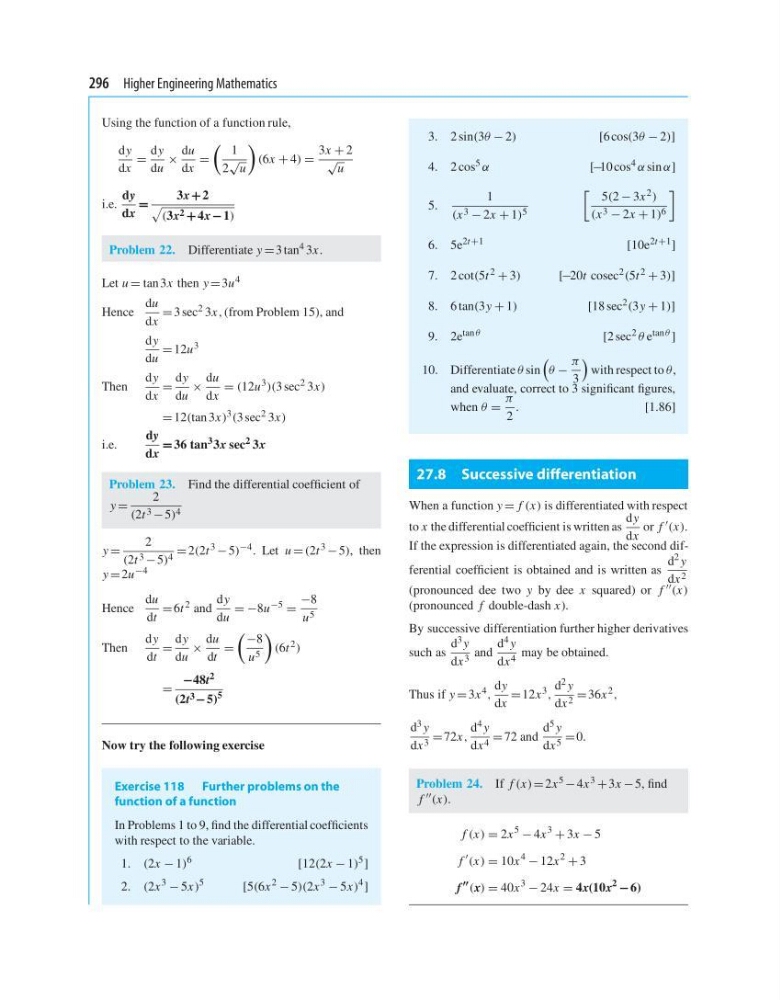
Using the function of a function rule,
dy
dx
=
dy
du
×
du
dx
=
1
2
√
u
(6x + 4) =
3x + 2
√
u
i.e.
dy
dx
=
3x + 2
(3x 2 + 4x − 1)
Problem 22. Differentiate y = 3 tan 4 3x.
Let u = tan 3x then y = 3u 4
Hence
du
dx
= 3 sec 2 3x, (from Problem 15), and
dy
du
= 12u 3
Then
dy
dx
=
dy
du
×
du
dx
= (12u 3 )(3 sec 2 3x)
= 12(tan 3x) 3 (3 sec 2 3x)
i.e.
dy
dx
= 36 tan 3 3x sec 2 3x
Problem 23. Find the differential coefficient of
y =
2
(2t 3 − 5) 4
y =
2
(2t 3 − 5) 4 = 2(2t 3 − 5) −4 . Let u = (2t 3 − 5), then
y = 2u −4
Hence
du
dt
= 6t 2 and
dy
du
= −8u −5 =
−8
u 5
Then
dy
dt
=
dy
du
×
du
dt
=
−8
u 5
(6t 2 )
=
−48t 2
(2t 3 − 5)
5
Now try the following exercise
Exercise 118 Further problems on the
function of a function
In Problems 1 to 9, find the differential coefficients
with respect to the variable.
1. (2x − 1) 6
[12(2x − 1) 5 ]
2. (2x
3
− 5x)
5
[5(6x
2
− 5)(2x
3
− 5x)
4 ]
3. 2 sin(3θ − 2)
[6 cos(3θ − 2)]
4. 2 cos 5 α
[−10 cos 4 α sin α]
5.
1
(x 3 − 2x + 1) 5
5(2 − 3x 2 )
(x 3 − 2x + 1) 6
6. 5e 2t +1
[10e 2t +1 ]
7. 2 cot(5t 2 + 3)
[−20t cosec 2 (5t 2 + 3)]
8. 6 tan(3y + 1)
[18 sec 2 (3y + 1)]
9. 2e tan θ
[2 sec 2 θ e tan θ ]
10. Differentiate θ sin
θ −
π
3
with respect to θ,
and evaluate, correct to 3 significant figures,
when θ =
π
2
.
[1.86]
27.8 Successive differentiation
When a function y = f (x) is differentiated with respect
to x the differential coefficient is written as
dy
dx
or f (x).
If the expression is differentiated again, the second differential coefficient is obtained and is written as
d
2 y
dx 2
(pronounced dee two y by dee x squared) or f (x)
(pronounced f double-dash x).
By successive differentiation further higher derivatives
such as
d 3 y
dx 3 and
d 4 y
dx 4 may be obtained.
Thus if y = 3x 4 ,
dy
dx
= 12x 3 ,
d 2 y
dx 2 = 36x 2 ,
d 3 y
dx 3 = 72x,
d 4 y
dx 4 = 72 and
d 5 y
dx 5 = 0.
Problem 24. If f (x) = 2x 5 − 4x 3 + 3x − 5, find
f (x).
f (x) = 2x
5
− 4x
3
+ 3x − 5
f
(x) = 10x
4
− 12x
2
+ 3
f
(x) = 40x
3
− 24x = 4x(10x
2
− 6)
Using the function of a function rule,
dy
dx
=
dy
du
×
du
dx
=
1
2
√
u
(6x + 4) =
3x + 2
√
u
i.e.
dy
dx
=
3x + 2
(3x 2 + 4x − 1)
Problem 22. Differentiate y = 3 tan 4 3x.
Let u = tan 3x then y = 3u 4
Hence
du
dx
= 3 sec 2 3x, (from Problem 15), and
dy
du
= 12u 3
Then
dy
dx
=
dy
du
×
du
dx
= (12u 3 )(3 sec 2 3x)
= 12(tan 3x) 3 (3 sec 2 3x)
i.e.
dy
dx
= 36 tan 3 3x sec 2 3x
Problem 23. Find the differential coefficient of
y =
2
(2t 3 − 5) 4
y =
2
(2t 3 − 5) 4 = 2(2t 3 − 5) −4 . Let u = (2t 3 − 5), then
y = 2u −4
Hence
du
dt
= 6t 2 and
dy
du
= −8u −5 =
−8
u 5
Then
dy
dt
=
dy
du
×
du
dt
=
−8
u 5
(6t 2 )
=
−48t 2
(2t 3 − 5)
5
Now try the following exercise
Exercise 118 Further problems on the
function of a function
In Problems 1 to 9, find the differential coefficients
with respect to the variable.
1. (2x − 1) 6
[12(2x − 1) 5 ]
2. (2x
3
− 5x)
5
[5(6x
2
− 5)(2x
3
− 5x)
4 ]
3. 2 sin(3θ − 2)
[6 cos(3θ − 2)]
4. 2 cos 5 α
[−10 cos 4 α sin α]
5.
1
(x 3 − 2x + 1) 5
5(2 − 3x 2 )
(x 3 − 2x + 1) 6
6. 5e 2t +1
[10e 2t +1 ]
7. 2 cot(5t 2 + 3)
[−20t cosec 2 (5t 2 + 3)]
8. 6 tan(3y + 1)
[18 sec 2 (3y + 1)]
9. 2e tan θ
[2 sec 2 θ e tan θ ]
10. Differentiate θ sin
θ −
π
3
with respect to θ,
and evaluate, correct to 3 significant figures,
when θ =
π
2
.
[1.86]
27.8 Successive differentiation
When a function y = f (x) is differentiated with respect
to x the differential coefficient is written as
dy
dx
or f (x).
If the expression is differentiated again, the second differential coefficient is obtained and is written as
d
2 y
dx 2
(pronounced dee two y by dee x squared) or f (x)
(pronounced f double-dash x).
By successive differentiation further higher derivatives
such as
d 3 y
dx 3 and
d 4 y
dx 4 may be obtained.
Thus if y = 3x 4 ,
dy
dx
= 12x 3 ,
d 2 y
dx 2 = 36x 2 ,
d 3 y
dx 3 = 72x,
d 4 y
dx 4 = 72 and
d 5 y
dx 5 = 0.
Problem 24. If f (x) = 2x 5 − 4x 3 + 3x − 5, find
f (x).
f (x) = 2x
5
− 4x
3
+ 3x − 5
f
(x) = 10x
4
− 12x
2
+ 3
f
(x) = 40x
3
− 24x = 4x(10x
2
− 6)