

290 Higher Engineering Mathematics
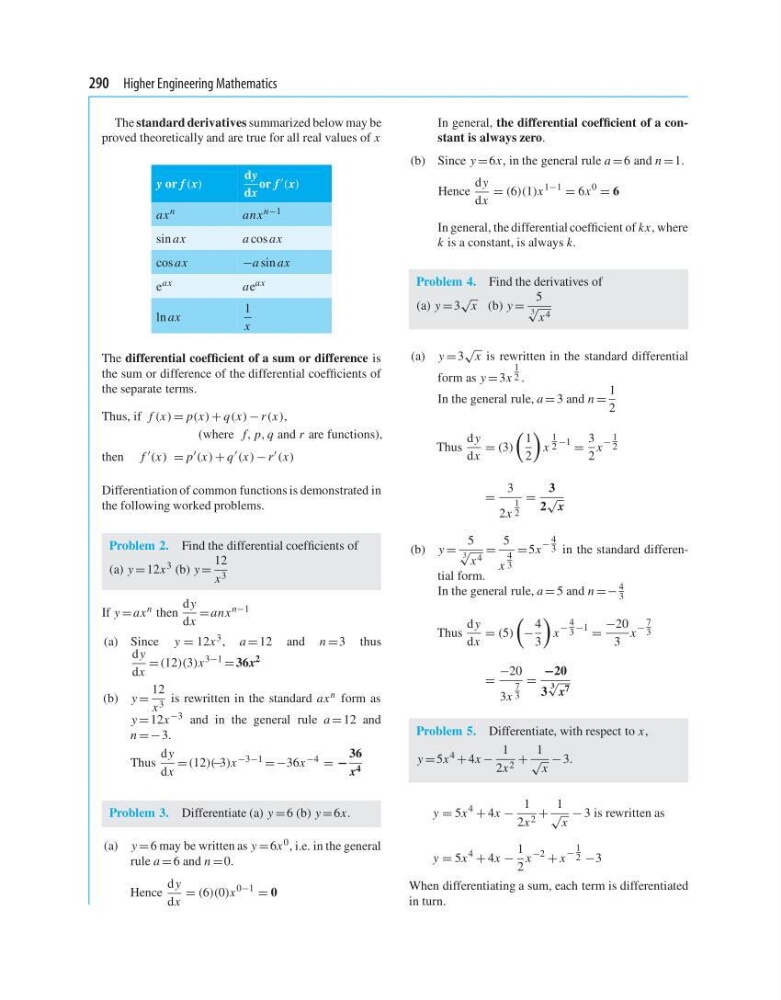
The standard derivatives summarized below may be
proved theoretically and are true for all real values of x
y or f (x)
dy
dx
or f (x)
ax n
anx n−1
sin ax
a cos ax
cos ax
−a sin ax
e ax
ae ax
ln ax
1
x
The differential coefficient of a sum or difference is
the sum or difference of the differential coefficients of
the separate terms.
Thus, if f (x) = p(x) + q(x) − r(x),
(where f, p, q and r are functions),
then f (x) = p (x) + q (x) − r (x)
Differentiation of common functions is demonstrated in
the following worked problems.
Problem 2. Find the differential coefficients of
(a) y = 12x 3 (b) y =
12
x 3
If y = ax n then
d y
dx
= anx n−1
(a) Since y = 12x 3 , a = 12 and n =3 thus
d y
dx
= (12)(3)x 3−1 = 36x 2
(b) y =
12
x 3 is rewritten in the standard ax n form as
y = 12x −3 and in the general rule a = 12 and
n =−3.
Thus
d y
dx
= (12)(−3)x −3−1 =−36x −4 = −
36
x 4
Problem 3. Differentiate (a) y = 6 (b) y = 6x.
(a) y = 6 may be written as y = 6x 0 , i.e. in the general
rule a = 6 and n =0.
Hence
d y
dx
= (6)(0)x
0−1
= 0
In general, the differential coefficient of a constant is always zero.
(b) Since y = 6x, in the general rule a = 6 and n =1.
Hence
d y
dx
= (6)(1)x
1−1
= 6x
0
= 6
In general, the differential coefficient of kx, where
k is a constant, is always k.
Problem 4. Find the derivatives of
(a) y = 3
√
x (b) y =
5
3
√
x 4
(a) y = 3
√
x is rewritten in the standard differential
form as y = 3x
1
2 .
In the general rule, a = 3 and n =
1
2
Thus
d y
dx
= (3)
1
2
x
1
2 −1 =
3
2
x
−
1
2
=
3
2x
1
2
=
3
2
√
x
(b) y =
5
3
√
x 4
=
5
x
4
3
= 5x
−
4
3 in the standard differential form.
In the general rule, a = 5 and n =−
4
3
Thus
d y
dx
= (5)
−
4
3
x
−
4
3 −1 =
−20
3
x
−
7
3
=
−20
3x
7
3
=
−20
3
3
√
x 7
Problem 5. Differentiate, with respect to x,
y = 5x 4 + 4x −
1
2x 2 +
1
√
x
− 3.
y = 5x
4
+ 4x −
1
2x 2 +
1
√
x
− 3 is rewritten as
y = 5x
4
+ 4x −
1
2
x
−2
+ x
−
1
2 −3
When differentiating a sum, each term is differentiated
in turn.
The standard derivatives summarized below may be
proved theoretically and are true for all real values of x
y or f (x)
dy
dx
or f (x)
ax n
anx n−1
sin ax
a cos ax
cos ax
−a sin ax
e ax
ae ax
ln ax
1
x
The differential coefficient of a sum or difference is
the sum or difference of the differential coefficients of
the separate terms.
Thus, if f (x) = p(x) + q(x) − r(x),
(where f, p, q and r are functions),
then f (x) = p (x) + q (x) − r (x)
Differentiation of common functions is demonstrated in
the following worked problems.
Problem 2. Find the differential coefficients of
(a) y = 12x 3 (b) y =
12
x 3
If y = ax n then
d y
dx
= anx n−1
(a) Since y = 12x 3 , a = 12 and n =3 thus
d y
dx
= (12)(3)x 3−1 = 36x 2
(b) y =
12
x 3 is rewritten in the standard ax n form as
y = 12x −3 and in the general rule a = 12 and
n =−3.
Thus
d y
dx
= (12)(−3)x −3−1 =−36x −4 = −
36
x 4
Problem 3. Differentiate (a) y = 6 (b) y = 6x.
(a) y = 6 may be written as y = 6x 0 , i.e. in the general
rule a = 6 and n =0.
Hence
d y
dx
= (6)(0)x
0−1
= 0
In general, the differential coefficient of a constant is always zero.
(b) Since y = 6x, in the general rule a = 6 and n =1.
Hence
d y
dx
= (6)(1)x
1−1
= 6x
0
= 6
In general, the differential coefficient of kx, where
k is a constant, is always k.
Problem 4. Find the derivatives of
(a) y = 3
√
x (b) y =
5
3
√
x 4
(a) y = 3
√
x is rewritten in the standard differential
form as y = 3x
1
2 .
In the general rule, a = 3 and n =
1
2
Thus
d y
dx
= (3)
1
2
x
1
2 −1 =
3
2
x
−
1
2
=
3
2x
1
2
=
3
2
√
x
(b) y =
5
3
√
x 4
=
5
x
4
3
= 5x
−
4
3 in the standard differential form.
In the general rule, a = 5 and n =−
4
3
Thus
d y
dx
= (5)
−
4
3
x
−
4
3 −1 =
−20
3
x
−
7
3
=
−20
3x
7
3
=
−20
3
3
√
x 7
Problem 5. Differentiate, with respect to x,
y = 5x 4 + 4x −
1
2x 2 +
1
√
x
− 3.
y = 5x
4
+ 4x −
1
2x 2 +
1
√
x
− 3 is rewritten as
y = 5x
4
+ 4x −
1
2
x
−2
+ x
−
1
2 −3
When differentiating a sum, each term is differentiated
in turn.