

Chapter 27
Methods of differentiation
27.1 Introduction to calculus
Calculus is a branch of mathematics involving or leading to calculations dealing with continuously varying
functions – such as velocity and acceleration, rates
of change and maximum and minimum values of
curves.
Calculus has widespread applications in science and
engineering and is used to solve complicated problems
for which algebra alone is insufficient.
Calculus is a subject that falls into two parts:
(i) differential calculus, or differentiation, which
is covered in Chapters 27 to 36, and
(ii) integral calculus, or integration, which is covered in Chapters 37 to 44.
27.2 The gradient of a curve
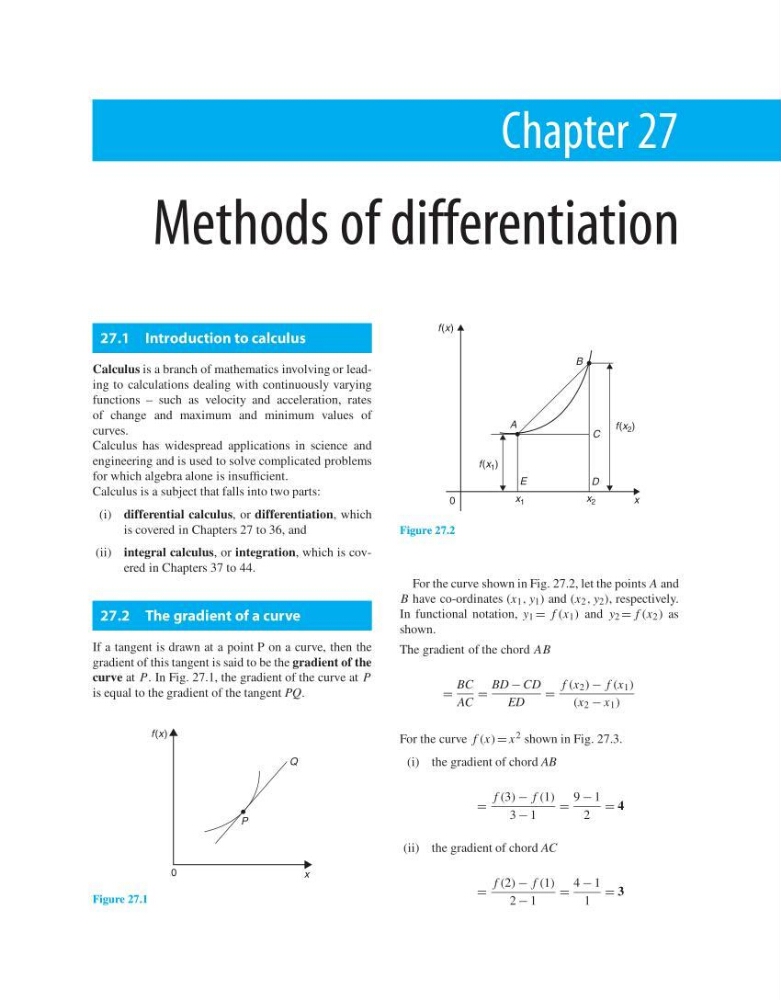
If a tangent is drawn at a point P on a curve, then the
gradient of this tangent is said to be the gradient of the
curve at P. In Fig. 27.1, the gradient of the curve at P
is equal to the gradient of the tangent PQ.
0
x
Q
P
f (x)
Figure 27.1
0
B
A
E
D
C
f(x 2 )
f(x 1 )
f(x)
x
x 1
x 2
Figure 27.2
For the curve shown in Fig. 27.2, let the points A and
B have co-ordinates (x 1 , y 1 ) and (x 2 , y 2 ), respectively.
In functional notation, y 1 = f (x 1 ) and y 2 = f (x 2 ) as
shown.
The gradient of the chord AB
=
BC
AC
=
BD − CD
ED
=
f (x 2 ) − f (x 1 )
(x 2 − x 1 )
For the curve f (x) = x 2 shown in Fig. 27.3.
(i) the gradient of chord AB
=
f (3) − f (1)
3 − 1
=
9 − 1
2
= 4
(ii) the gradient of chord AC
=
f (2) − f (1)
2 − 1
=
4 − 1
1
= 3
Methods of differentiation
27.1 Introduction to calculus
Calculus is a branch of mathematics involving or leading to calculations dealing with continuously varying
functions – such as velocity and acceleration, rates
of change and maximum and minimum values of
curves.
Calculus has widespread applications in science and
engineering and is used to solve complicated problems
for which algebra alone is insufficient.
Calculus is a subject that falls into two parts:
(i) differential calculus, or differentiation, which
is covered in Chapters 27 to 36, and
(ii) integral calculus, or integration, which is covered in Chapters 37 to 44.
27.2 The gradient of a curve
If a tangent is drawn at a point P on a curve, then the
gradient of this tangent is said to be the gradient of the
curve at P. In Fig. 27.1, the gradient of the curve at P
is equal to the gradient of the tangent PQ.
0
x
Q
P
f (x)
Figure 27.1
0
B
A
E
D
C
f(x 2 )
f(x 1 )
f(x)
x
x 1
x 2
Figure 27.2
For the curve shown in Fig. 27.2, let the points A and
B have co-ordinates (x 1 , y 1 ) and (x 2 , y 2 ), respectively.
In functional notation, y 1 = f (x 1 ) and y 2 = f (x 2 ) as
shown.
The gradient of the chord AB
=
BC
AC
=
BD − CD
ED
=
f (x 2 ) − f (x 1 )
(x 2 − x 1 )
For the curve f (x) = x 2 shown in Fig. 27.3.
(i) the gradient of chord AB
=
f (3) − f (1)
3 − 1
=
9 − 1
2
= 4
(ii) the gradient of chord AC
=
f (2) − f (1)
2 − 1
=
4 − 1
1
= 3