

280 Higher Engineering Mathematics
10. Find the angle between the velocity vectors
υ 1 = 5i +2j + 7k and υ 2 = 4i +j − k.
[66.40 ◦ ]
11. Calculate the work done by a force
F =(−5i + j +7k) N when its point of application moves from point (−2i − 6j +k) m to
the point (i − j + 10k) m.
[53 Nm]
26.3 Vector products
A second product of two vectors is called the vector or
cross product and is defined in terms of its modulus
and the magnitudes of the two vectors and the sine of
the angle between them. The vector product of vectors
oa and ob is written as oa ×ob and is defined by:
|oa × ob| =oa obsinθ
where θ is the angle between the two vectors.
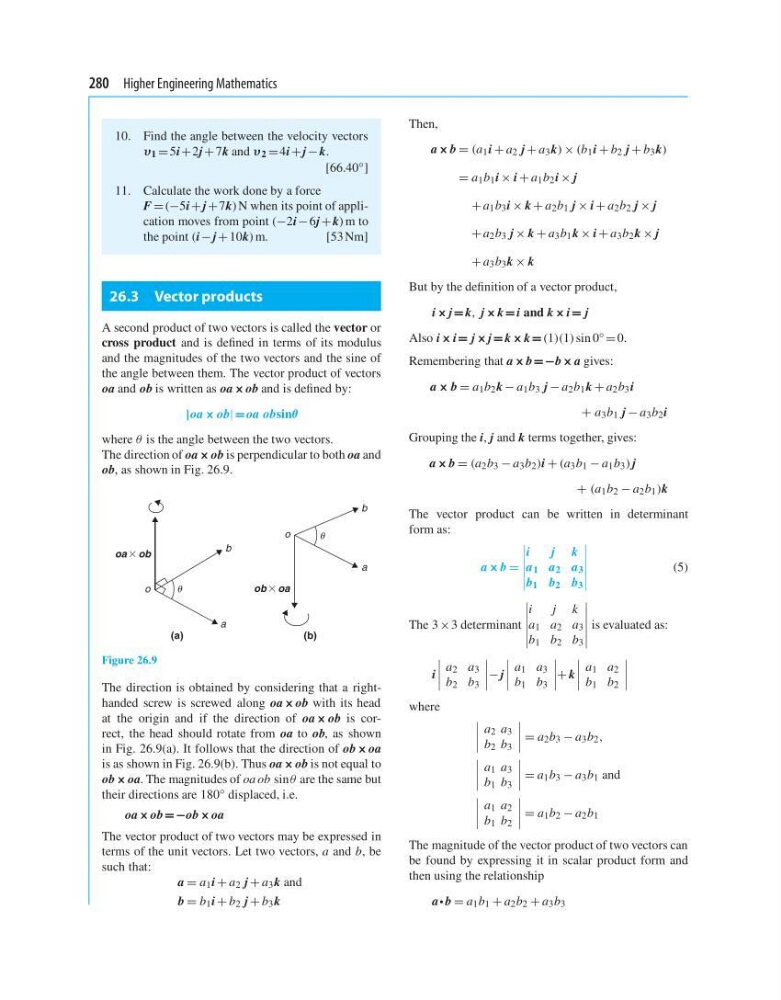
The direction of oa × ob is perpendicular to both oa and
ob, as shown in Fig. 26.9.
(a)
(b)
o
b
a
oa ϫ ob
b
a
ob ϫ oa
o
Figure 26.9
The direction is obtained by considering that a righthanded screw is screwed along oa ×ob with its head
at the origin and if the direction of oa × ob is correct, the head should rotate from oa to ob, as shown
in Fig. 26.9(a). It follows that the direction of ob ×oa
is as shown in Fig. 26.9(b). Thus oa × ob is not equal to
ob × oa. The magnitudes of oa ob sin θ are the same but
their directions are 180 ◦ displaced, i.e.
oa ×ob =−ob ×oa
The vector product of two vectors may be expressed in
terms of the unit vectors. Let two vectors, a and b, be
such that:
a = a 1 i + a 2 j + a 3 k and
b = b 1 i + b 2 j + b 3 k
Then,
a ×b = (a 1 i + a 2 j + a 3 k) × (b 1 i + b 2 j + b 3 k)
= a 1 b 1 i × i + a 1 b 2 i × j
+ a 1 b 3 i × k + a 2 b 1 j × i + a 2 b 2 j × j
+ a 2 b 3 j × k + a 3 b 1 k × i + a 3 b 2 k × j
+ a 3 b 3 k × k
But by the definition of a vector product,
i × j = k, j ×k = i and k × i = j
Also i × i = j ×j = k × k = (1)(1) sin 0 ◦ = 0.
Remembering that a ×b =−b × a gives:
a × b = a 1 b 2 k − a 1 b 3 j − a 2 b 1 k + a 2 b 3 i
+ a 3 b 1 j − a 3 b 2 i
Grouping the i, j and k terms together, gives:
a ×b = (a 2 b 3 − a 3 b 2 )i + (a 3 b 1 − a 1 b 3 ) j
+ (a 1 b 2 − a 2 b 1 )k
The vector product can be written in determinant
form as:
a ×b =
i j k
a 1 a 2 a 3
b 1 b 2 b 3
(5)
The 3 × 3 determinant
i
j k
a 1 a 2 a 3
b 1 b 2 b 3
is evaluated as:
i
a 2 a 3
b 2 b 3
− j
a 1 a 3
b 1 b 3
+ k
a 1 a 2
b 1 b 2
where
a 2 a 3
b 2 b 3
= a 2 b 3 − a 3 b 2 ,
a 1 a 3
b 1 b 3
= a 1 b 3 − a 3 b 1 and
a 1 a 2
b 1 b 2
= a 1 b 2 − a 2 b 1
The magnitude of the vector product of two vectors can
be found by expressing it in scalar product form and
then using the relationship
a • b = a 1 b 1 + a 2 b 2 + a 3 b 3
10. Find the angle between the velocity vectors
υ 1 = 5i +2j + 7k and υ 2 = 4i +j − k.
[66.40 ◦ ]
11. Calculate the work done by a force
F =(−5i + j +7k) N when its point of application moves from point (−2i − 6j +k) m to
the point (i − j + 10k) m.
[53 Nm]
26.3 Vector products
A second product of two vectors is called the vector or
cross product and is defined in terms of its modulus
and the magnitudes of the two vectors and the sine of
the angle between them. The vector product of vectors
oa and ob is written as oa ×ob and is defined by:
|oa × ob| =oa obsinθ
where θ is the angle between the two vectors.
The direction of oa × ob is perpendicular to both oa and
ob, as shown in Fig. 26.9.
(a)
(b)
o
b
a
oa ϫ ob
b
a
ob ϫ oa
o
Figure 26.9
The direction is obtained by considering that a righthanded screw is screwed along oa ×ob with its head
at the origin and if the direction of oa × ob is correct, the head should rotate from oa to ob, as shown
in Fig. 26.9(a). It follows that the direction of ob ×oa
is as shown in Fig. 26.9(b). Thus oa × ob is not equal to
ob × oa. The magnitudes of oa ob sin θ are the same but
their directions are 180 ◦ displaced, i.e.
oa ×ob =−ob ×oa
The vector product of two vectors may be expressed in
terms of the unit vectors. Let two vectors, a and b, be
such that:
a = a 1 i + a 2 j + a 3 k and
b = b 1 i + b 2 j + b 3 k
Then,
a ×b = (a 1 i + a 2 j + a 3 k) × (b 1 i + b 2 j + b 3 k)
= a 1 b 1 i × i + a 1 b 2 i × j
+ a 1 b 3 i × k + a 2 b 1 j × i + a 2 b 2 j × j
+ a 2 b 3 j × k + a 3 b 1 k × i + a 3 b 2 k × j
+ a 3 b 3 k × k
But by the definition of a vector product,
i × j = k, j ×k = i and k × i = j
Also i × i = j ×j = k × k = (1)(1) sin 0 ◦ = 0.
Remembering that a ×b =−b × a gives:
a × b = a 1 b 2 k − a 1 b 3 j − a 2 b 1 k + a 2 b 3 i
+ a 3 b 1 j − a 3 b 2 i
Grouping the i, j and k terms together, gives:
a ×b = (a 2 b 3 − a 3 b 2 )i + (a 3 b 1 − a 1 b 3 ) j
+ (a 1 b 2 − a 2 b 1 )k
The vector product can be written in determinant
form as:
a ×b =
i j k
a 1 a 2 a 3
b 1 b 2 b 3
(5)
The 3 × 3 determinant
i
j k
a 1 a 2 a 3
b 1 b 2 b 3
is evaluated as:
i
a 2 a 3
b 2 b 3
− j
a 1 a 3
b 1 b 3
+ k
a 1 a 2
b 1 b 2
where
a 2 a 3
b 2 b 3
= a 2 b 3 − a 3 b 2 ,
a 1 a 3
b 1 b 3
= a 1 b 3 − a 3 b 1 and
a 1 a 2
b 1 b 2
= a 1 b 2 − a 2 b 1
The magnitude of the vector product of two vectors can
be found by expressing it in scalar product form and
then using the relationship
a • b = a 1 b 1 + a 2 b 2 + a 3 b 3