

Scalar and vector products 279
The direction cosines are:
cos α =
x
x 2 + y 2 + z 2
=
3
√
14
= 0.802
cos β =
y
x 2 + y 2 + z 2
=
2
√
14
= 0.535
and cos γ =
y
x 2 + y 2 + z 2
=
1
√
14
= 0.267
(and hence α = cos −1 0.802 = 36.7 ◦ , β = cos −1 0.535 =
57.7 ◦ and γ = cos −1 0.267 =74.5 ◦ ).
Note that cos 2 α + cos 2 β + cos 2 γ = 0.802 2 + 0.535 2 +
0.267 2 = 1.
Practical application of scalar product
Problem 6. A constant force of
F =10i + 2j −k newtons displaces an object from
A =i + j +k to B =2i − j +3k (in metres). Find the
work done in newton metres.
One of the applications of scalar products is to the work
done by a constant force when moving a body. The work
done is the product of the applied force and the distance
moved in the direction of the force.
i.e. work done = F • d
The principles developed in Problem 13, page 262,
apply equally to this problem when determining the
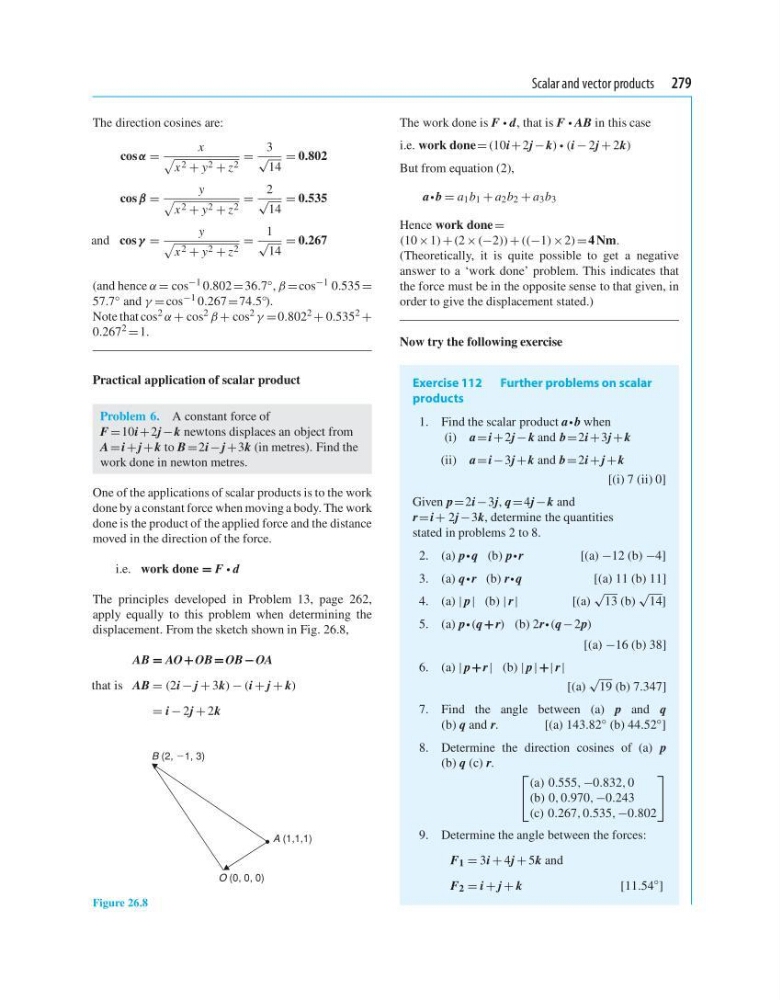
displacement. From the sketch shown in Fig. 26.8,
AB = AO + OB = OB − OA
that is AB = (2i − j + 3k) − (i + j + k)
= i − 2j + 2k
A (1,1,1)
B (2, 21, 3)
O (0, 0, 0)
Figure 26.8
The work done is F • d, that is F • AB in this case
i.e. work done = (10i + 2j − k) • (i − 2j + 2k)
But from equation (2),
a • b = a 1 b 1 + a 2 b 2 + a 3 b 3
Hence work done =
(10 × 1) + (2 × (−2)) + ((−1) × 2) = 4 Nm.
(Theoretically, it is quite possible to get a negative
answer to a ‘work done’ problem. This indicates that
the force must be in the opposite sense to that given, in
order to give the displacement stated.)
Now try the following exercise
Exercise 112 Further problems on scalar
products
1. Find the scalar product a • b when
(i) a =i + 2j − k and b =2i + 3j +k
(ii) a =i − 3j +k and b = 2i + j +k
[(i) 7 (ii) 0]
Given p =2i − 3j, q = 4j −k and
r =i + 2j −3k, determine the quantities
stated in problems 2 to 8.
2. (a) p • q (b) p • r
[(a) −12 (b) −4]
3. (a) q • r (b) r • q
[(a) 11 (b) 11]
4. (a) | p | (b) | r |
[(a)
√
13 (b)
√
14]
5. (a) p • (q + r) (b) 2r • (q − 2p)
[(a) −16 (b) 38]
6. (a) | p +r | (b) | p | +| r |
[(a)
√
19 (b) 7.347]
7. Find the angle between (a) p and q
(b) q and r.
[(a) 143.82 ◦ (b) 44.52 ◦ ]
8. Determine the direction cosines of (a) p
(b) q (c) r.
⎡
⎣
(a) 0.555, −0.832, 0
(b) 0, 0.970, −0.243
(c) 0.267, 0.535, −0.802
⎤
⎦
9. Determine the angle between the forces:
F 1 = 3i + 4j + 5k and
F 2 = i + j + k
[11.54
◦ ]
The direction cosines are:
cos α =
x
x 2 + y 2 + z 2
=
3
√
14
= 0.802
cos β =
y
x 2 + y 2 + z 2
=
2
√
14
= 0.535
and cos γ =
y
x 2 + y 2 + z 2
=
1
√
14
= 0.267
(and hence α = cos −1 0.802 = 36.7 ◦ , β = cos −1 0.535 =
57.7 ◦ and γ = cos −1 0.267 =74.5 ◦ ).
Note that cos 2 α + cos 2 β + cos 2 γ = 0.802 2 + 0.535 2 +
0.267 2 = 1.
Practical application of scalar product
Problem 6. A constant force of
F =10i + 2j −k newtons displaces an object from
A =i + j +k to B =2i − j +3k (in metres). Find the
work done in newton metres.
One of the applications of scalar products is to the work
done by a constant force when moving a body. The work
done is the product of the applied force and the distance
moved in the direction of the force.
i.e. work done = F • d
The principles developed in Problem 13, page 262,
apply equally to this problem when determining the
displacement. From the sketch shown in Fig. 26.8,
AB = AO + OB = OB − OA
that is AB = (2i − j + 3k) − (i + j + k)
= i − 2j + 2k
A (1,1,1)
B (2, 21, 3)
O (0, 0, 0)
Figure 26.8
The work done is F • d, that is F • AB in this case
i.e. work done = (10i + 2j − k) • (i − 2j + 2k)
But from equation (2),
a • b = a 1 b 1 + a 2 b 2 + a 3 b 3
Hence work done =
(10 × 1) + (2 × (−2)) + ((−1) × 2) = 4 Nm.
(Theoretically, it is quite possible to get a negative
answer to a ‘work done’ problem. This indicates that
the force must be in the opposite sense to that given, in
order to give the displacement stated.)
Now try the following exercise
Exercise 112 Further problems on scalar
products
1. Find the scalar product a • b when
(i) a =i + 2j − k and b =2i + 3j +k
(ii) a =i − 3j +k and b = 2i + j +k
[(i) 7 (ii) 0]
Given p =2i − 3j, q = 4j −k and
r =i + 2j −3k, determine the quantities
stated in problems 2 to 8.
2. (a) p • q (b) p • r
[(a) −12 (b) −4]
3. (a) q • r (b) r • q
[(a) 11 (b) 11]
4. (a) | p | (b) | r |
[(a)
√
13 (b)
√
14]
5. (a) p • (q + r) (b) 2r • (q − 2p)
[(a) −16 (b) 38]
6. (a) | p +r | (b) | p | +| r |
[(a)
√
19 (b) 7.347]
7. Find the angle between (a) p and q
(b) q and r.
[(a) 143.82 ◦ (b) 44.52 ◦ ]
8. Determine the direction cosines of (a) p
(b) q (c) r.
⎡
⎣
(a) 0.555, −0.832, 0
(b) 0, 0.970, −0.243
(c) 0.267, 0.535, −0.802
⎤
⎦
9. Determine the angle between the forces:
F 1 = 3i + 4j + 5k and
F 2 = i + j + k
[11.54
◦ ]