

276 Higher Engineering Mathematics
26.2 The scalar product of two
vectors
When vector oa is multiplied by a scalar quantity, say k,
the magnitude of the resultant vector will be k times the
magnitude of oa and its direction will remain the same.
Thus 2 ×(5 N at 20 ◦ ) results in a vector of magnitude
10 N at 20 ◦ .
One of the products of two vector quantities is called the
scalar or dot product of two vectors and is defined as
the product of their magnitudes multiplied by the cosine
of the angle between them. The scalar product of oa and
ob is shown as oa • ob. For vectors oa = oa at θ 1 , and
ob = ob at θ 2 where θ 2 >θ 1 , the scalar product is:
oa • ob = oa ob cos(θ 2 − θ 1 )
For vectors v 1 and v 2 shown in Fig. 26.4, the scalar
product is:
v 1 • v 2 = v 1 v 2 cos θ
v 2
v 1
Figure 26.4
The commutative law of algebra, a × b = b × a applies
to scalar products. This is demonstrated in Fig. 26.5. Let
oa represent vector v 1 and ob represent vector v 2 . Then:
oa • ob = v 1 v 2 cos θ (by definition of
a scalar product)
O
v 1
v 2
b
a
Figure 26.5
Similarly, ob • oa = v 2 v 1 cos θ = v 1 v 2 cos θ by the commutative law of algebra. Thus oa • ob = ob • oa.
(b)
(a)
a
c
b
O
v 2
v 2 cos
v 1
c o s
v 2
v 1
v 1
Figure 26.6
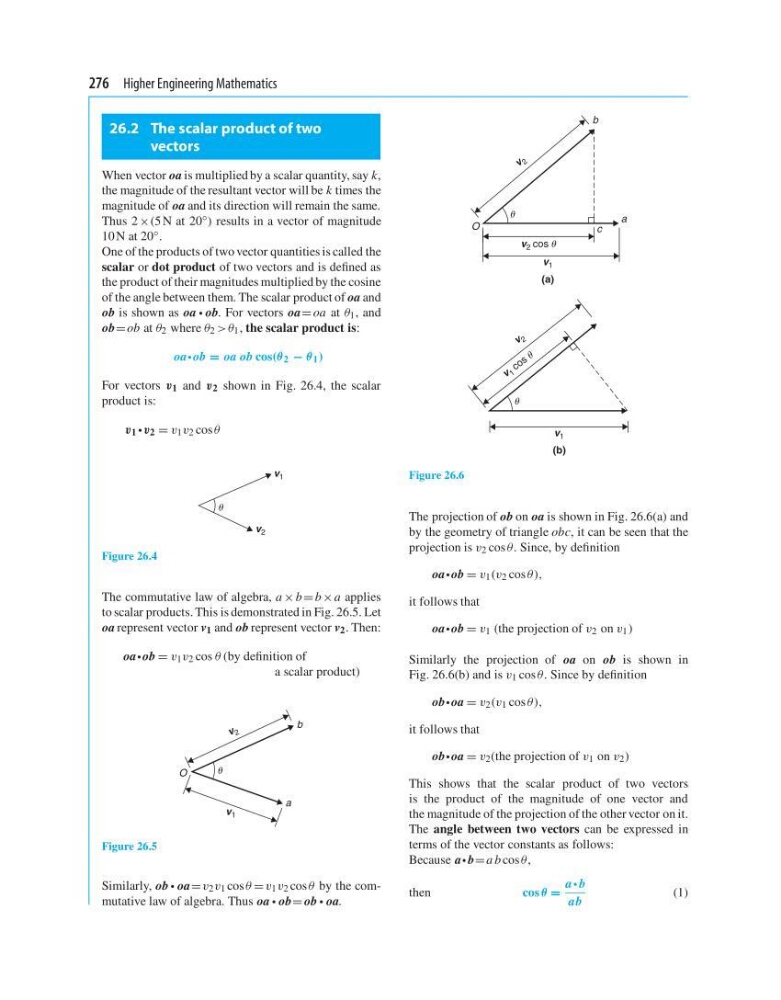
The projection of ob on oa is shown in Fig. 26.6(a) and
by the geometry of triangle obc, it can be seen that the
projection is v 2 cos θ. Since, by definition
oa • ob = v 1 (v 2 cos θ),
it follows that
oa • ob = v 1 (the projection of v 2 on v 1 )
Similarly the projection of oa on ob is shown in
Fig. 26.6(b) and is v 1 cos θ. Since by definition
ob • oa = v 2 (v 1 cos θ),
it follows that
ob • oa = v 2 (the projection of v 1 on v 2 )
This shows that the scalar product of two vectors
is the product of the magnitude of one vector and
the magnitude of the projection of the other vector on it.
The angle between two vectors can be expressed in
terms of the vector constants as follows:
Because a • b = a b cos θ,
then
cos θ =
a • b
ab
(1)
26.2 The scalar product of two
vectors
When vector oa is multiplied by a scalar quantity, say k,
the magnitude of the resultant vector will be k times the
magnitude of oa and its direction will remain the same.
Thus 2 ×(5 N at 20 ◦ ) results in a vector of magnitude
10 N at 20 ◦ .
One of the products of two vector quantities is called the
scalar or dot product of two vectors and is defined as
the product of their magnitudes multiplied by the cosine
of the angle between them. The scalar product of oa and
ob is shown as oa • ob. For vectors oa = oa at θ 1 , and
ob = ob at θ 2 where θ 2 >θ 1 , the scalar product is:
oa • ob = oa ob cos(θ 2 − θ 1 )
For vectors v 1 and v 2 shown in Fig. 26.4, the scalar
product is:
v 1 • v 2 = v 1 v 2 cos θ
v 2
v 1
Figure 26.4
The commutative law of algebra, a × b = b × a applies
to scalar products. This is demonstrated in Fig. 26.5. Let
oa represent vector v 1 and ob represent vector v 2 . Then:
oa • ob = v 1 v 2 cos θ (by definition of
a scalar product)
O
v 1
v 2
b
a
Figure 26.5
Similarly, ob • oa = v 2 v 1 cos θ = v 1 v 2 cos θ by the commutative law of algebra. Thus oa • ob = ob • oa.
(b)
(a)
a
c
b
O
v 2
v 2 cos
v 1
c o s
v 2
v 1
v 1
Figure 26.6
The projection of ob on oa is shown in Fig. 26.6(a) and
by the geometry of triangle obc, it can be seen that the
projection is v 2 cos θ. Since, by definition
oa • ob = v 1 (v 2 cos θ),
it follows that
oa • ob = v 1 (the projection of v 2 on v 1 )
Similarly the projection of oa on ob is shown in
Fig. 26.6(b) and is v 1 cos θ. Since by definition
ob • oa = v 2 (v 1 cos θ),
it follows that
ob • oa = v 2 (the projection of v 1 on v 2 )
This shows that the scalar product of two vectors
is the product of the magnitude of one vector and
the magnitude of the projection of the other vector on it.
The angle between two vectors can be expressed in
terms of the vector constants as follows:
Because a • b = a b cos θ,
then
cos θ =
a • b
ab
(1)