

Chapter 26
Scalar and vector products
26.1 The unit triad
When a vector x of magnitude x units and direction θ ◦
is divided by the magnitude of the vector, the result is a
vector of unit length at angle θ ◦ . The unit vector for a
velocity of 10 m/s at 50 ◦ is
10 m/s at 50 ◦
10 m/s
, i.e. 1 at 50 ◦ .
In general, the unit vector for oa is
oa
|oa|
, the oa being
a vector and having both magnitude and direction and
|oa| being the magnitude of the vector only.
One method of completely specifying the direction of
a vector in space relative to some reference point is to
use three unit vectors, mutually at right angles to each
other, as shown in Fig. 26.1. Such a system is called a
unit triad.
y
x
o
z
k
j
i
Figure 26.1
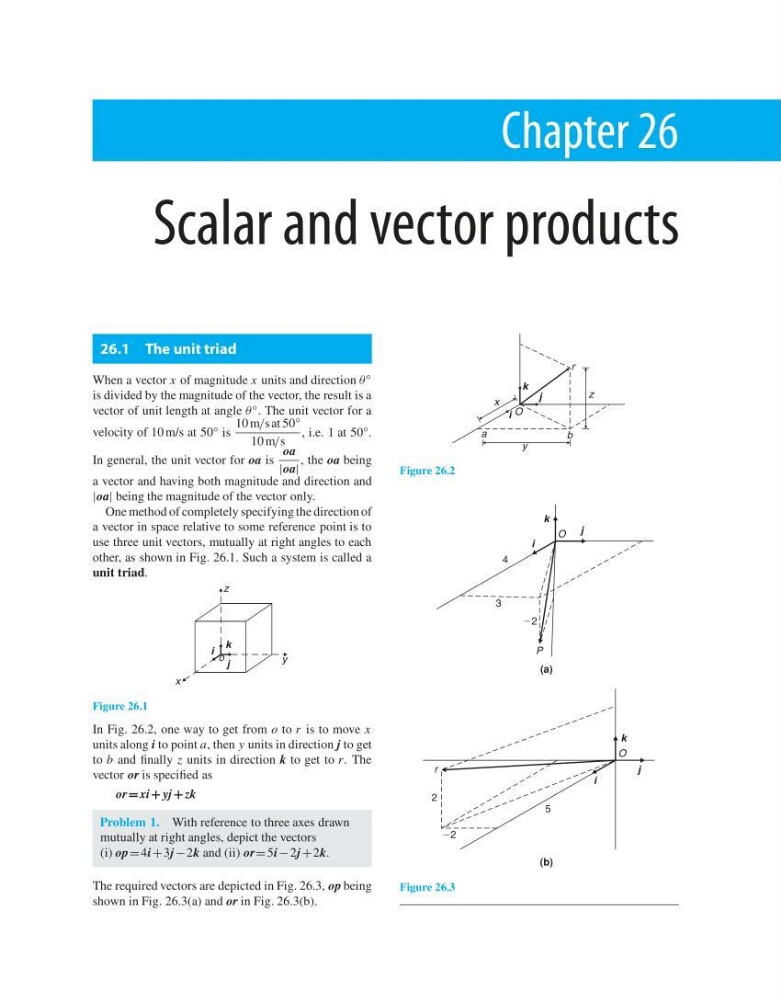
In Fig. 26.2, one way to get from o to r is to move x
units along i to point a, then y units in direction j to get
to b and finally z units in direction k to get to r. The
vector or is specified as
or =xi + yj + zk
Problem 1. With reference to three axes drawn
mutually at right angles, depict the vectors
(i) op = 4i +3j −2k and (ii) or= 5i − 2j +2k.
The required vectors are depicted in Fig. 26.3, op being
shown in Fig. 26.3(a) and or in Fig. 26.3(b).
y
x
z
k
j
b
a
r
i O
Figure 26.2
(a)
(b)
k
P
j
i
4
3
22
O
i
r
j
k
O
5
2
22
Figure 26.3
Scalar and vector products
26.1 The unit triad
When a vector x of magnitude x units and direction θ ◦
is divided by the magnitude of the vector, the result is a
vector of unit length at angle θ ◦ . The unit vector for a
velocity of 10 m/s at 50 ◦ is
10 m/s at 50 ◦
10 m/s
, i.e. 1 at 50 ◦ .
In general, the unit vector for oa is
oa
|oa|
, the oa being
a vector and having both magnitude and direction and
|oa| being the magnitude of the vector only.
One method of completely specifying the direction of
a vector in space relative to some reference point is to
use three unit vectors, mutually at right angles to each
other, as shown in Fig. 26.1. Such a system is called a
unit triad.
y
x
o
z
k
j
i
Figure 26.1
In Fig. 26.2, one way to get from o to r is to move x
units along i to point a, then y units in direction j to get
to b and finally z units in direction k to get to r. The
vector or is specified as
or =xi + yj + zk
Problem 1. With reference to three axes drawn
mutually at right angles, depict the vectors
(i) op = 4i +3j −2k and (ii) or= 5i − 2j +2k.
The required vectors are depicted in Fig. 26.3, op being
shown in Fig. 26.3(a) and or in Fig. 26.3(b).
y
x
z
k
j
b
a
r
i O
Figure 26.2
(a)
(b)
k
P
j
i
4
3
22
O
i
r
j
k
O
5
2
22
Figure 26.3