

246 Higher Engineering Mathematics
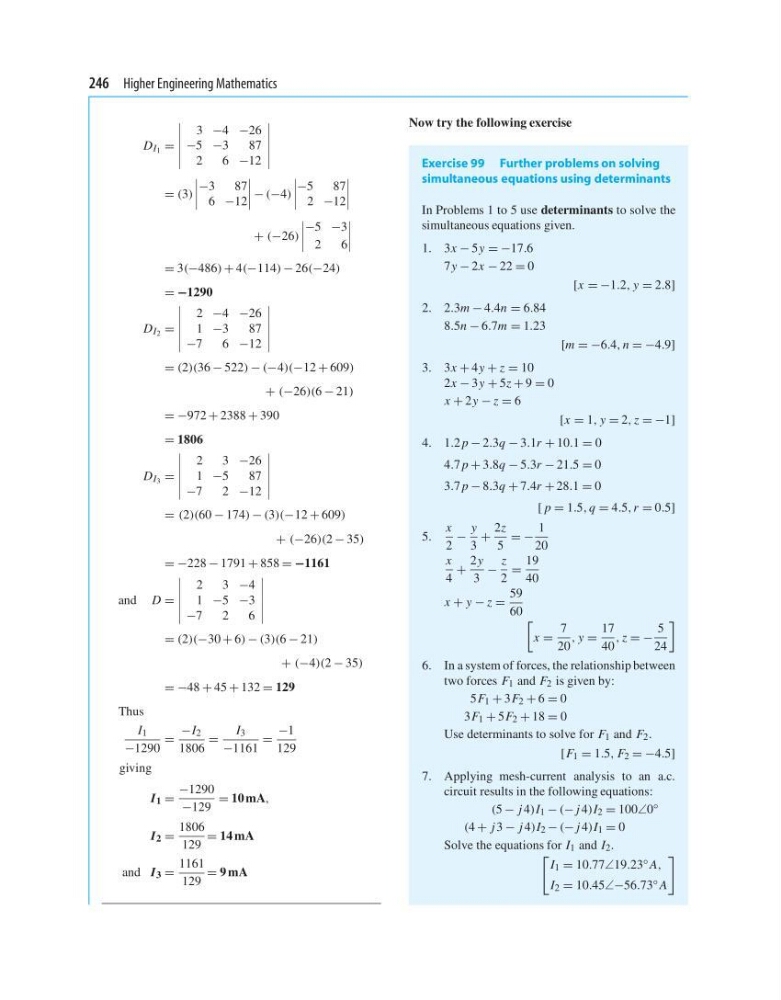
D I 1 =
3 −4 −26
−5 −3
87
2
6 −12
= (3)
−3
87
6 −12
− (−4)
−5
87
2 −12
+ (−26)
−5 −3
2
6
= 3(−486) + 4(−114) − 26(−24)
= −1290
D I 2 =
2 −4 −26
1 −3
87
−7
6 −12
= (2)(36 − 522) − (−4)(−12 + 609)
+ (−26)(6 − 21)
= −972 + 2388 + 390
= 1806
D I 3 =
2
3 −26
1 −5
87
−7
2 −12
= (2)(60 − 174) − (3)(−12 + 609)
+ (−26)(2 − 35)
= −228 − 1791 + 858 = −1161
and D =
2
3 −4
1 −5 −3
−7
2
6
= (2)(−30 + 6) − (3)(6 − 21)
+ (−4)(2 − 35)
= −48 + 45 + 132 = 129
Thus
I 1
−1290
=
−I 2
1806
=
I 3
−1161
=
−1
129
giving
I 1 =
−1290
−129
= 10 mA,
I 2 =
1806
129
= 14 mA
and I 3 =
1161
129
= 9 mA
Now try the following exercise
Exercise 99 Further problems on solving
simultaneous equations using determinants
In Problems 1 to 5 use determinants to solve the
simultaneous equations given.
1. 3x − 5y = −17.6
7y − 2x − 22 = 0
[x = −1.2, y = 2.8]
2. 2.3m − 4.4n = 6.84
8.5n − 6.7m = 1.23
[m = −6.4, n = −4.9]
3. 3x + 4y + z = 10
2x − 3y + 5z + 9 = 0
x + 2y − z = 6
[x = 1, y = 2, z = −1]
4. 1.2 p − 2.3q − 3.1r + 10.1 = 0
4.7 p + 3.8q − 5.3r − 21.5 = 0
3.7 p − 8.3q + 7.4r + 28.1 = 0
[ p = 1.5, q = 4.5, r = 0.5]
5.
x
2
−
y
3
+
2z
5
= −
1
20
x
4
+
2y
3
−
z
2
=
19
40
x + y − z =
59
60
x =
7
20
, y =
17
40
, z = −
5
24
6. In a system of forces, the relationship between
two forces F 1 and F 2 is given by:
5F 1 + 3F 2 + 6 = 0
3F 1 + 5F 2 + 18 = 0
Use determinants to solve for F 1 and F 2 .
[F 1 = 1.5, F 2 = −4.5]
7. Applying mesh-current analysis to an a.c.
circuit results in the following equations:
(5 − j 4)I 1 − (− j 4)I 2 = 100∠0 ◦
(4 + j 3 − j 4)I 2 − (− j 4)I 1 = 0
Solve the equations for I 1 and I 2 .
I 1 = 10.77∠19.23 ◦ A,
I 2 = 10.45∠−56.73 ◦ A
D I 1 =
3 −4 −26
−5 −3
87
2
6 −12
= (3)
−3
87
6 −12
− (−4)
−5
87
2 −12
+ (−26)
−5 −3
2
6
= 3(−486) + 4(−114) − 26(−24)
= −1290
D I 2 =
2 −4 −26
1 −3
87
−7
6 −12
= (2)(36 − 522) − (−4)(−12 + 609)
+ (−26)(6 − 21)
= −972 + 2388 + 390
= 1806
D I 3 =
2
3 −26
1 −5
87
−7
2 −12
= (2)(60 − 174) − (3)(−12 + 609)
+ (−26)(2 − 35)
= −228 − 1791 + 858 = −1161
and D =
2
3 −4
1 −5 −3
−7
2
6
= (2)(−30 + 6) − (3)(6 − 21)
+ (−4)(2 − 35)
= −48 + 45 + 132 = 129
Thus
I 1
−1290
=
−I 2
1806
=
I 3
−1161
=
−1
129
giving
I 1 =
−1290
−129
= 10 mA,
I 2 =
1806
129
= 14 mA
and I 3 =
1161
129
= 9 mA
Now try the following exercise
Exercise 99 Further problems on solving
simultaneous equations using determinants
In Problems 1 to 5 use determinants to solve the
simultaneous equations given.
1. 3x − 5y = −17.6
7y − 2x − 22 = 0
[x = −1.2, y = 2.8]
2. 2.3m − 4.4n = 6.84
8.5n − 6.7m = 1.23
[m = −6.4, n = −4.9]
3. 3x + 4y + z = 10
2x − 3y + 5z + 9 = 0
x + 2y − z = 6
[x = 1, y = 2, z = −1]
4. 1.2 p − 2.3q − 3.1r + 10.1 = 0
4.7 p + 3.8q − 5.3r − 21.5 = 0
3.7 p − 8.3q + 7.4r + 28.1 = 0
[ p = 1.5, q = 4.5, r = 0.5]
5.
x
2
−
y
3
+
2z
5
= −
1
20
x
4
+
2y
3
−
z
2
=
19
40
x + y − z =
59
60
x =
7
20
, y =
17
40
, z = −
5
24
6. In a system of forces, the relationship between
two forces F 1 and F 2 is given by:
5F 1 + 3F 2 + 6 = 0
3F 1 + 5F 2 + 18 = 0
Use determinants to solve for F 1 and F 2 .
[F 1 = 1.5, F 2 = −4.5]
7. Applying mesh-current analysis to an a.c.
circuit results in the following equations:
(5 − j 4)I 1 − (− j 4)I 2 = 100∠0 ◦
(4 + j 3 − j 4)I 2 − (− j 4)I 1 = 0
Solve the equations for I 1 and I 2 .
I 1 = 10.77∠19.23 ◦ A,
I 2 = 10.45∠−56.73 ◦ A