

The solution of simultaneous equations by matrices and determinants 245
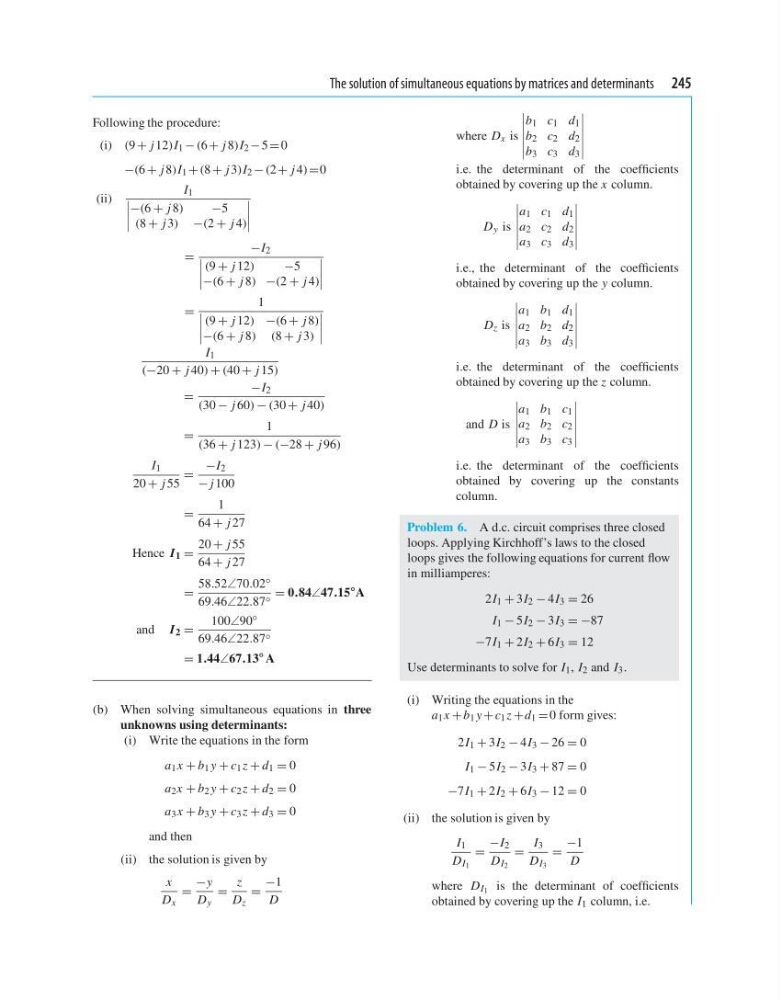
Following the procedure:
(i) (9 + j 12)I 1 − (6 + j 8)I 2 − 5 = 0
−(6 + j 8)I 1 + (8 + j 3)I 2 − (2 + j 4) =0
(ii)
I 1
−(6 + j 8)
−5
(8 + j 3) −(2 + j 4)
=
−I 2
(9 + j 12)
−5
−(6 + j 8) −(2 + j 4)
=
1
(9 + j 12) −(6 + j 8)
−(6 + j 8) (8 + j 3)
I 1
(−20 + j 40) + (40 + j 15)
=
−I 2
(30 − j 60) − (30 + j 40)
=
1
(36 + j 123) − (−28 + j 96)
I 1
20 + j 55
=
−I 2
− j 100
=
1
64 + j 27
Hence I 1 =
20 + j 55
64 + j 27
=
58.52∠70.02 ◦
69.46∠22.87 ◦ = 0.84∠47.15
◦ A
and I 2 =
100∠90 ◦
69.46∠22.87 ◦
= 1.44∠67.13
◦ A
(b) When solving simultaneous equations in three
unknowns using determinants:
(i) Write the equations in the form
a 1 x + b 1 y + c 1 z + d 1 = 0
a 2 x + b 2 y + c 2 z + d 2 = 0
a 3 x + b 3 y + c 3 z + d 3 = 0
and then
(ii) the solution is given by
x
D x
=
−y
D y
=
z
D z
=
−1
D
where D x is
b 1 c 1 d 1
b 2 c 2 d 2
b 3 c 3 d 3
i.e. the determinant of the coefficients
obtained by covering up the x column.
D y is
a 1 c 1 d 1
a 2 c 2 d 2
a 3 c 3 d 3
i.e., the determinant of the coefficients
obtained by covering up the y column.
D z is
a 1 b 1 d 1
a 2 b 2 d 2
a 3 b 3 d 3
i.e. the determinant of the coefficients
obtained by covering up the z column.
and D is
a 1 b 1 c 1
a 2 b 2 c 2
a 3 b 3 c 3
i.e. the determinant of the coefficients
obtained by covering up the constants
column.
Problem 6. A d.c. circuit comprises three closed
loops. Applying Kirchhoff’s laws to the closed
loops gives the following equations for current flow
in milliamperes:
2I 1 + 3I 2 − 4I 3 = 26
I 1 − 5I 2 − 3I 3 = −87
−7I 1 + 2I 2 + 6I 3 = 12
Use determinants to solve for I 1 , I 2 and I 3 .
(i) Writing the equations in the
a 1 x + b 1 y + c 1 z +d 1 = 0 form gives:
2I 1 + 3I 2 − 4I 3 − 26 = 0
I 1 − 5I 2 − 3I 3 + 87 = 0
−7I 1 + 2I 2 + 6I 3 − 12 = 0
(ii) the solution is given by
I 1
D I 1
=
−I 2
D I 2
=
I 3
D I 3
=
−1
D
where D I 1 is the determinant of coefficients
obtained by covering up the I 1 column, i.e.
Following the procedure:
(i) (9 + j 12)I 1 − (6 + j 8)I 2 − 5 = 0
−(6 + j 8)I 1 + (8 + j 3)I 2 − (2 + j 4) =0
(ii)
I 1
−(6 + j 8)
−5
(8 + j 3) −(2 + j 4)
=
−I 2
(9 + j 12)
−5
−(6 + j 8) −(2 + j 4)
=
1
(9 + j 12) −(6 + j 8)
−(6 + j 8) (8 + j 3)
I 1
(−20 + j 40) + (40 + j 15)
=
−I 2
(30 − j 60) − (30 + j 40)
=
1
(36 + j 123) − (−28 + j 96)
I 1
20 + j 55
=
−I 2
− j 100
=
1
64 + j 27
Hence I 1 =
20 + j 55
64 + j 27
=
58.52∠70.02 ◦
69.46∠22.87 ◦ = 0.84∠47.15
◦ A
and I 2 =
100∠90 ◦
69.46∠22.87 ◦
= 1.44∠67.13
◦ A
(b) When solving simultaneous equations in three
unknowns using determinants:
(i) Write the equations in the form
a 1 x + b 1 y + c 1 z + d 1 = 0
a 2 x + b 2 y + c 2 z + d 2 = 0
a 3 x + b 3 y + c 3 z + d 3 = 0
and then
(ii) the solution is given by
x
D x
=
−y
D y
=
z
D z
=
−1
D
where D x is
b 1 c 1 d 1
b 2 c 2 d 2
b 3 c 3 d 3
i.e. the determinant of the coefficients
obtained by covering up the x column.
D y is
a 1 c 1 d 1
a 2 c 2 d 2
a 3 c 3 d 3
i.e., the determinant of the coefficients
obtained by covering up the y column.
D z is
a 1 b 1 d 1
a 2 b 2 d 2
a 3 b 3 d 3
i.e. the determinant of the coefficients
obtained by covering up the z column.
and D is
a 1 b 1 c 1
a 2 b 2 c 2
a 3 b 3 c 3
i.e. the determinant of the coefficients
obtained by covering up the constants
column.
Problem 6. A d.c. circuit comprises three closed
loops. Applying Kirchhoff’s laws to the closed
loops gives the following equations for current flow
in milliamperes:
2I 1 + 3I 2 − 4I 3 = 26
I 1 − 5I 2 − 3I 3 = −87
−7I 1 + 2I 2 + 6I 3 = 12
Use determinants to solve for I 1 , I 2 and I 3 .
(i) Writing the equations in the
a 1 x + b 1 y + c 1 z +d 1 = 0 form gives:
2I 1 + 3I 2 − 4I 3 − 26 = 0
I 1 − 5I 2 − 3I 3 + 87 = 0
−7I 1 + 2I 2 + 6I 3 − 12 = 0
(ii) the solution is given by
I 1
D I 1
=
−I 2
D I 2
=
I 3
D I 3
=
−1
D
where D I 1 is the determinant of coefficients
obtained by covering up the I 1 column, i.e.