

The solution of simultaneous equations by matrices and determinants 243
⎛
⎝
1 0 0
0 1 0
0 0 1
⎞
⎠ ×
⎛
⎝
x
y
z
⎞
⎠ =
1
35
×
⎛
⎝
(14 × 4) + (0 × 33) + (7 × 2)
(16 × 4) + ((−5) × 33) + ((−2) × 2)
(5 × 4) + (5 × 33) + ((−5) × 2)
⎞
⎠
⎛
⎝
x
y
z
⎞
⎠ =
1
35
⎛
⎝
(14 × 4) + (0 × 33) + (7 × 2)
(16 × 4) + ((−5) × 33) + ((−2) × 2)
(5 × 4) + (5 × 33) + ((−5) × 2)
⎞
⎠
=
1
35
⎛
⎝
70
−105
175
⎞
⎠
=
⎛
⎝
2
−3
5
⎞
⎠
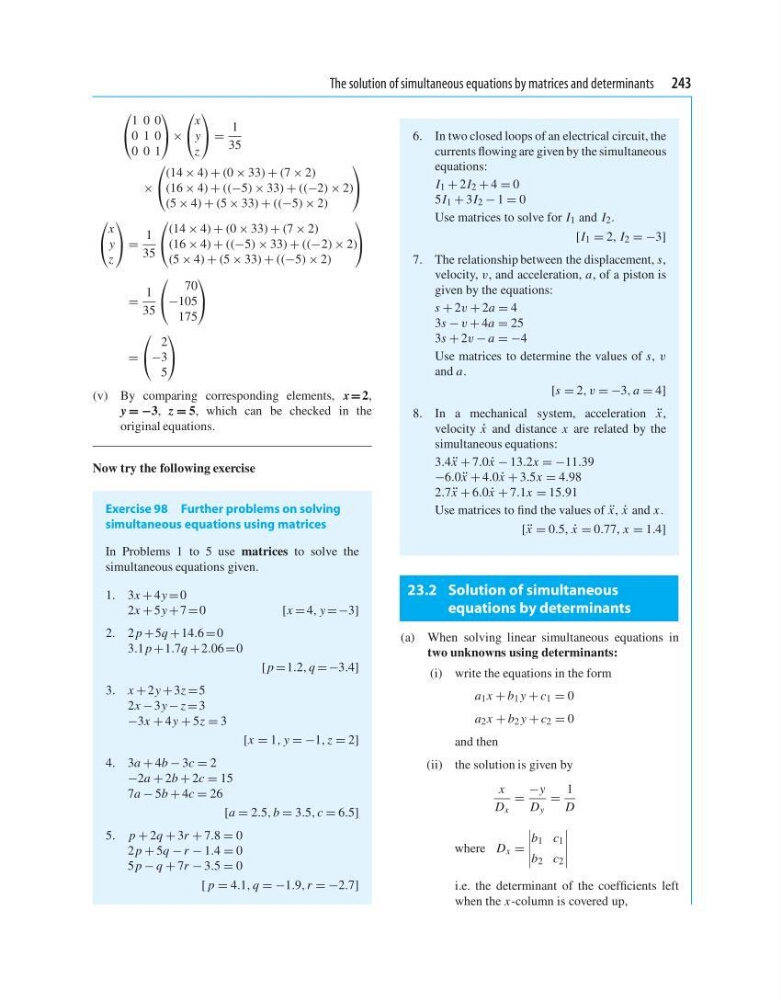
(v) By comparing corresponding elements, x = 2,
y = −3, z = 5, which can be checked in the
original equations.
Now try the following exercise
Exercise 98 Further problems on solving
simultaneous equations using matrices
In Problems 1 to 5 use matrices to solve the
simultaneous equations given.
1. 3x + 4y = 0
2x + 5y + 7 = 0
[ x = 4, y =−3]
2. 2 p +5q + 14.6 = 0
3.1 p +1.7q + 2.06 =0
[ p =1.2, q =−3.4]
3. x + 2y + 3z =5
2x − 3y − z = 3
−3x + 4y + 5z = 3
[x = 1, y = −1, z = 2]
4. 3a + 4b − 3c = 2
−2a + 2b + 2c = 15
7a − 5b + 4c = 26
[a = 2.5, b = 3.5, c = 6.5]
5. p + 2q + 3r + 7.8 = 0
2 p + 5q − r − 1.4 = 0
5 p − q + 7r − 3.5 = 0
[ p = 4.1, q = −1.9, r = −2.7]
6. In two closed loops of an electrical circuit, the
currents flowing are given by the simultaneous
equations:
I 1 + 2I 2 + 4 = 0
5I 1 + 3I 2 − 1 = 0
Use matrices to solve for I 1 and I 2 .
[I 1 = 2, I 2 = −3]
7. The relationship between the displacement, s,
velocity, v, and acceleration, a, of a piston is
given by the equations:
s + 2v + 2a = 4
3s − v + 4a = 25
3s + 2v − a = −4
Use matrices to determine the values of s, v
and a.
[s = 2, v = −3, a = 4]
8. In a mechanical system, acceleration ¨
x ,
velocity ˙
x and distance x are related by the
simultaneous equations:
3.4 ¨
x + 7.0 ˙
x − 13.2x = −11.39
−6.0 ¨
x + 4.0 ˙
x + 3.5x = 4.98
2.7 ¨
x + 6.0 ˙
x + 7.1x = 15.91
Use matrices to find the values of ¨
x, ˙
x and x.
[ ¨
x = 0.5, ˙
x = 0.77, x = 1.4]
23.2 Solution of simultaneous
equations by determinants
(a) When solving linear simultaneous equations in
two unknowns using determinants:
(i) write the equations in the form
a 1 x + b 1 y + c 1 = 0
a 2 x + b 2 y + c 2 = 0
and then
(ii) the solution is given by
x
D x
=
−y
D y
=
1
D
where D x =
b 1 c 1
b 2 c 2
i.e. the determinant of the coefficients left
when the x-column is covered up,
⎛
⎝
1 0 0
0 1 0
0 0 1
⎞
⎠ ×
⎛
⎝
x
y
z
⎞
⎠ =
1
35
×
⎛
⎝
(14 × 4) + (0 × 33) + (7 × 2)
(16 × 4) + ((−5) × 33) + ((−2) × 2)
(5 × 4) + (5 × 33) + ((−5) × 2)
⎞
⎠
⎛
⎝
x
y
z
⎞
⎠ =
1
35
⎛
⎝
(14 × 4) + (0 × 33) + (7 × 2)
(16 × 4) + ((−5) × 33) + ((−2) × 2)
(5 × 4) + (5 × 33) + ((−5) × 2)
⎞
⎠
=
1
35
⎛
⎝
70
−105
175
⎞
⎠
=
⎛
⎝
2
−3
5
⎞
⎠
(v) By comparing corresponding elements, x = 2,
y = −3, z = 5, which can be checked in the
original equations.
Now try the following exercise
Exercise 98 Further problems on solving
simultaneous equations using matrices
In Problems 1 to 5 use matrices to solve the
simultaneous equations given.
1. 3x + 4y = 0
2x + 5y + 7 = 0
[ x = 4, y =−3]
2. 2 p +5q + 14.6 = 0
3.1 p +1.7q + 2.06 =0
[ p =1.2, q =−3.4]
3. x + 2y + 3z =5
2x − 3y − z = 3
−3x + 4y + 5z = 3
[x = 1, y = −1, z = 2]
4. 3a + 4b − 3c = 2
−2a + 2b + 2c = 15
7a − 5b + 4c = 26
[a = 2.5, b = 3.5, c = 6.5]
5. p + 2q + 3r + 7.8 = 0
2 p + 5q − r − 1.4 = 0
5 p − q + 7r − 3.5 = 0
[ p = 4.1, q = −1.9, r = −2.7]
6. In two closed loops of an electrical circuit, the
currents flowing are given by the simultaneous
equations:
I 1 + 2I 2 + 4 = 0
5I 1 + 3I 2 − 1 = 0
Use matrices to solve for I 1 and I 2 .
[I 1 = 2, I 2 = −3]
7. The relationship between the displacement, s,
velocity, v, and acceleration, a, of a piston is
given by the equations:
s + 2v + 2a = 4
3s − v + 4a = 25
3s + 2v − a = −4
Use matrices to determine the values of s, v
and a.
[s = 2, v = −3, a = 4]
8. In a mechanical system, acceleration ¨
x ,
velocity ˙
x and distance x are related by the
simultaneous equations:
3.4 ¨
x + 7.0 ˙
x − 13.2x = −11.39
−6.0 ¨
x + 4.0 ˙
x + 3.5x = 4.98
2.7 ¨
x + 6.0 ˙
x + 7.1x = 15.91
Use matrices to find the values of ¨
x, ˙
x and x.
[ ¨
x = 0.5, ˙
x = 0.77, x = 1.4]
23.2 Solution of simultaneous
equations by determinants
(a) When solving linear simultaneous equations in
two unknowns using determinants:
(i) write the equations in the form
a 1 x + b 1 y + c 1 = 0
a 2 x + b 2 y + c 2 = 0
and then
(ii) the solution is given by
x
D x
=
−y
D y
=
1
D
where D x =
b 1 c 1
b 2 c 2
i.e. the determinant of the coefficients left
when the x-column is covered up,