

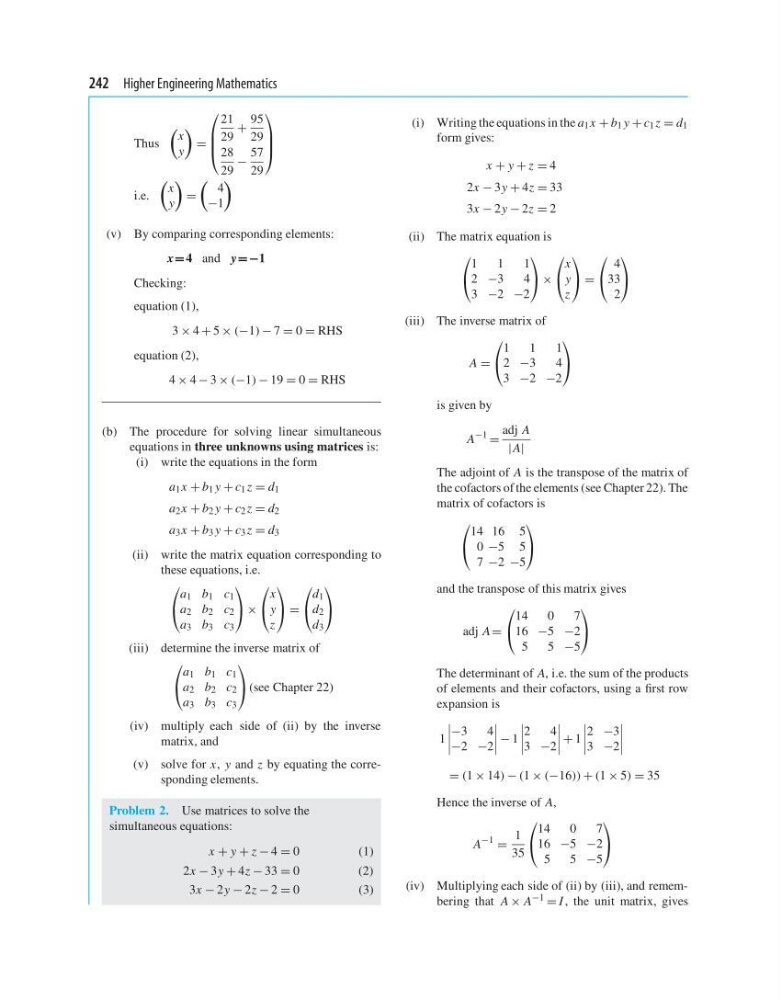
242 Higher Engineering Mathematics
Thus
x
y
=
⎛
⎜
⎜
⎝
21
29
+
95
29
28
29
−
57
29
⎞
⎟
⎟
⎠
i.e.
x
y
=
4
−1
(v) By comparing corresponding elements:
x = 4 and y =−1
Checking:
equation (1),
3 × 4 + 5 × (−1) − 7 = 0 = RHS
equation (2),
4 × 4 − 3 × (−1) − 19 = 0 = RHS
(b) The procedure for solving linear simultaneous
equations in three unknowns using matrices is:
(i) write the equations in the form
a 1 x + b 1 y + c 1 z = d 1
a 2 x + b 2 y + c 2 z = d 2
a 3 x + b 3 y + c 3 z = d 3
(ii) write the matrix equation corresponding to
these equations, i.e.
⎛
⎝
a 1 b 1 c 1
a 2 b 2 c 2
a 3 b 3 c 3
⎞
⎠ ×
⎛
⎝
x
y
z
⎞
⎠ =
⎛
⎝
d 1
d 2
d 3
⎞
⎠
(iii) determine the inverse matrix of
⎛
⎝
a 1 b 1 c 1
a 2 b 2 c 2
a 3 b 3 c 3
⎞
⎠ (see Chapter 22)
(iv) multiply each side of (ii) by the inverse
matrix, and
(v) solve for x, y and z by equating the corresponding elements.
Problem 2. Use matrices to solve the
simultaneous equations:
x + y + z − 4 = 0
( 1 )
2x − 3y + 4z − 33 = 0
( 2 )
3x − 2y − 2z − 2 = 0
( 3 )
(i) Writing the equations in the a 1 x + b 1 y + c 1 z = d 1
form gives:
x + y + z = 4
2x − 3y + 4z = 33
3x − 2y − 2z = 2
(ii) The matrix equation is
⎛
⎝
1
1
1
2 −3
4
3 −2 −2
⎞
⎠ ×
⎛
⎝
x
y
z
⎞
⎠ =
⎛
⎝
4
33
2
⎞
⎠
(iii) The inverse matrix of
A =
⎛
⎝
1
1
1
2 −3
4
3 −2 −2
⎞
⎠
is given by
A
−1
=
adj A
|A|
The adjoint of A is the transpose of the matrix of
the cofactors of the elements (see Chapter 22). The
matrix of cofactors is
⎛
⎝
14 16 5
0 −5 5
7 −2 −5
⎞
⎠
and the transpose of this matrix gives
adj A =
⎛
⎝
14
0
7
16 −5 −2
5
5 −5
⎞
⎠
The determinant of A, i.e. the sum of the products
of elements and their cofactors, using a first row
expansion is
1
−3
4
−2 −2
− 1
2
4
3 −2
+ 1
2 −3
3 −2
= (1 × 14) − (1 × (−16)) + (1 × 5) = 35
Hence the inverse of A,
A
−1
=
1
35
⎛
⎝
14
0
7
16 −5 −2
5
5 −5
⎞
⎠
(iv) Multiplying each side of (ii) by (iii), and remembering that A × A −1 = I , the unit matrix, gives
Thus
x
y
=
⎛
⎜
⎜
⎝
21
29
+
95
29
28
29
−
57
29
⎞
⎟
⎟
⎠
i.e.
x
y
=
4
−1
(v) By comparing corresponding elements:
x = 4 and y =−1
Checking:
equation (1),
3 × 4 + 5 × (−1) − 7 = 0 = RHS
equation (2),
4 × 4 − 3 × (−1) − 19 = 0 = RHS
(b) The procedure for solving linear simultaneous
equations in three unknowns using matrices is:
(i) write the equations in the form
a 1 x + b 1 y + c 1 z = d 1
a 2 x + b 2 y + c 2 z = d 2
a 3 x + b 3 y + c 3 z = d 3
(ii) write the matrix equation corresponding to
these equations, i.e.
⎛
⎝
a 1 b 1 c 1
a 2 b 2 c 2
a 3 b 3 c 3
⎞
⎠ ×
⎛
⎝
x
y
z
⎞
⎠ =
⎛
⎝
d 1
d 2
d 3
⎞
⎠
(iii) determine the inverse matrix of
⎛
⎝
a 1 b 1 c 1
a 2 b 2 c 2
a 3 b 3 c 3
⎞
⎠ (see Chapter 22)
(iv) multiply each side of (ii) by the inverse
matrix, and
(v) solve for x, y and z by equating the corresponding elements.
Problem 2. Use matrices to solve the
simultaneous equations:
x + y + z − 4 = 0
( 1 )
2x − 3y + 4z − 33 = 0
( 2 )
3x − 2y − 2z − 2 = 0
( 3 )
(i) Writing the equations in the a 1 x + b 1 y + c 1 z = d 1
form gives:
x + y + z = 4
2x − 3y + 4z = 33
3x − 2y − 2z = 2
(ii) The matrix equation is
⎛
⎝
1
1
1
2 −3
4
3 −2 −2
⎞
⎠ ×
⎛
⎝
x
y
z
⎞
⎠ =
⎛
⎝
4
33
2
⎞
⎠
(iii) The inverse matrix of
A =
⎛
⎝
1
1
1
2 −3
4
3 −2 −2
⎞
⎠
is given by
A
−1
=
adj A
|A|
The adjoint of A is the transpose of the matrix of
the cofactors of the elements (see Chapter 22). The
matrix of cofactors is
⎛
⎝
14 16 5
0 −5 5
7 −2 −5
⎞
⎠
and the transpose of this matrix gives
adj A =
⎛
⎝
14
0
7
16 −5 −2
5
5 −5
⎞
⎠
The determinant of A, i.e. the sum of the products
of elements and their cofactors, using a first row
expansion is
1
−3
4
−2 −2
− 1
2
4
3 −2
+ 1
2 −3
3 −2
= (1 × 14) − (1 × (−16)) + (1 × 5) = 35
Hence the inverse of A,
A
−1
=
1
35
⎛
⎝
14
0
7
16 −5 −2
5
5 −5
⎞
⎠
(iv) Multiplying each side of (ii) by (iii), and remembering that A × A −1 = I , the unit matrix, gives